
Pontiac Engineers Drilled Holes Through Their Own Frames—In The Name Of Speed
By the early 1960s, the arms race between factory-built drag racers had hit a fever pitch. Then in 1963, Pontiac engineers dialed it up to eleven, all in the name of speed. The pencil pushers stepped in to end the party early. Pontiac’s performance engineers pivoted their focus toward street cars. The rest is, as they say, history.
Detroit Put Its Factory Drag Racers On Ruthless Diets

Mopar muscle fans know the company was serious about factory drag racers. The 1963 Dodge 330 Max Wedge Lightweight was especially extreme. It featured a 426 cubic-inch “ Max Wedge” big-block V8 that claimed 425 horsepower, then backed it up with some drastic weight-saving measures. Dodge replaced the hood, front fenders, front bumper, and bumper supports with aluminum, moved the battery to the trunk, and deleted equipment such as the heater and radio. But its competitors went one step further.
For its 1963 Galaxie 500, Ford began with a lightweight six-cylinder-spec frame. Then it paired it with a 427 cubic-inch V8. This was obviously not a car engineered for longevity. It also wasn’t engineered for passing crash tests: Ford tossed the steel bumpers in favor of aluminum units. Its hood, front fenders, and even the trunk lid were cutting-edge fiberglass technology. By the time Ford had stripped out the interior, the factory drag racer weighed about 420 pounds less than a regular production Galaxie 500.

General Motors wasn’t about to sit by and let Ford and Dodge have all the fun. In 1963, Chevrolet built the Impala Z11. The full-size car got a 427 cubic-inch V8 rated at 430 horsepower, plus aluminum front-end and body components to strip weight from the big Chevy. It’s almost like Pontiac saw what its crosstown cousin was assembling and said, “Hold my slide rule and watch this.” Then its engineering team picked up the drills instead.

Pontiac Answered With A 405-HP “Super Duty”

Pontiac’s engineers decided to build 1963’s factory racer around the Catalina. Its 120-inch wheelbase was ideal for drag racing.
The team took production Catalinas and installed the Code 13B 421 Super Duty V8. It got dual Carter AFB four-barrel carburetors atop a special aluminum intake, plus lightweight cast-aluminum exhaust manifolds. The Super Duty was paired with a heavy-duty three-speed manual transmission. Pontiac conservatively rated the package at 405 horsepower.
Pontiac had already become a major contender in early-1960s drag racing, and the 1963 Catalina Super Duty was its attempt to stay on top. Pontiac Engineering selected serious drag teams to campaign the cars in NHRA, AHRA, and match racing, including names such as Jim Wangers and Arnie Beswick. But the 421’s factory rating was still just 405 horsepower. The uncompromising truth of power-to-weight ratio meant Pontiac had to get creative with the Catalina’s “diet.”
Then Pontiac Engineers Started Drilling Holes Through The Frame

Pontiac eliminated the Super Duty Catalina’s boxed frame rails and even tossed the front sway bar. But it needed an even lighter car. So the team drilled approximately 120 holes throughout the frame rails, literally slicing away chunks of metal to drop weight. The strategy earned the drag racer the nickname that stuck: the “Swiss Cheese” Catalina.
Pontiac also shed its steel hood, outer front fenders, inner front fenders, bumpers, bumper brackets, and even the radiator core support. It replaced everything with aluminum. When engineers found aluminum too soft for pieces such as the huge hood, they reinforced it with fiberglass. Pontiac even used aluminum for major mechanical components such as the rear-axle center section and transmission bellhousing. Sound-deadening material and seam sealer disappeared too.

So what was the result? The commonly cited finished weight for the Swiss Cheese Catalina is 3,308 pounds, an astonishing number for a 120-inch-wheelbase, full-size Pontiac. These weren’t civilized street cars with a clever option package. They were all-out race cars built around one job: getting down a quarter-mile faster than the other guy.
Pontiac Built Its Wildest Drag Racer Just Before GM Pulled The Plug

Pontiac’s racing program was in full swing, drilling holes in Catalina frames and assembling Super Duty drag racers, when it received a shocking proclamation from the company brass. GM leadership was getting out of factory racing. A January 24, 1963, Pontiac memo read, “Effective today January 24, 1963 389 and 421 Super Duty engines are cancelled and no further orders will be accepted.”
Historians haven’t unearthed a smoking-gun document explaining exactly why GM executives made the call. In 1957, the Automobile Manufacturers Association had adopted an anti-racing resolution. The agreement proved porous, and Ford formally withdrew in 1962, with Chrysler following. By January 1963, AMC president Roy Abernethy was publicly criticizing Detroit’s continued emphasis on racing and performance. Whether GM feared government scrutiny, bad optics, or some combination of the two, it chose to end its racing programs.

Arnie Beswick revealed what the shutdown felt like from the racer’s side. “GM made the announcement, ‘We are no longer in racing. We will not be supporting any race cars…with any parts or pieces.’” He remembered being one of the lucky racers who had gotten orders in early: “I did get a wagon, and I got a Catalina.” Beswick remembered GM’s announcement reaching him in March, while Pontiac’s internal Super Duty cancellation memo is dated January 24. He chose to remain loyal to Pontiac, fielding an independent team without factory backing.
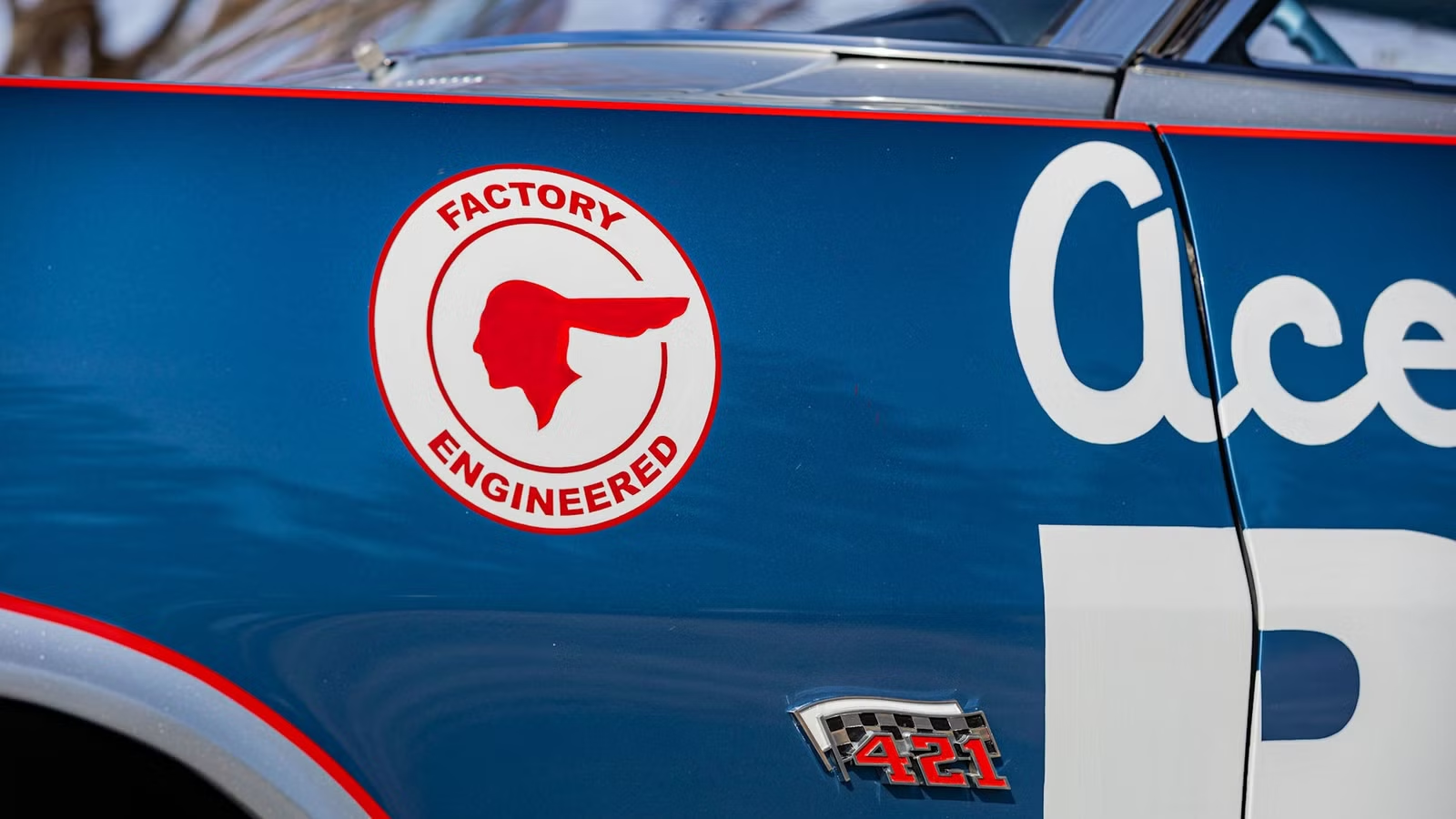
Mecum Auctions recently sold VIN 363P97384 (pictured) for $742,500. This Catalina 421 Super Duty—raced by Ace Wilson—is one of the 14 Swiss Cheese factory racers generally counted as completed before the January ban. Royal Pontiac later hotrodded its engine to 505 horsepower and swapped in a four-speed manual. Its race résumé was real too: the car won its class at the U.S. Nationals and finished runner-up against “Little Eliminator.”
One fascinating exception is VIN 363P165870. Barrett-Jackson says this Catalina was not one of those 14 factory racers, but was assembled on April 2 as a “Pontiac company car for engineering purposes.” It later wore Collingwood Motors racing livery, making it a fascinating post-ban coda to a program GM had supposedly just killed.
Pontiac’s Power-To-Weight Formula Changed Detroit Forever

The factory drag-racer wars raged on, even without General Motors. One of the most extreme next steps was Ford’s 1964 Thunderbolt. FoMoCo shoehorned a 427 V8 into the smaller Fairlane, reworked the front-end suspension points to make it fit, and stripped weight with fiberglass body panels until the car came in around 3,200 pounds.
Beswick remembered the Thunderbolts as ubiquitous and “just sick” when properly set up. At Daytona, he recalled, “I bet there were 50 Thunderbolts that showed up,” and said a properly sorted one was “badass.” It might have been enough to test his devotion to Pontiac. And the automaker couldn’t officially help him out. But Pontiac’s street-performance engineers had another kind of lightweight big-engine car waiting in the wings.
Pontiac fans know the early 1960s were a pivotal time for the company. After the racing ban, its performance focus increasingly shifted toward cars that ordinary customers could buy. For the 1964 model year, the LeMans-based GTO package arrived and would become the car most commonly credited with igniting the classic muscle-car era. It didn’t lift chassis or powertrain technology from the Swiss Cheese Catalina. But the idea of putting a big engine in the lightest useful package was already deeply familiar territory at Pontiac.
Beswick bought a brand-new 1964 GTO, then went to work supercharging the pioneering muscle car. The result was his infamous “Mystery Tornado” drag car. The 1963 Swiss Cheese Catalina proved Pontiac engineers would do almost anything in the name of speed. The GTO proved the same basic power-to-weight instinct could work without asking customers to live with a frame that looked like a colander. The GTO became the legend. But Pontiac had already built something rarer, wilder, and less remembered by most muscle car fans.
Sources: Mecum, Barrett-Jackson, Pontiac Preservation Society, Rocky Rotella’s Pontiac V8, Pontiac

Related posts




Latest Post


No Comments