
Oldsmobile 394 Rocket V8: 345 HP Before the 442
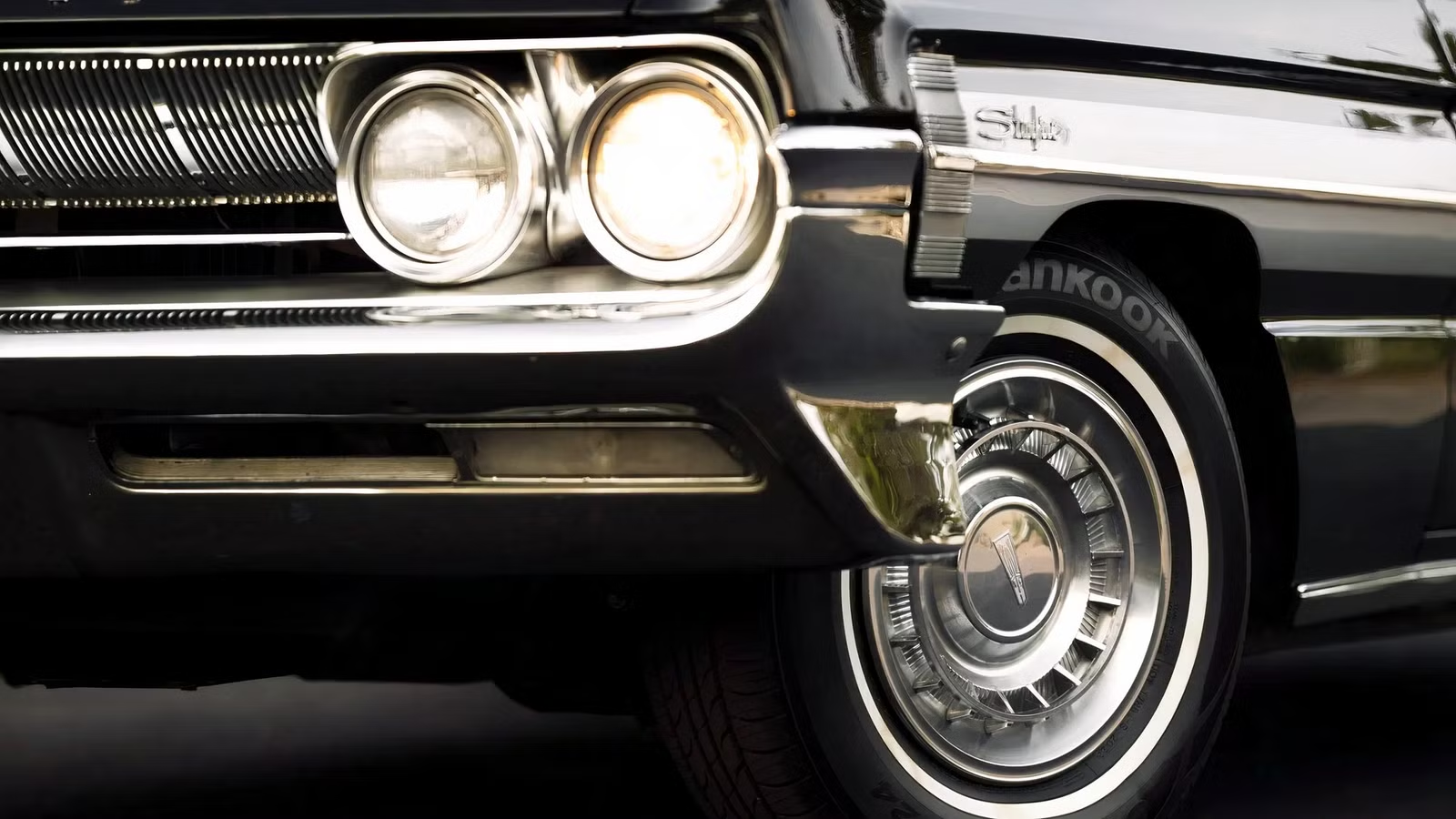
In the era of muscle car wars, big V8s, more horsepower, and quicker quarter miles were the formula everyone wanted to crack. The 1964 Pontiac GTO perfectly captured that mindset, and it not only became a hit, but also earned its reputation of being one of the earliest machines that helped define the muscle car era. But there was one brand that wanted to do things differently, and to hit the marks that a GTO couldn’t.

Oldsmobile answered with the 442. It is one of the more popular Oldsmobiles to employ a big V8 engine under the hood, churning out 310 hp in its launch year (1964). Just a year later, the 442 engine was up-tuned to produce 345 hp. But even before the 442 arrived, Oldsmobile had one offering that made 345 horses for less money, now gone and forgotten.
Oldsmobile Had A Performance Secret Years Before The 442
Muscle cars weren’t exactly a new concept in the early 1960s, as the category started evolving way before. During those years, nobody was losing sleep over soft seats, or cared whether the dashboard looked inviting. If your spine survived the drive, that was just part of the experience. The problem was that speed and luxury rarely came as a package deal. A fast car usually wasn’t refined, while a comfortable one wasn’t exactly exciting. However, buyers wanted both; a car that looked mean, launched hard, and still felt upscale inside. In short, a “performance-oriented luxury car” is what buyers were looking for.

This is where Oldsmobile did things differently. While most associated this GM subsidiary with a plush interior and effortless highway cruising, it quietly redefined what an American performance car could be. It wasn’t just chasing numbers, but trying to make its car feel balanced and rewarding to drive. Remember the Super 88? Its story began in 1949 with the introduction of the 88 lineup, which had a V8 engine under the hood. The Rocket engine marked its debut with the Olds 88.

In 1951, Oldsmobile introduced an upgraded version called the Super 88, with subtle styling updates, a more premium cabin, and a slightly longer wheelbase. Even so, the Super 88’s biggest talking point wasn’t its chrome trim or cushier seats. It was the engine hiding beneath the hood. Those updates hinted at something bigger. Oldsmobile was beginning to prove that a car didn’t have to sacrifice comfort to be genuinely exciting to drive. The market noticed. Oldsmobile’s “Make a Date With 88” campaign wasn’t just clever advertising; it captured the excitement surrounding the car. Buyers weren’t simply getting another full-size American sedan; they were getting one of the quickest cars money could buy. But what led Oldsmobile to develop the “Rocket V8”?
394 Rocket V8 Quietly Became Oldsmobile’s Most Powerful Early Engine

After World War II, the automotive industry around the globe underwent a rapid transition. European automakers were earning a reputation for sophisticated engineering and capable engines, forcing American automakers to rethink their traditional approach. Seeing the market shift, Oldsmobile embarked on a new V8 engine project led by Charles Kettering. His ideas and engineering expertise played a major role in shaping the powerplant. In fact, his contribution was so significant that the engine was originally expected to carry his name. Actually, it never did.
A name could make almost as much of an impression as the engine itself. Americans were fascinated by new technology, speed, and the promise of the future. Compared to something like “Kettering Power,” the word “Rocket” perfectly captured that optimism. The Rocket V8 made its debut in 1949 under the hood of the Oldsmobile 88. Displacing 303 cubic inches (just under 5.0 liters), it was among the first American production V8s to feature an overhead-valve configuration. The engine churned out 135 horsepower and 253 lb-ft of torque while running a 7.25:1 compression ratio.
The Journey Of Rocket V8
It had a long road ahead, as Oldsmobile employed its V8 engine across its range, including the flagship 98. The displacement was gradually increased over time to meet evolving requirements. The original engine had a two-barrel carburetor, but in 1952, Oldsmobile introduced a four-barrel version that boosted output to 160 horsepower. A year later, power climbed again to 165 horsepower with a higher 8.0:1 compression ratio. The engine didn’t stop evolving there. Its displacement grew from 303 cubic inches to 324 cubic inches for the 1954-1956 model years, before increasing again to 371 cubic inches in 1957.
394 Rocket V8 Started It All

However, the biggest leap came in 1959 with the arrival of the 394 Rocket V8. Often overshadowed by later muscle car icons, it was one of the most potent American engines of its era and also the largest V8 Oldsmobile ever put into production, featuring a 4.125-inch bore and a 3.6875-inch stroke. While the earlier versions in 1959 produced 315 hp, it was up-tuned to make 330 hp between 1961 and 1962. However, the peak performance was extracted from 1963 to 1964, when the 394 Rocket V8 produced a whopping 345 hp. Much of that gain came from raising the compression ratio to 10.5:1, earning the engine its “Ultra High Compression” designation.
The Rocket V8 powered several Oldsmobile models, but it arguably found its best match in the Starfire. Here, the 394 V8 was paired with Oldsmobile’s Roto Hydra-Matic, better known as the “Slim Jim,” a 3-speed automatic transmission that used a fluid coupling stator called Accel-A-Rotor.
The Starfire Proved Luxury And Muscle Could Coexist

Although the Starfire became an independent model in 1961, the nameplate first debuted as a convertible concept in 1953. It was based on the Super 88 and was initially available in a single convertible body style. While horsepower was an obsession in that era, the Starfire proved that performance didn’t have to come at the expense of comfort. It could surge down a highway with effortless V8 power, then pamper its occupants with a level of comfort and refinement few performance cars could match. It was fast when you wanted it to be, and luxurious when you didn’t.

Amenities on board the Starfire included leather-upholstered bucket seats that were not only plush enough for long highway drives but also supportive when the road turned twisty. Other features included power steering, power windows, power seats, and power brakes. For its time, it was a remarkably well-equipped package. All of this made the Starfire special.

Interestingly, the Starfire also shared its UHC engine with the Oldsmobile 98 Custom Sports Coupe. The 98 Custom Sports Coupe was a hardtop variant and was the only 98 series variant to come with a 345 hp engine. Since it was the flagship model in the Oldsmobile lineup, it had features like a foot-operated parking brake, two-speed windshield wipers, a self-regulating electric clock, dual rear-seat cigarette lighters, and a special headliner.
The 442 Took The Spotlight, But The 394 Rocket V8 Set The Stage

Buyer preferences began to shift in the mid-1960s. Comfortable performance cruisers were no longer enough. Enthusiasts wanted V8 thunder, and cars that felt right at home on a drag strip. When the Pontiac GTO was launched, it set a performance benchmark for muscle cars. Oldsmobile knew it couldn’t afford to watch from the sidelines, so it answered with the 442.

Since it was more focused on outright performance and handling, buyers were eager for something new. Following the launch of the 442, Oldsmobile discontinued the Starfire, with the 442 carrying forward the legacy the Rocket V8 had started. It featured a four-barrel carburetor-fed V8 paired with a four-speed manual transmission. Today, the Starfire is often overlooked, while the 442 is remembered as one of Oldsmobile’s defining muscle cars.
This Overlooked Oldsmobile Is Still A Bargain For Classic V8 Enthusiasts

Although the Starfire remained an unsung hero, very few cars of its era matched its blend of performance and comfort. It wasn’t just one of the earliest performance-oriented Oldsmobiles, but also offered an affordable way to own a Rocket V8. Today, the Starfire still flies under the radar, which is good news for collectors. Well-maintained examples typically sell for around $35,000, while project cars can still be found for anywhere between $3,800 and $9,500.
The Slim Jim transmission offered in the Starfire has one major caveat: reliability. If you’re planning to drive one home, inspect the gearbox carefully and look for signs of fluid leaks. A thorough pre-purchase inspection can save you from an expensive repair bill later.
Sources: Oldsmobile V8 engine history, Rare Car Network

Related posts





Latest Post


No Comments