
Nissan Leaf road test: better than ever, yet too little too late?
Recent Nissans such as the Qashqai and X-Trail have struck a very successful balance between offering modern technology and maintaining good ergonomics, and the Leaf tries to do much the same, though it has succumbed to one or two tech gimmicks.
There’s a wide screen panel for the main infotainment and the driver display, as is the modern norm, and it looks sharp and visually up to date, without being particularly flashy. It is joined by plenty of physical buttons for things like the media volume, mirrors and even toggling the head-up display.

Special mention goes to the buttons and scroll wheels on the steering wheel, which have the satisfying heft you might expect in an early-2000s VW. Sadly less successful are the climate controls, which are touch-sensitive and hidden in a kind of gutter below the main screen, making them awkward and inconsistent to operate.
One other user-interface quirk is that a lot of the vehicle settings are adjusted in the driver display using the steering wheel buttons, rather than on the main screen, which involves lots of scrolling menus. Thankfully, it’s mostly stuff you set once and then leave, such as whether you want the electric seat to slide out of the way when you open the door, or whether you want the adaptive cruise control to slow down for corners.

There’s a general feeling of quality in the materials and fittings, with substantial mouldings and door handles, and a mix of soft-touch synthetic leather and fabric covering most of the important touchpoints. Having said that, our car did have a rattle from the rooflining, and a loose piece of trim on the D-pillar.
Style-wise, high-spec trims offer a choice between a dark interior with black synthetic leather, or a light one with cream and purple, while lower-end trims have dark cloth or synthetic leather. The light interior is a little funkier and more interesting than what’s on offer in the European rivals, though a Skoda Elroq in the right spec will feel homelier.
When it was delivered with just over 100 miles on the clock, our test car had a bit of the unpleasant vinyl smell you often get in Chinese cars, but this wore off over the next 700 miles. Still, we wish Nissan would offer an alternative to fake leather on the higher trims.
Being lower than most rivals might do wonders for the Mk3 Leaf’s new-found style but clearly gave the engineers some packaging headaches. As a result, the interior space is somewhat squeezed in between the battery pack and the roofline.
The driver’s seat feels high in relation to the rest of the car, so rather than enjoy an SUV-style commanding driving position, you just look down on the dashboard, and while there’s no shortage of head room, tall drivers will still be tempted to hunch to look under the rear-view mirror. The seats don’t help either: while the electric seats have lumbar and tilt adjustment, they don’t offer quite enough lower back support.
Rear-seat passengers suffer from a similar problem. The high floor forces a knees-up seating position, and head room is impacted by that sloping roofline – it’s better than in the Toyota C-HR+, but the squarer Kia EV4 and more SUV-ish Skoda Elroq are substantially more accommodating, and have a lot more knee room as well. In short, adults can sit in the back of the Leaf but wouldn’t want to do so for too long.
At 437 litres, the boot is down on volume compared with rivals, but by our measurements it’s about the same as the EV4’s, and it comes as standard with a movable floor that can be turned into a divider, which is very handy.
Multimedia
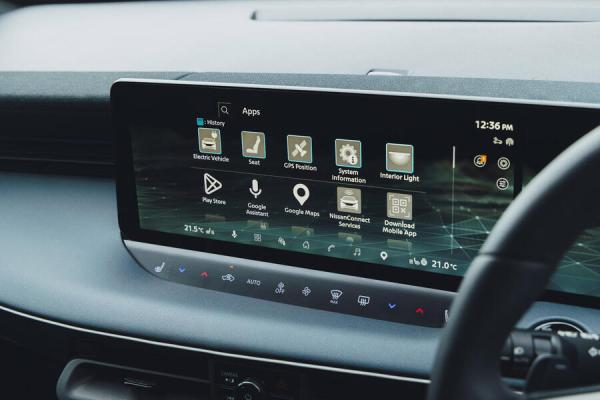
Nissan’s Google-based infotainment system is a model of how a touchscreen interface can be designed. It isn’t the most visually dazzling, but it’s clear, quick to respond and very logical, and offers wireless phone mirroring. It is also possible to navigate the screen using the steering wheel controls if you are truly touchscreen-averse, but this isn’t very intuitive.

Related posts





Latest Post


No Comments