
The Old-School Engine Design That Still Beats Modern Rivals
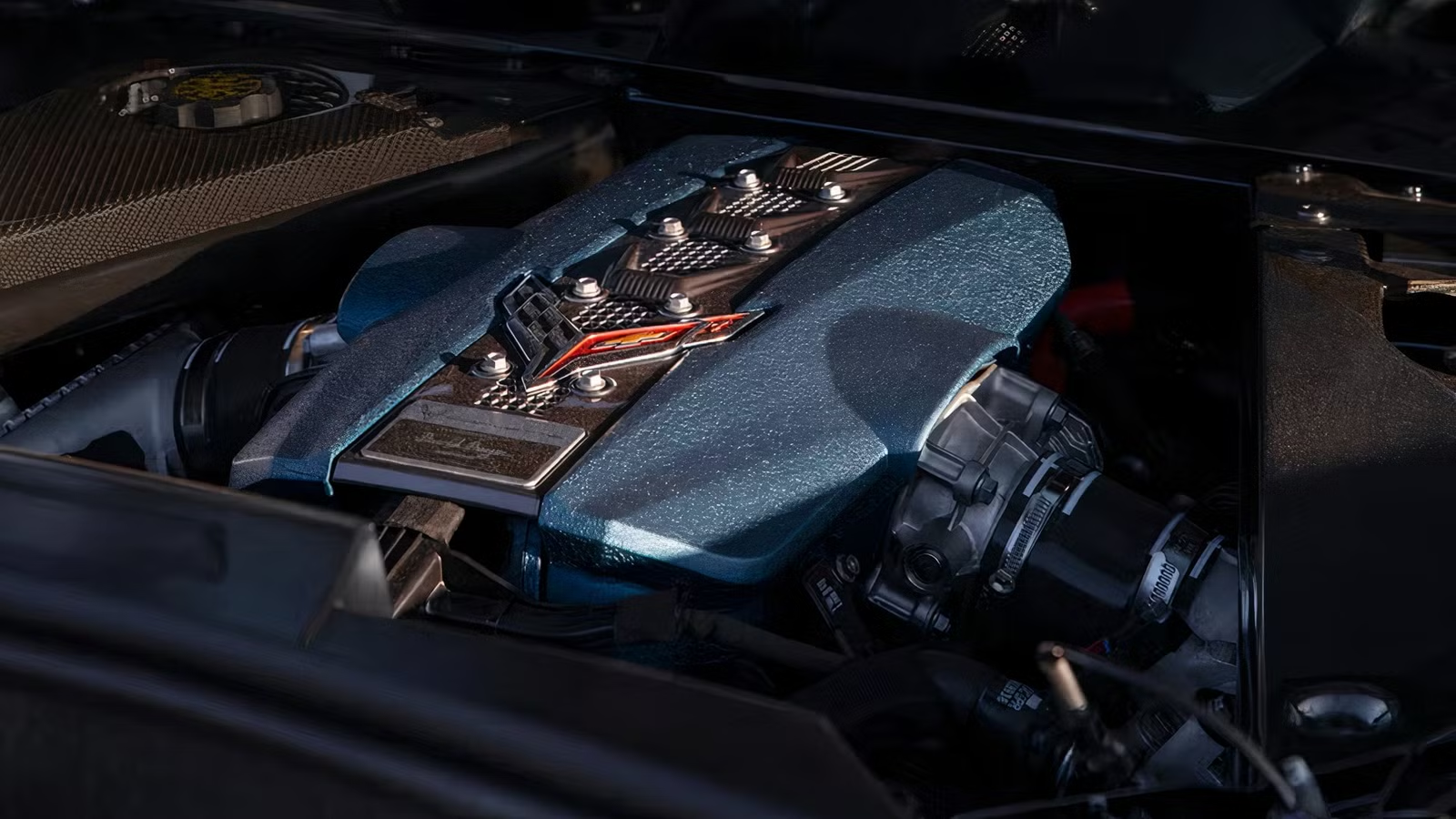
American automakers are currently rethinking their pure electric car transition timelines due to drastically declining sales. This has led to brands doubling down on V-8 engines to secure steady profits from core buyers.

High battery costs and charging infrastructure gaps are reshaping corporate strategy. Executives pivot toward hybrid powertrains and traditional combustion options. This shift secures steady revenue while the electric vehicle market share stabilizes across North America.
Chevrolet’s Industry-Leading V-8 Design
Chevrolet stands as a cornerstone of American automotive culture. Founded in 1911 by Louis Chevrolet and William C. Durant, the division rapidly grew into General Motors’ primary high-volume brand. Chevrolet built a reputation on accessibility, durability, and performance, delivering reliable transportation to millions of drivers globally.

Central to Chevrolet’s legacy is its historical connection to versatile engines designed for durability and accessibility. Chevrolet introduced early overhead-valve designs that defined mainstream performance by combining lightweight construction, impressive power output, and mechanical simplicity. These engines powered legendary models like the Corvette and Bel Air while establishing a reputation for simple serviceability.
Over subsequent decades, Chevrolet expanded its engine lineup to include high-displacement engines for heavy-duty applications alongside efficient inline and modular designs. The brand continuously refines these architectures across multiple generations, integrating advanced fuel management and strong internal components while maintaining compact engine footprints. Today, Chevrolet continues manufacturing engines for high-performance sports cars, full-size pickup trucks, and everyday passenger vehicles. This focus on adaptable, robust engineering remains a fundamental pillar of Chevrolet’s identity.
How Chevy Reshaped The V-8 Game

The Chevrolet small-block V-8 stands as one of the most impactful engine architectures in automotive history. Introduced in 1955, this lightweight, overhead-valve pushrod design transformed performance vehicle development. Its compact physical footprint allowed easy installation across diverse vehicle platforms, establishing a template for high-volume American performance.
In the muscle car sector, the small-block democratized high-power outputs. Early 265-cubic-inch variants produced 162 horsepower, while modern supercharged LT derivatives exceed 650 hp. This vast output range powered iconic muscle cars, including the Chevrolet Camaro, Chevelle, and Corvette. The engine line provided extraordinary tuning potential, making it the primary choice for street rodders, drag racers, and aftermarket builders.
The small-block proved equally decisive for the truck industry. Chevrolet integrated the engine into full-size pickups, light commercial vans, and SUVs like the Suburban and Tahoe. The small-block delivered low-end torque, simple mechanical reliability, and heavy towing capability. These traits established General Motors as a dominant force in truck sales for decades. Modern LT-series small-block engines continue driving 2026 Chevrolet Silverado and GMC Sierra trucks today. The small-block architecture remains an enduring benchmark for pushrod engine efficiency and durability.
The Small Block Prioritizes A Simple Design

The Chevrolet small-block V-8‘s design is based on a compact ninety-degree engine block layout. Engineers cast the cylinder block from gray iron or lightweight aluminum alloy depending on the application. The design maintains a fixed 4.4-inch bore center distance between adjacent cylinder walls. Deep-skirt crankcase walls enclose the main bearings to stiffen the lower block structure. This rigid foundation reduces flex under high mechanical loads. Integrated oil galleries supply pressurized lubricant directly to critical internal friction points.
A cross-plane crankshaft is supported by two-bolt or four-bolt main bearing caps. Manufacturer specifications call for nodular cast iron or forged steel crankshafts. Forged steel connecting rods attach the crankshaft to cast aluminum alloy pistons. Piston skirts feature low-friction coatings to maximize cylinder wall longevity. Full-floating wrist pins link the pistons to the connecting rods. The rotating assembly balances rotational forces, minimizing vibration across the operating range.
Perfecting The Pushrod V-8 Design
The engine uses an overhead valve pushrod architecture. A single camshaft sits directly above the crankshaft inside the engine block. The camshaft drives hydraulic roller lifters inside dedicated block bores. Solid steel pushrods extend upward through the cylinder heads to actuate stamped steel or roller rocker arms. Overhead valves open into the combustion chambers against coil valve springs. This single-cam arrangement eliminates complex timing belts, secondary chains, and overhead camshaft hardware.
Cylinder heads mount to the top of the block using high-tensile head bolts. Modern heads utilize cast aluminum alloy to reduce weight and improve heat dissipation. Wedge-shaped combustion chambers optimize fuel-air mixing. Two valves per cylinder control airflow, with intake valves featuring larger diameters than exhaust valves. Symmetrical intake and exhaust ports align cleanly across the cylinder head surface. Internal coolant jackets surround each combustion chamber to stabilize operating temperatures.
This component combination establishes an exceptional balance between durability and output. The pushrod layout keeps overall engine dimensions small while minimizing moving parts. Fewer moving components reduce physical wear points and lower the risk of valvetrain failure. Heavy-duty bottom-end materials handle high cylinder pressures without distorting. High-velocity port designs generate strong low-end torque while supporting top-end horsepower. The small-block achieves long operational lifespans and delivers efficient power delivery through simple, effective engineering.
How GM Future-Proofs Its Iconic V-8

General Motors builds the sixth-generation small block V-8 architecture around a similar pushrod overhead-valve design while modernizing key internal components. The architecture retains the classic 4.4-inch bore spacing and single-cam-in-block layout. Engineers future-proof the design by implementing a dual-fuel system that combines port fuel injection and direct injection. This dual-injection arrangement minimizes carbon buildup on intake valves while optimizing fuel delivery across all operating loads.
The engine block also incorporates revised cooling jackets with targeted coolant flow around the combustion chambers and exhaust valves. These structural updates allow the engine to meet stricter global emissions mandates, while maintaining similar external dimensions and fitment flexibility. The flagship 6.7-liter LS6 variant generates 535 hp at 6,100 RPM and 520 lb-ft of torque at 4,600 RPM. A longer 100 mm stroke expands displacement over previous generations and yields substantial low-end torque.
Truck and SUV applications utilize 5.7-liter and 6.6-liter variants engineered specifically for towing capacity and low-rpm work. The 5.7-liter version delivers an estimated 400 hp and 430 lb-ft of torque. A high 13.0 to 1 compression ratio extracts maximum energy from each combustion cycle. Revised intake manifolding and a larger 95 mm throttle body accelerate airflow into the cylinders to maximize power generation throughout the rev range.
Thermal efficiency increases through the elevated compression ratio and precise dual-fuel management. The dual-injection strategy reduces cold-start emissions and maintains stoichiometric air-fuel ratios during heavy engine loads. To ensure reliability under severe operating conditions, engineers fit forged pistons and forged connecting rods into the rotating assembly. A secondary oil feed to the crankshaft prevents oil starvation under high bearing loads and aggressive cornering. Targeted cooling jackets suppress hot spots near spark plugs to prevent knock and pre-ignition. These combined engineering solutions resolve past mechanical vulnerabilities and establish durability across performance and truck applications.
The Small-Block Does Struggle With Some Issues

Chevrolet small-block V-8 engines face recurring issues with displacement-on-demand valvetrain hardware. Active Fuel Management lifters collapse over time, causing engine ticking, misfires, and camshaft lobe damage. Low-tension piston rings and faulty positive crankcase ventilation valves trigger elevated oil consumption across modern generations. Direct-injection variants accumulate heavy carbon deposits on intake valves because fuel no longer washes over the valve stems.
Maintaining long-term engine reliability requires strict adherence to short oil-change intervals. High-quality full-synthetic oil protects delicate hydraulic lifters and variable valve timing actuators from premature wear. Technicians replace spark plugs and inspect ignition wires at scheduled milestones to prevent ignition misfires. Regular coolant flushes prevent internal corrosion and protect head gaskets from thermal degradation. Periodic intake valve chemical cleaning removes carbon buildup and restores proper airflow into the combustion chambers.
Recalls That The Small Block V-8 Has Been Subject To

Major safety recalls for Chevrolet small-block V-8 engines focus heavily on manufacturing defects and critical mechanical failures in recent generations. General Motors issued a massive recall affecting roughly 721,000 trucks and full-size SUVs equipped with the 6.2-liter L87 V-8 engine. Flaws in crankshaft dimensions and rod bearing tolerances can cause metal debris to contaminate the oil supply, which leads to sudden bearing destruction and catastrophic engine failure.
Production runs across Generation V V-8 engines also experienced widespread service actions for defective valve springs. Faulty metallurgical batches cause valve springs to fracture under normal operation, resulting in severe engine misfires and potential valve-to-piston contact. Earlier small-block iterations faced recalls for high-pressure fuel line leaks and software glitches in engine control modules that increased fire risks or caused sudden stalling during driving.

Available Models
Chevrolet
- Founded
-
November 3, 1911
- Founder
-
Louis Chevrolet, Arthur Chevrolet, William C. Durant
- Headquarters
-
Detroit, Michigan, United States of America
- Owned By
-
General Motors
- Current CEO
-
Mary Barra
Sources: MotorReviewer and the NHTSA

Related posts



Latest Post


No Comments