
Naturally Aspirated Engines Are Nearly Gone From New Cars, And A 2026 Ranking Shows Exactly What’s Left
The naturally aspirated engine is running out of road. CarBuzz published a torque-ranked inventory this week of every free-breathing production engine still available in a 2026 vehicle — and the count is sobering. From Porsche’s hand-assembled 4.0-liter flat-six to GM’s outgoing 6.2-liter pushrod V8, the list covers eleven engines across a shrinking handful of segments. For buyers who specifically want to avoid turbochargers, hybrid boost, or both, this is close to the complete menu.

The timing matters. Several of these engines are already in their final model years, and used-market prices are beginning to reflect that. If you want a new naturally aspirated performance car in 2026, your window is narrowing fast.
What the Ranking Covers, and What It Excludes
CarBuzz’s list focuses strictly on passenger-car and light-truck production engines — no heavy-duty commercial or industrial applications. The ranking is sorted by peak torque output, which makes for an interesting hierarchy: the engines with the highest redlines tend to sit near the bottom, because free-revving configurations trade low-end torque for top-end power. That’s exactly why Porsche’s 4.0-liter flat-six, which spins to 9,000 RPM, opens the list at 346 lb-ft despite being one of the most technically sophisticated engines on it.

The spread runs from that 346 lb-ft Porsche all the way to the Aston Martin Valkyrie’s Cosworth-built 6.5-liter V12, which makes 1,000 horsepower and revs to 11,000 RPM — a figure CarBuzz notes is a record for any naturally aspirated production engine. Those two endpoints tell the whole story of what’s left: either exotic, high-revving performance hardware or large-displacement American pushrod V8s built around torque from the ground up.
The Engines Most Buyers Can Actually Access

Below the supercar tier, the list gets more relevant for real-world shoppers. The 5.7-liter Hemi V8 — now more than two decades into production — continues in Stellantis trucks and SUVs, delivering 410 lb-ft from a pushrod architecture that’s been refined through years of real-world use. Some configurations pair it with the e-Torque mild-hybrid system, though that system operates externally and doesn’t change the engine’s own output figures.
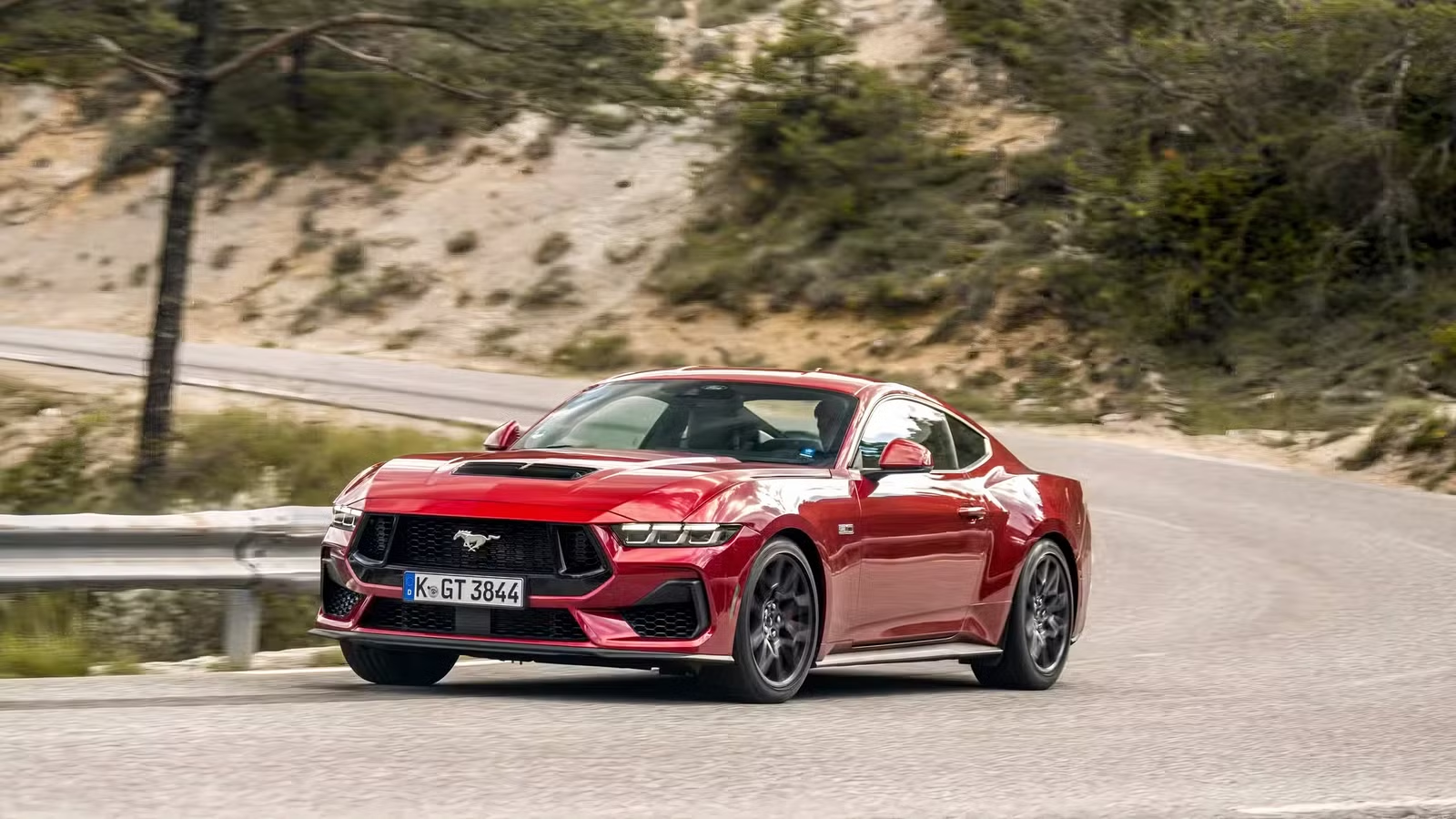
Ford’s fourth-generation Coyote 5.0-liter V8 in the Mustang GT produces 418 lb-ft, aided by a dual-intake, dual-throttle setup that helps it breathe more freely than earlier versions. It’s also happy to spin past 7,000 RPM — a combination of high compression and advanced cam timing that gives it a character distinct from the pushrod alternatives. GM’s 6.2-liter L87, found in Chevrolet and GMC trucks and SUVs, sits higher on the torque chart but is being phased out in favor of a new 6.7-liter unit. The C8 Corvette’s LT2 version of the same 6.2-liter architecture makes 470 lb-ft in its mid-engine application, and it too will give way to the 6.7-liter for 2027. On the Mopar side, the 6.4-liter Hemi produces 475 lb-ft — more torque, the CarBuzz piece notes, than the original 1990s Viper V10, from two fewer cylinders and less displacement.
The Collector Cases: Porsche GT3 and the Lexus LC V8

Two engines on the list stand apart for reasons beyond raw output. Porsche’s 4.0-liter flat-six in the 911 GT3 is hand-assembled in a dedicated motorsport facility, uses titanium connecting rods to reduce rotating mass, and achieves its 9,000 RPM ceiling through engineering choices that prioritize character over peak torque. It’s worth noting that Subaru retired its own flat-six configuration seven years ago — the last one appeared in the Legacy 3.6R Limited — leaving Porsche as the only manufacturer still selling a flat-six in the U.S. market. Used GT3 prices are already trending upward as buyers recognize that naturally aspirated, manual-transmission Porsches are becoming genuinely scarce.
The Lexus LC’s 5.0-liter V8 is a different kind of loss. Lexus ended LC production earlier this summer, ending a run for an engine that Yamaha helped tune for sound quality — a detail that distinguished it from anything else in the segment. The 2UR-GSE V8 had a lineage of smooth, high-revving performance stretching back through multiple Lexus performance models. With production now closed, the LC is transitioning from sports car to collectible in real time, and values are expected to hold accordingly.
How NA Torque Actually Feels Against Turbocharged Alternatives

Peak torque numbers only tell part of the story. A turbocharged four-cylinder can match or exceed the Coyote’s 418 lb-ft on a spec sheet, but the delivery is different — boost builds with RPM and load, creating a surge rather than a linear climb. Naturally aspirated engines, particularly high-revving ones like the GT3’s flat-six, respond directly to throttle position across the rev range. There’s no lag to account for, no waiting for boost to arrive. For drivers who tune their inputs around predictable, linear response, that distinction is meaningful and not easily replicated by software or boost mapping.
For buyers weighing an NA option against a turbocharged rival, the practical question is whether that character is worth the trade-offs — typically less peak torque at low RPM and lower fuel efficiency than a modern downsized engine. In most segments, the turbocharged option is now the default, and the naturally aspirated alternative, where it still exists, requires actively seeking it out.
If naturally aspirated is a hard requirement, the 2026 model year still offers real choices — from a Mustang GT to a Ferrari Purosangue — but the list is shorter than it’s ever been, and several of these engines are already confirmed for replacement. Buyers who want one new, from a dealer, with a warranty, are working against a clock that’s moving faster than it looks.
Source: Carbuzz

Related posts

Latest Post



No Comments