
The Cruiser That Rarely Gives Owners A Reason To Upgrade
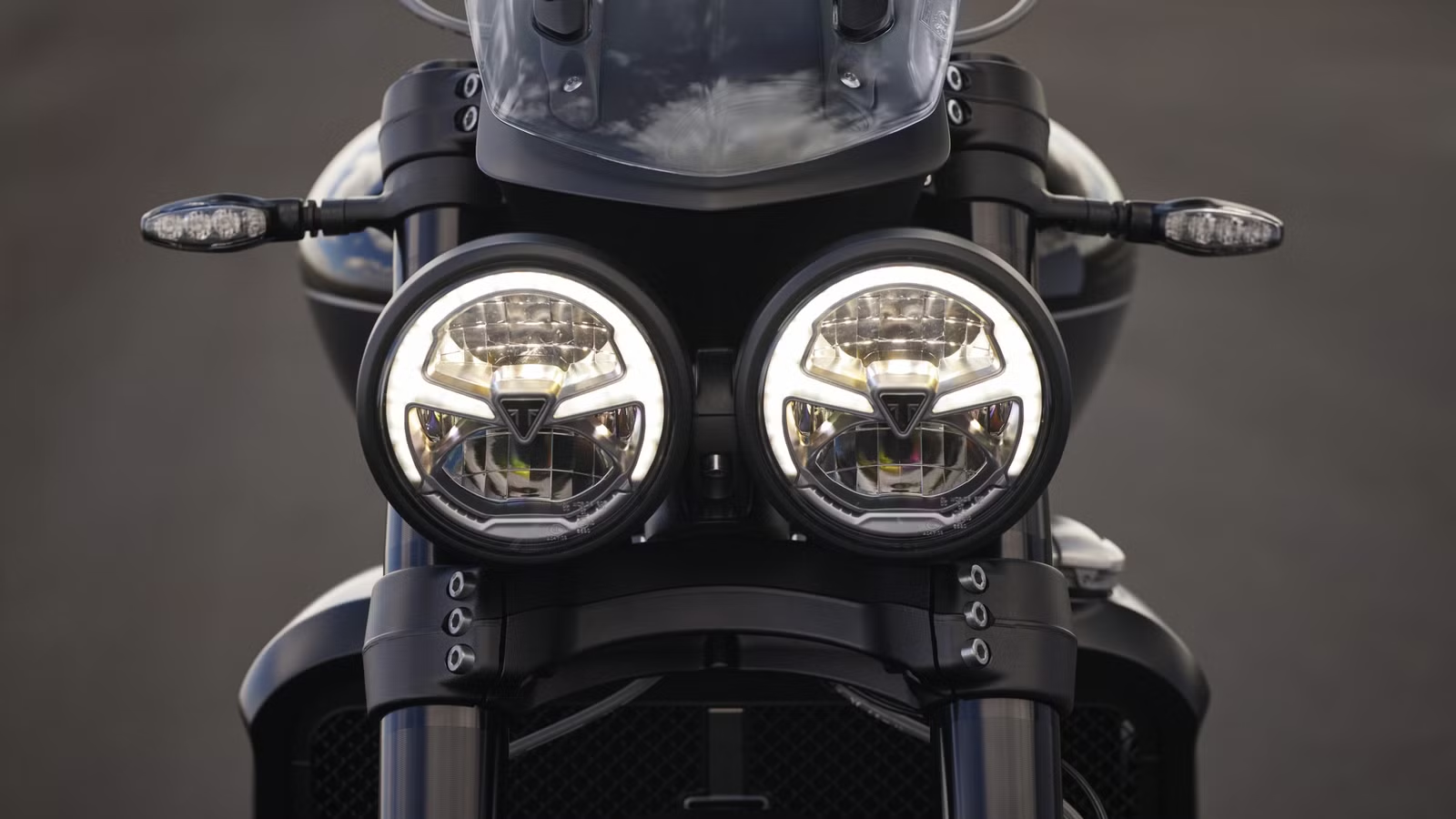
Imagine you want a cruiser motorcycle to keep for several years. You’d inevitably need something that doesn’t give you a reason to upgrade, which is where we usually find flagship machines. However, even among these flagship cruisers, there are several examples that have chinks in their armor. They can get tiresome over distance, feel slow over the years, or simply succumb to newer machines since they don’t get regular updates. That leaves us with a small set of cruisers that rarely give owners a reason to upgrade, and a prime example of that comes from Britain’s biggest bikemaker.
Key Requirements For A Cruiser That Doesn’t Give A Reason To Upgrade

Before diving in, you have to understand what the prerequisites of such a long-term cruiser. First and foremost is the aesthetic charm. It needs to look the part and remain true to the cruiser elements. These include a low-slung and long profile, topped with round lights and stylish attention to detail. Oh, and chrome isn’t exactly a key requirement anymore, as nearly all bikemakers try to favor blacked-out mechanicals now.

Then, there’s performance. Dollops of low-end punch is a non-negotiable, topped with some serious displacement figures. The latter means a less-stressed tune for the powerhouse, which in turn means better reliability and long service intervals. After all, no one wants to visit the shop every few months (or every few thousand miles). Bonus points if the performance output is unbeaten in the segment.

Last but not least, technology and comfort play a key role. As much as we appreciate raw bikes, modern rider aids make real-world riding easier and help deal with unpredictability. Not to mention, we all love creature comforts like cruise control to take the edge off on days where things just aren’t going to plan. As for comfort, a large two-up saddle is key, and so are forward-set footpegs for a laidback riding triangle. That means you don’t have to invest in aftermarket saddles or spend extra when you want to take your significant other with you.

The Triumph Rocket 3 GT Won’t Give You A Reason To Upgrade

Compile all of those requirements, take a deep look at the flagship cruiser segment, and you’ll end up shortlisting the Triumph Rocket 3 GT. This is thanks to its blend of a high-performance powerhouse, long service intervals, thoughtful comfort-oriented bits, and a good blend of modern-day tech. At the same time, the design is long, low, and head-turning, with nothing coming remotely close to the road presence of this heavyweight.
The ‘rarely gives reason to upgrade’ factor is confirmed by ownership portals and market position. There is no shortage of high-mileage examples, where 30-40,000 miles is a regular occurrence, while some examples even have six-digit odometer readings. In fact, some Triumph dealers claim that once they sell a Rocket 3, owners never bring them in to trade them in.
A Competitive MSRP Strengthens The Rocket 3 GT’s Case

As for the market, none of its rivals beat the GT’s overall balance. No American machine–be it from Harley-Davidson, Buell, or Indian–comes close to matching the performance or tech. Whereas, other flagship metric cruisers–like the Ducati XDiavel–can’t promise similar comfort or equipment. Overall value is a big plus, too.
Speaking of which, the Rocket 3 GT sells for $27,495. The MSRP is a few thousand dollars more than premium American names like the Harley-Davidson Low Rider ST, Heritage Classic (two-up), and Fat Boy. But all of these have much smaller, less powerful, and basic engines in comparison. They also can’t match the premium mechanical package of the Rocket.

The only bike that can come close as a whole is the Ducati XDiavel V4. It has comparable horsepower figures, a unique V4 engine with scarcely believable reliability, and top-drawer underpinnings. But Ducati charges you around $1,500 more while still missing out on nitty-gritty bits. For instance, you neither get a windscreen nor a pillion backrest on the Diavel. Adding these means spending around $800 more.
A Deep Dive Into The 2026 Rocket 3 GT

While all of the above certify the Rocket as an ideal long-term cruiser purchase, the details only sweeten the pot. Let’s dive in.
Powered By The World’s Largest Production Motorcycle Engine

We start with the USP: the behemoth of an engine. This is the world’s largest production motorcycle engine, displacing 2,458 cubic centimeters. That, along with its inline-triple layout, makes it a mechanical marvel in itself. Yet, it backs up the capacity with scarcely believable numbers of 179.5 horsepower and 166 pound-feet. It somehow still keeps the compression ratio relatively chill at 10.8:1.
Although these are superbike-spec numbers, all of it is tuned for a cruiser package. The torque peaks at just 4,000 RPM—the same as the Harley-Davidson Low Rider ST. Oh, and as a bonus, the power reaches the wheel via a shaft drive. This means barely any regular maintenance compared to belt or chain drive setups.
A Unique Chassis For A Unique Engine

The unique engine pairs up with a unique chassis. In a sea of double-cradle frames, you get an aluminum chassis on the Rocket with the engine as a stressed member. This is paired with a single-sided swingarm (again from aluminum), while being suspended on Showa 47 mm upside-down forks and an RSU monoshock. Both ends have adjustability–another rarity for regular cruisers–and attach to 17/16-inch alloy wheels. As for brakes, you get top-drawer Brembo Stylema calipers up top and a four-piston rear caliper.
The Heft Is Real Here

Why triple four-piston calipers to shed speed? Because this is a proper heavyweight. The Rocket 3 GT tips the scales at 705.5 pounds, even with all of its aluminum usage. This is backed up by other massive dimensions like:
- Wheelbase: 65.4 inches
- Width: 35.9 inches
- Rake: 27.9 degrees
- Height: ~42 inches
Likable Features And Forward-Set Footpegs Up The Comfort

The GT is the more long-haul-oriented version in the Rocket 3 lineup. It achieves that by featuring forward-set footpegs and a rearward-swept handlebar. This pairs up with a different seat lower than the R for a 29.5-inch saddle height. A windscreen and backrest top things off. Once aboard, a TFT instrument cluster greets you. It not only has an army of rider aids to keep you safe (cornering ABS, cornering traction control, dedicated wheelie control, and ride modes), but it’s also the gateway to hill hold and cruise control. Triumph also sells a two-way quickshifter as a factory accessory.
Source: Triumph Motorcycles

Related posts


Latest Post



No Comments