
Meet The Trans Am 455 HO V8 Pontiac Loyalists Still Worship
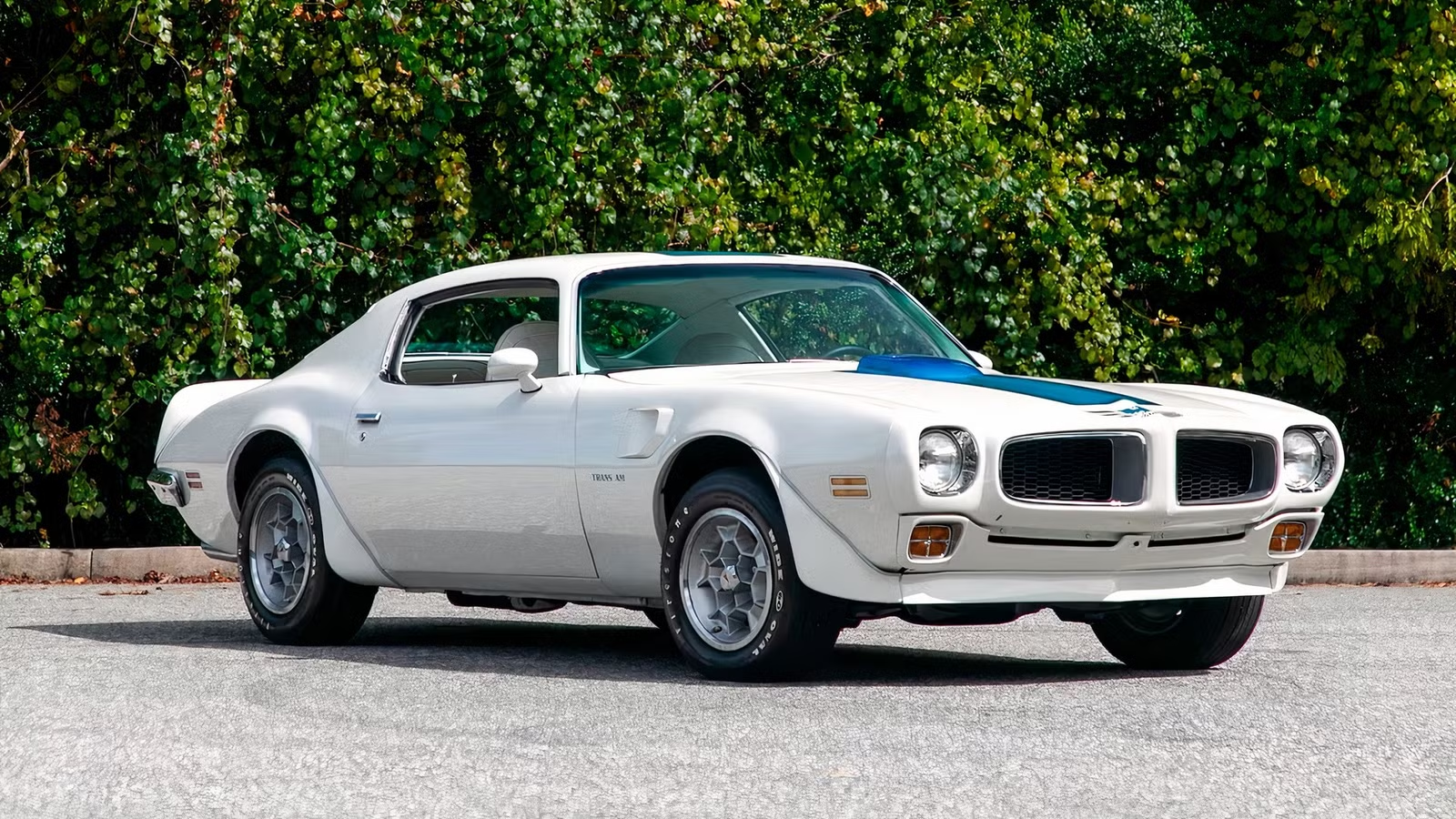
Lower compression was supposed to mean lower expectations. As the muscle-car business began to adjust to changing fuel requirements and tighter emissions standards, buying a performance car increasingly meant paying for a reputation that the engine could no longer support. Pontiac’s engineers apparently disliked that arrangement, because their response involved 455 cubic inches, serious cylinder heads, and enough torque to make surrender feel premature.

The resulting engine wasn’t Pontiac’s most powerful, and the Super Duty that followed deserved its own spotlight. But the 1971–72 round-port 455 HO made a persuasive argument for performance you could actually use. Its appeal survives because the engineering holds up under scrutiny, although today’s collector prices demand that you scrutinize considerably more than the shaker scoop.
The Muscle-Car Sunset Gave Pontiac Something To Prove
Lower Compression Did Not Have To Mean Giving Up
For 1971, General Motors moved toward engines compatible with lower-octane fuel, bringing compression ratios down across its divisions. Pontiac’s approximately 8.4:1 455 HO reflected that new reality, abandoning the high-compression approach associated with earlier performance engines.

The trick was preserving useful output without relying on the old recipe. Pontiac combined substantial displacement with improved breathing and a street-oriented camshaft, creating an engine that didn’t need a frantic upper-rpm charge to justify its existence. You could lose compression without losing every reason to buy the car.
The Trans Am Had To Deliver More Than A Big Engine

The second-generation Trans Am gave that engine a convincing home. Its performance identity included suspension tuning, power-assisted front disc brakes, and a driver-focused cockpit, rather than simply a large displacement figure attached to an ordinary transportation appliance.
That distinction matters because an engine’s reputation develops inside a complete car. Gearing, transmission choice, traction, and chassis behavior shape what you feel from the driver’s seat. The shaker moving above the hood supplied the theater, but Pontiac still had to deliver something worthwhile when you pressed the accelerator.
The 1971–72 Trans Am Made The Round-Port 455 HO Its Calling Card
A 455-Cubic-Inch V8 With The Numbers Put In Context

The 1971 Trans Am’s 455 HO carried an SAE net rating of approximately 305 horsepower, alongside the familiar advertised SAE gross rating of 335 horsepower. Its often-quoted 480 pound-feet of torque was also a gross figure. Calling those 335 horsepower “net” gives the engine credit under the wrong measuring system.
For 1972, the published figures were 300 horsepower and 415 pound-feet of torque SAE net. Gross testing was conducted under more favorable laboratory conditions, while net testing more closely reflected its installed configuration, including relevant accessories and intake and exhaust restrictions. The apparent drop from 335 to 300 horsepower therefore cannot be treated as 35 horsepower mechanically disappearing between model years.
Two Model Years Created A Distinct Collector Target

The round-port 455 HO was standard in the 1971 and 1972 Trans Am, with either a four-speed manual or three-speed automatic transmission. Production totaled 2,116 Trans Ams for 1971 and 1,286 for 1972, giving collectors a relatively small population to draw on before decades of modifications and attrition enter the equation.
The engine wasn’t exclusive to the Trans Am; Pontiac also offered it in the Firebird Formula and selected A-body applications. Nor does every later “455 HO” badge identify this engine, because the designation was used on the 1975 Trans Am with a substantially different D-port 455. Those letters require a model year attached.
Pontiac Preserved Street Performance Through Airflow And Displacement
Round-Port Heads Helped Make Low Compression Work

The HO’s defining hardware included round-port cylinder heads, an aluminum intake manifold, and high-flow exhaust manifolds. Its heads drew on Pontiac’s earlier Ram Air development, while the 068 hydraulic camshaft emphasized usable output rather than turning the engine into a temperamental weekend science project.
Those components worked as a package. The heads and manifolds helped the engine breathe, while 455 cubic inches provided the displacement needed to produce strong output without relying on high engine speeds. You weren’t buying an ordinary 455 with optimistic lettering on its air cleaner.
That helps explain the engine’s street appeal. Acceleration didn’t depend entirely on winding through the last few hundred rpm before a shift, although gearing and transmission choice still mattered. The appeal was accessible muscle, with enough breathing capacity to keep the displacement from becoming merely a brochure talking point.
The Super Duty Comparison Is About Priorities

The 1973–74 SD-455 went further, using a specially reinforced block, forged connecting rods and pistons, and revised round-port heads. Interviews with Pontiac engineers, published in High Performance Pontiac, document a development effort aimed at achieving substantial performance potential under increasingly stringent emissions constraints.
That makes it difficult to defend declaring the HO categorically “better engineered.” In a 2005 LS1Tech discussion comparing the engines, contributor “vikingramair” praised the HO but described the SD as an improvement, illustrating that enthusiast discussion doesn’t establish unanimous HO superiority.
The defensible argument is about suitability. You can appreciate the HO’s combination of street-oriented tuning and capable airflow without pretending the Super Duty’s stronger internals were unnecessary. The HO earns its place without requiring its successor to lose an imaginary family argument.
Auction Results Show What Collectors Actually Reward
Documented Sales Reveal A Wide Spread

A Lucerne Blue 1971 four-speed sold on Bring a Trailer for $120,000 in May 2022. Advertised as numbers-matching, it had undergone refurbishment, and its listing showed an engine stamping matching the chassis number’s final six digits. That is more meaningful evidence than a seller simply typing “original motor.”
In February 2024, a Cameo White 1972 four-speed brought $97,500 on the same platform. Its description disclosed refurbishment, quarter-panel sheet-metal repairs, a bumper scuff, and unknown total mileage. Another 1971 four-speed reached $135,000 that November after extensive refurbishment, including engine and transmission rebuilds.
The lower end needs equal attention. A modified 1971 sold for $53,250 in September 2026 with a replacement 455, a later four-speed automatic, an older refurbishment, dashboard deterioration, and air-conditioning faults. It belongs in the buying discussion, but it cannot establish the value of an authenticated original-engine HO car.
Buying The Legend Starts With Proving What Is Under The Shaker
Factory Documentation And Engine Stampings Must Agree


Start with Pontiac Historic Services documentation to establish how the car was originally configured. Then compare that record with the vehicle identification, engine application code, partial VIN stamping, casting numbers, and casting dates. Factory paperwork describes the car as built; it doesn’t prove the same engine remains installed.
An accurate casting number tells only part of the story. The engine’s identity and chronology must agree with the vehicle, while the heads, intake, carburetor, and other application-specific components deserve examination. An original block can carry replacement components, and a correct replacement engine remains a replacement.
Have a Pontiac specialist assess questionable stampings and any evidence of restamping. “Numbers-matching,” “date-correct,” and “service replacement” describe materially different situations, even when the finished engine compartments look equally convincing.
Pay For Evidence Before Paying For The Story
Inspect the body structure, corrosion repairs, cooling system, oil pressure, transmission operation, and quality of previous restoration work. Missing HO-specific parts also deserve attention, because assembling the right hardware can become its own expensive collecting hobby.
The round-port 455 HO deserves respect because Pontiac preserved meaningful performance when the easy engineering answers were disappearing. If you want that particular achievement in your garage, buy the car whose evidence supports its asking price. The shaker can provide the entertainment after the numbers provide the reassurance.
Sources: PontiacDIY.com, Hotrod.com, LS1Tech.com, Bring A Trailer, bandittransamclub.com

Related posts






Latest Post


No Comments