Kia’s K5 GT Now Runs 330i Pace For A Camry-Level Sticker
8 minutes reading
Sunday, 27 Sep 2026 19:01 0 6 autotech
For years, choosing between a Kia sedan and a BMW meant accepting a straightforward trade involving German driving dynamics and badge prestige for a lot more money. That math is getting harder to justify. The 2026 Kia K5 GT, a 290-horsepower turbocharged sedan stickered at $33,490, now runs 0-60 mph in about the same time as a base BMW 330i, a car that costs nearly $48,000 before options. That’s a $14,500 gap for matched straight-line performance. This piece breaks down exactly where the K5 GT has caught up, where the 330i still earns its premium, and which buyer each one actually serves.
For years, the gap between a mainstream Korean sedan and an entry-luxury German one was assumed rather than measured: the BMW simply felt faster, sharper, more special, and that feeling justified the premium. The 2026 Kia K5 GT complicates that assumption. Stickered around $33,490, it now matches the 330i’s 0-60 mph time almost to the tenth, while undercutting BMW’s roughly $48,000 ask by about $14,500. That’s not a rounding error; it’s a down payment on a second car. So where exactly did BMW’s advantage go, and where is it still very much intact?
Rear 3/4 action shot of 2026 Kia K5 GTKia
This comparison only matters because both cars are aimed at the same buyer, someone shopping by feel as much as by spec sheet, who wants a sedan that doesn’t apologize for itself at a stoplight. A decade ago, that buyer’s choice was simple. Stretch the budget for the badge, or settle for a car that looked the part but couldn’t back it up. The K5 GT forces a different kind of decision—one where the performance case is no longer the tiebreaker. That shifts the real argument onto chassis feel, everyday usability, and what a badge is actually worth once the stopwatch stops being the deciding factor.
The 290-HP K5 GT Delivers 330i-Level Straight-Line Pace For $33,490
Start with the number that makes this comparison worth having at all: 5.4 seconds to 60 mph. That’s the K5 GT’s documented time, and it lands the front-drive Kia in the same window as a base BMW 330i, a car that costs nearly 45 percent more before options. The GT’s 2.5-liter turbo-four makes 290 horsepower, sent to the front wheels through an eight-speed dual-clutch automatic, and it pulls hard enough in-gear that highway passing maneuvers feel genuinely urgent rather than merely adequate.
It’s worth noting the strongest instrumented test data for this matchup comes from 2021-2023 testing, not a freshly logged 2026 run. That matters less than it might seem, because the 2026 K5 GT carries an unchanged 290-horsepower spec, so those earlier numbers hold as a reliable proxy for what the current car will do at the strip. If anything, minor calibration tweaks to the transmission’s launch behavior over the years have only tightened consistency, not softened it.
Rear action shot of 2026 Kia K5 GT driving on roadKia
The quarter-mile tells a similar story. Both cars land in the low-14-second range, with trap speeds close enough that the difference comes down to driver technique more than hardware. In-gear response, the kind that matters when merging or overtaking on a two-lane road, favors the K5 GT slightly at lower speeds thanks to its torque coming on earlier in the rev range.
This is a car built by people who understood that most buyers experience acceleration in 20–40 mph bursts, not launch-control runs, and tuned accordingly. None of this means the K5 GT drives like a BMW. It means that in the one metric most cross-shoppers actually care about first—a straight line and a stopwatch—the mainstream sedan has closed a gap that used to be Kia’s biggest weakness.
FWD Versus RWD Is Where The BMW Still Creates Real Distance
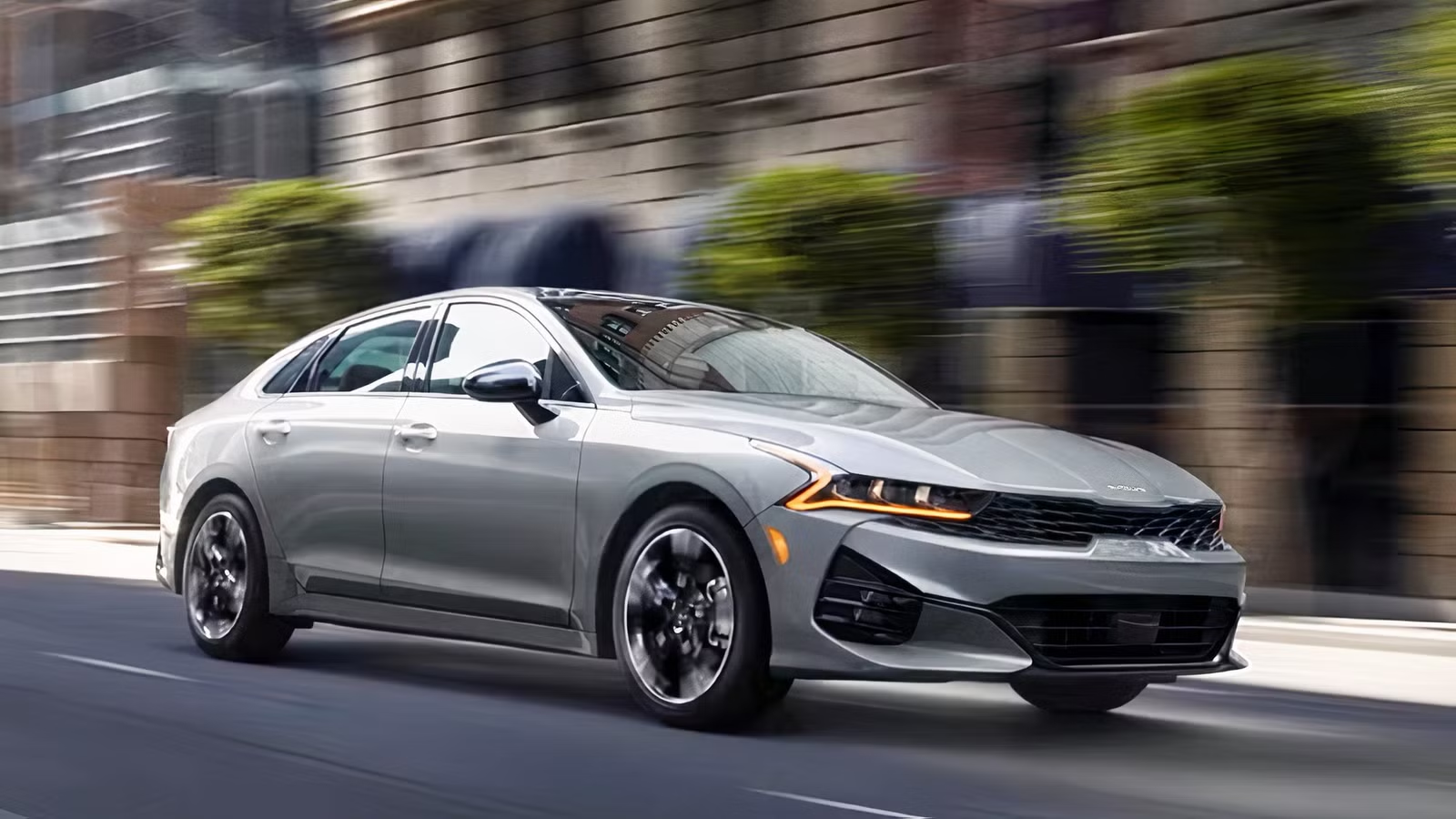
Front action shot of 2026 Kia K5 GT driving on roadKia
A front-wheel-drive sedan will never behave like a rear-wheel-drive sport sedan in a corner, no matter how close the 0-60 times are. That’s not a knock on the K5 GT, it’s physics, and it’s exactly where the 330i earns back a meaningful chunk of its premium.
The 330i’s 50/50 weight distribution and rear-biased power delivery (or full xDrive grip on all-wheel-drive variants) let it rotate through a corner in a way no FWD platform can replicate. Trail-brake into a decreasing-radius turn, and the BMW settles, tucks, and lets you get back on power early. Try the same thing in the K5 GT, and you’ll feel the front tires start doing double duty, managing both steering and the bulk of the power, which shows up as mild understeer and torque steer under hard acceleration out of slow corners.
Rear 3/4 shot of 2026 BMW 330i parkedBMW
Steering feedback widens the gap further. BMW’s electric power steering, even in its more muted modern era, still communicates road surface and grip level with more nuance than Kia’s tuning, which leans toward light, easy effort at the expense of texture. The GT’s adaptive dampers (standard on the trim) do a genuinely good job of controlling body motion on choppy pavement, but damping control and steering communication are different skills, and this is where the 330i’s chassis engineering—decades deep—still shows.
For a driver whose idea of fun is a canyon road or an autocross weekend, this section of the comparison is decisive. The K5 GT is fast in a straight line and composed on a highway on-ramp; the 330i is those things and also genuinely engaging when you start asking more of it. That’s a real, defensible reason to pay more, and buyers should weigh it honestly rather than assume matched acceleration numbers mean matched driving experiences.
Where Kia’s $33,490 Sticker Actually Outspecs A $55,000 BMW
If the chassis section favors BMW, the cabin section is where the Kia K5 GT claws territory back, and in some respects gets ahead. Kia’s GT trim comes standard with a curved dual-panel display setup, a 12.3-inch touchscreen paired with a matching digital gauge cluster, wireless Apple CarPlay and Android Auto, a Bose sound system, heated and ventilated front seats, and a heated steering wheel, all included in that $33,490 sticker.
Reaching that same equipment level on a 330i means climbing the options sheet, and BMW’s infotainment, while polished, gates features like adaptive cruise refinement and premium audio behind packages that push the effective price further from the base $48,000 figure and closer to $55,000. The K5 GT’s warranty adds another practical edge: Kia’s 10-year/100,000-mile powertrain coverage dwarfs BMW’s four-year/50,000-mile warranty, a meaningful consideration for buyers planning to keep a car past the initial ownership period.
Shot of 2026 Kia K5 GT interior showing front seatsKia
Interior materials still tip toward BMW in the details—stitched surfaces, switchgear weighting, ambient lighting execution—but the gap has narrowed enough that it’s no longer an obvious tell in a blind comparison. Rear seat space actually favors the Kia, with more usable legroom for a segment where back-seat comfort often gets sacrificed in pursuit of a sportier roofline. Day to day, the K5 GT asks less of its owner: fewer options to chase, less anxiety about out-of-warranty repair bills, and tech that feels current without requiring a subscription to unlock features that are already included.
K5 GT Or 330i: The Same Speed, Two Very Different Kinds Of Sport Sedan
2025 Kia K5 GT front 3/4 action shot driving on the road.Kia
Line the two cars up at a stoplight, and they’ll likely hit 60 mph within a few tenths of each other. Everything else about the ownership experience diverges from there. The K5 GT is the smarter buy for someone who wants genuine sport-sedan urgency, a loaded cabin, and a long warranty without paying a premium for a driving dynamic they may rarely explore beyond merging onto a highway. The 330i is the right call for someone who actually corners hard on a regular basis, values chassis feedback as much as straight-line thrust, and sees the badge and the RWD engineering behind it as worth the extra $14,500.
Shot of 2026 Kia K5 GT interior showing rear seatsKia
Neither answer is wrong, but the calculus has genuinely shifted. A few years ago, this comparison wouldn’t have been close enough to write. Now it is, and that’s the real story. Not that Kia beat BMW, but that Kia made BMW’s premium a question buyers actually have to answer. If you’re cross-shopping these two, drive them back-to-back on the same stretch of curvy road, not just a straight on-ramp, and let that specific test settle which $14,500 gap actually matters to you.











No Comments