
The Honda Cruiser That Made Harley-Davidson Sweat In The 1980s
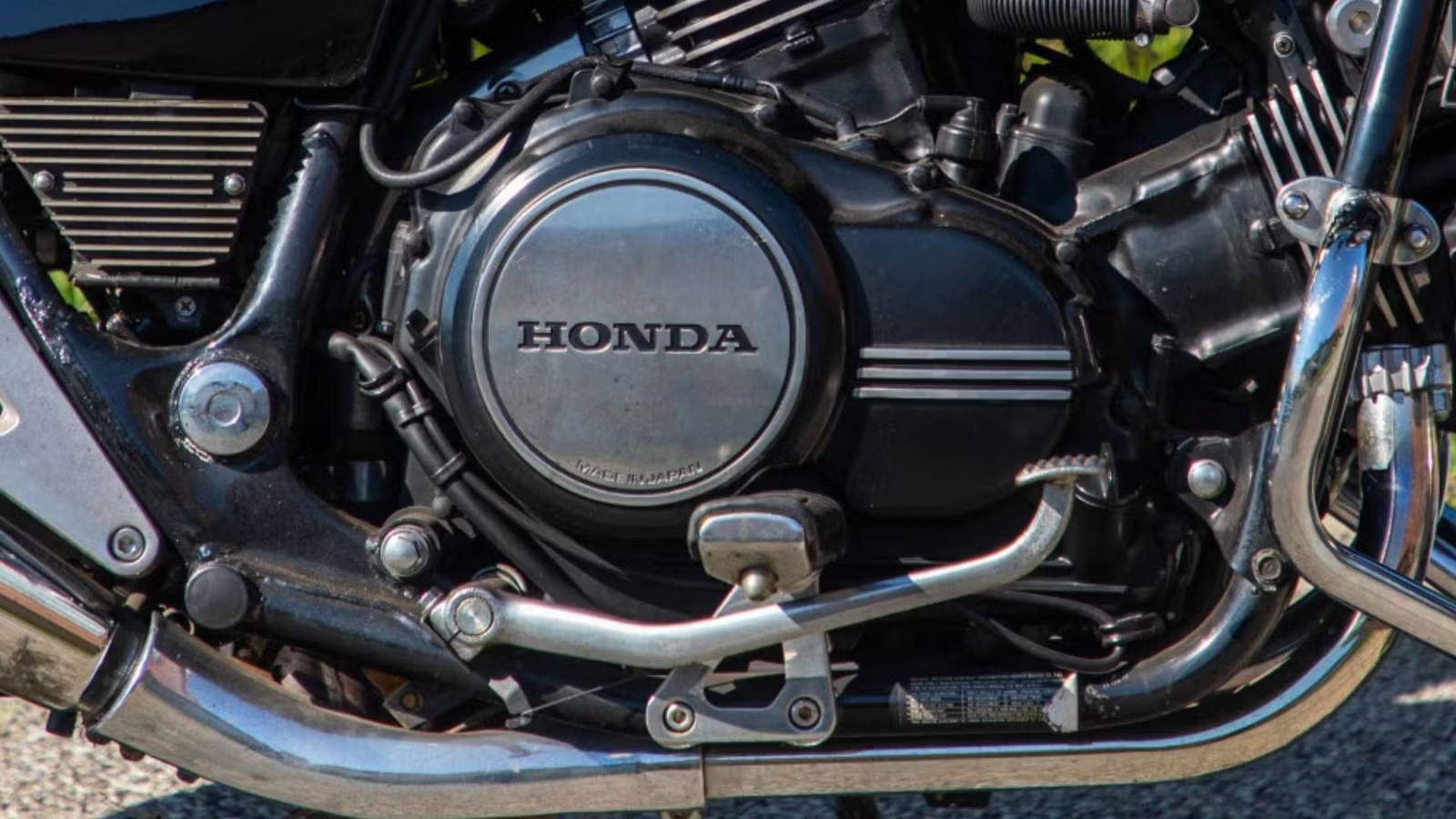
If you’re on the hunt for a classic cruiser, chances are that you’re tempted to snag a Harley. With the sound, styling, and sheer power that defined entire eras, it’s easy to be drawn in to the allure. Heck, diehard fans would even go as far as to say that any two-wheeler from another make hardly qualifies as a bike anyway. That’s not to say there aren’t some bikes that didn’t make the giant bleed, though.

In the 1980s, Honda unleashed a cruiser that didn’t just put Harley-Davidson in check; it beat the brakes off of its fastest bikes of the day. It hit the market hard with a four-cylinder engine at the forefront of the muscle bike movement, disappearing after a twenty-year run. Today, you can pick them up for dirt cheap, with the top variant still having the stats to put a hurting on Harley’s quickest bikes.
V4s Ruled The World In The 1980s
Harley-Davidson is famous for its V-twin monsters. It’s stuck to this engine layout since the beginning, producing leading variants one generation after another. That was the case in the 1980s, with the Sportster XR1000 being one of the nastiest cruisers around.

The Sportster XR1000 has a reputation as a street-legal racer that prioritized speed over comfort. Its 998 cc engine produced a respectable 70 horsepower that was able to sling the bike through the quarter-mile in 12.8 seconds, accelerating from 0-60 in the mid 4-second range. There are many quicker cruisers on the market today, such as the modern Sportster, but these stats are still very respectable and will keep even the most experienced rider entertained.
In the early 1980s, Honda motorcycles were primarily associated with the sports bike and powersports segments. While it had already dabbled with the cruiser segment, it wasn’t exactly taken seriously here. That’s why it’s next move took everyone by surprise. It came in swinging with a V4 monster that was so fierce that it started a whole new category of motorcycle. A bike so quick that gearheads are still in disbelief today.
Honda’s Rarest Motorcycle Was Too Advanced For Its Time
Honda’s $50k engineering vendetta. The 1992 marvel that used 32-valve oval pistons to bypass racing rules, creating a 125-hp carbon-fiber icon.
The Magna Was A Groundbreaking Cruiser

Honda brought the V45 Maga VF750C to market in 1982. Its name is inspired by the power plant that still feels alien to the world of cruiser bikes today. At the heart of this machine was a 45 cubic-inch (748cc) V4 that sounds more like an appropriate setup for its sport bikes of the era.
At its inception, the V45 Magna could produce around 80 horsepower. This was enough to clear the quarter mile in 12.2 seconds and reach a top speed of about 120 mph. It was not just an immediate threat to the XR1000, but a bike quick enough to make naysayers seem foolish.
The thing is, Honda was just getting started. The V45 Magna is a fantastic bike that many riders still covet to this day for its balance of speed, comfort, and relatively good agility for a dated cruiser. However, Honda released a variant that was absolutely bananas and would change the game forever.
65 Cubic Inches And A 10-Second Quarter

The V45 is a respectable machine by any metric. While its brakes are famously underpowered, it’s a solid bike anyone would enjoy riding. Even V-twin devotees would love it, but we’ll allow them to hide their joy behind a full-face helmet. The year after its release, however, Honda released an absolute weapon.
Honda dropped the V65 Magna VF1100C in 1983. Like the V45, its name referenced the displacement of the engine. This time around, Honda bumped the engine up to 65 cubic inches or 1,098cc. Not only was it considerably bigger, but it was much more powerful.
Honda Magna V65 Vs Sportster XR1000
|
Bike |
Engine |
Horsepower |
Quarter-Mile |
Top Speed |
|
1983 V65 Magna |
1,098cc V4 |
116 HP |
10.75s |
140 mph |
|
1983 Harley-Davidson XR1000 |
998cc V-Twin |
70 HP |
12.8s |
115 mph |
The V65 Magna hit the ground running with a whopping 116 hp. This is no small number. Even by today’s standards, the V65 Magna is a ridiculously fast bike. Period tests pushed it to the absolute limit where it achieved a quarter mile time of 10.75 seconds. It could also dart from 0-60 in just 2.9 seconds and hit a top speed of 138 mph, briefly earning it the title of fastest production bike in the world.
Compared to the 1985 XR1000, the V65 Magna took a near 2-second lead in the 1320. As big a win as that is, it still maintains a similar lead on the 2026 Sportster S, which is clearing the quarter in just 12.5 seconds.
The First Mass-Produced Motorcycle To Use A Factory V4 Engine
This engine almost killed the V4 layout entirely, until it was reworked to perfection.
The Death Of The Magna

The V65 Magna was an absolute monster for its time. Unfortunately, it didn’t have the sticking power of its main competitor, and Honda would ultimately scrap it just a few years after its introduction.
Like the muscle cars of the 1960s, rising insurance premiums were a plight ‘80s motorcycles like the Magna found themselves up against. This inevitably hurt its popularity. As did its issues with top-end oiling that led to rapid camshaft wear. Riders commonly call them “chocolate camshafts” because of it.

Yamaha stealing the limelight didn’t help sales either. It released the VMax in 1985, which shaped up to be the superior bike in the eyes of many. With a 10-second quarter-mile time and a true, muscular appearance complete with two, albeit nonfunctional, air scoops, it quickly won over the crowd.
The V65 Magna hung on for a few more years, but Honda ultimately scrapped it in 1986 in the US and 1988 internationally. Its sport bike counterpart, the V65 Sabre, which used the same engine, had an even shorter production run from 1984 to 1985. The entire Magna line was put on hold alongside the V65. However, in 1994, the name would reappear on the Super Magna generation that remained in production until 2003.
10 Big-Bore Vintage Superbikes Real Riders Worship Forever
These legendary machines from motorcycling’s golden era continue to command massive respect and serious auction money decades later.
A Dirt-Cheap Gem

While the tale of the V65 Magna is ultimately short and tragic, the silver lining is that they are dirt cheap today. Buyers on the hunt for a fast, good-looking forgotten classic can snatch these up for pennies on the dollar compared to other legends of the day.
Hagerty says a good-condition 1983 V65 Magna costs $2,800 on average. The thing is, you can find them for much cheaper all over the classifieds. Running bikes sell for under $2,000 all day long, with V45 models in prime condition selling for much less. And if you’re willing to take on a project, you can pick up either for just a few hundred dollars.
I’m not just saying that either. I personally purchased an ’85 model for $500 and an ’83 donor bike for $350. With a little bit of elbow grease, I slammed together a completely functional machine for under $1,000 (not including the cost of tires). Even if it’s got its share of blemishes, it’s hard to argue with the value. That said, it’s worth knowing that ’83 is the best year in terms of peak performance as Honda gradually de-tuned these bikes until canning them.
Despite being brutally fast, incredibly good-looking, and having seriously killer lore, Honda Magnas remain one of the most affordable ways into the power cruiser segment. They aren’t for the faint of heart, though. The lack of modern amenities like ABS, traction control, various rider modes, or even fuel injection means owning and riding one of these machines is a commitment to say the least.
Sources: Honda, Harley-Davidson, Hagerty, Motorcycle Specifications

Related posts

Latest Post


No Comments