
Japan’s 276-HP Cap Pushed Toyota To Overbuild The 2JZ For 700-HP Headroom
Horsepower limits are supposed to suck the fun out of fast cars, but Japan somehow managed the opposite. Its carmakers spent years agreeing to advertise the same suspiciously neat maximum figure, which only encouraged engineers to compete somewhere less obvious.

The spec sheets looked docile enough, but the hardware underneath them had other ideas, and one company took that contradiction far enough to create an engine American tuners still treat like industrial-strength folklore.
Japan Capped The Horsepower, Not The Engineering
By the late ’80s, Japan’s carmakers had settled on a voluntary ceiling of 280 PS, equivalent to roughly 276 hp, for domestic-market performance cars. The Gentlemen’s Agreement was intended to cool the escalating horsepower race before regulators stepped in. It wasn’t a legal horsepower limit, though. Japanese manufacturers just agreed that their brochures would stop at the same convenient number.

That distinction left engineers plenty of room to play. Advertised horsepower could stay frozen while stronger blocks, tougher rotating assemblies, and generous safety margins prepared these JDM engines for far more punishment than the official figures suggested. A 276-hp rating said surprisingly little about how much cylinder pressure the hardware might tolerate once American tuners started swapping turbos and rewriting factory engine management.
Toyota’s Shining Moment

The result became one of the most fascinating periods in Japanese performance car history. Nissan’s RB26DETT and other famous JDM engines wore the familiar 280 PS rating, but the engineering underneath told a much more ambitious story. The horsepower war had simply moved somewhere the brochure couldn’t explain.
For enthusiasts in the USA, that hidden potential eventually became part of the appeal. Japanese sports cars that once looked restrained on paper arrived in North American tuning culture with engines capable of absorbing serious aftermarket power, and Toyota was about to create the most brilliant example of all.
Toyota Had Bubble-Era Money And Nowhere Sensible To Put It

All things considered, the timing helped enormously. Toyota’s JZ engine family appeared as Japan’s Bubble Economy was reaching its spectacular peak, an era when engineering departments had access to budgets that would make today’s cost accountants develop a nervous twitch. Expensive solutions could survive the meeting room when durability mattered more than shaving every possible pound from a production engine.
That background helps explain why the Toyota 2JZ engine became such an outlier. Toyota was chasing factory refinement and reliability under boost, rather than designing a future hero for American drag strips. The result was an inline-six with far more structural strength than its advertised horsepower suggested, which later made the 2JZ-GTE a dream platform for tuners across the USA.
Plenty Of Room

The mythology does need one correction, though. There’s no official Toyota specification confirming that the 2JZ-GTE was intentionally engineered for exactly twice its factory horsepower. The popular ‘safety factor of two’ idea matches the kind of power the stock engine later proved capable of handling, but it’s not like it was an official Toyota development target.
The reality is more interesting anyway. Toyota engineered enough durability into a road-going JDM engine that decades later, enthusiasts could double the original Japanese horsepower figure and still be working with the factory bottom end. That’s a much better story than pretending somebody in Toyota City secretly wrote ‘700 hp’ in the margins of the original blueprint.
The 2JZ-GTE Was Built Like 276 HP Was A Typo

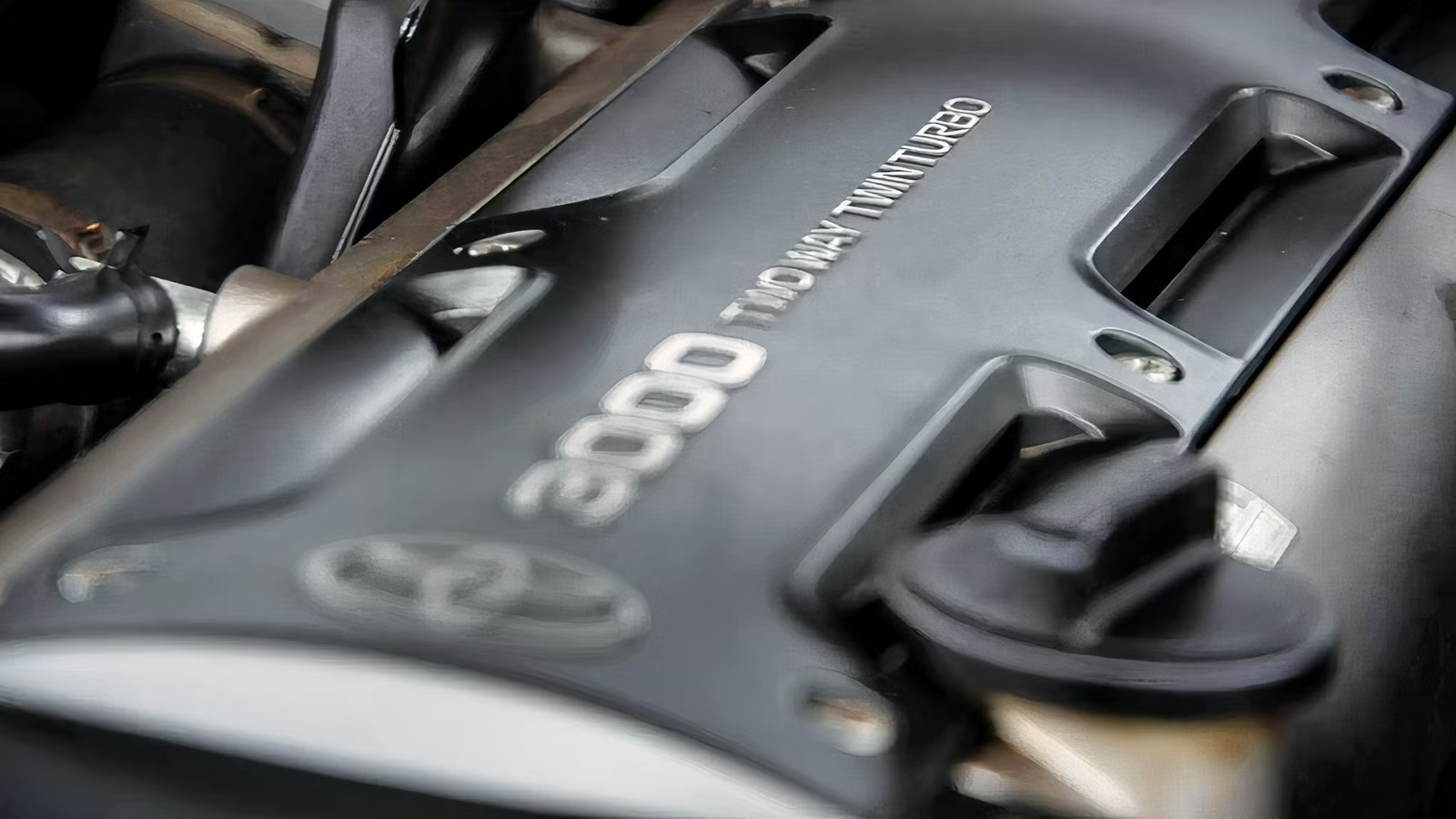
Toyota’s 2JZ-GTE was a 183ci twin-turbo inline-six best known in North America for powering the fourth-generation Toyota Supra Turbo. Japanese versions were rated at 280 PS under the Gentlemen’s Agreement, while the U.S.-market Mk4 Supra Turbo carried a healthier 320 hp rating. The famous 276 hp figure therefore belongs specifically to the JDM version, not every 2JZ-GTE sold around the world.
Underneath, the engine reads like Toyota expected someone to start an argument. The cast-iron block uses a closed, solid-deck design that gives the cylinders substantial support under boost. Seven main bearings secure a forged-steel crankshaft, while piston oil squirters help control temperatures when the engine is working hard. Its 3.39-inch bore and 3.39-inch stroke create a square design that also contributes to the 2JZ-GTE’s distinctive character.
Those choices explain the 2JZ’s reputation for 700 hp builds far better than internet folklore does. With a larger turbo, adequate fuel supply, improved intercooling, suitable engine management, and a careful tune, the stock Toyota 2JZ-GTE bottom end can operate around that territory without immediately requiring forged replacement internals. That kind of headroom is extraordinary for a production engine whose Japanese rating started at roughly 276 hp.
There are limits, and this is where the ‘all forged internals’ myth needs to leave the garage. The factory pistons are cast aluminum, so they become a significant concern as horsepower and cylinder pressure climb. The stock rods and forged crank are famously stout, but once power pushes beyond roughly 700 to 800 hp, sensible 2JZ builds start treating the untouched factory bottom end with more respect and less misplaced confidence.
Toyota Built Another Forever Six For The Opposite Job

The 2JZ looks less like a one-off accident when another Toyota inline-six enters the conversation. The 1HZ diesel pursued a completely different mission with a surprisingly familiar attitude toward durability. This roughly 254ci naturally aspirated six-cylinder engine used heavy iron construction, seven main bearings, and mechanical fuel injection without relying on an ECU to control the process.
Its 129 hp and 210 lb-ft sound almost comically modest next to a modified Toyota Supra, but the 1HZ was built for longevity rather than horsepower. Properly maintained examples are known to cross roughly 310,000 miles without a major rebuild. Mechanical injection also made remote servicing much simpler, an advantage in markets where reliability mattered more than outright performance or sophisticated electronics.
Different Way Of Thinking

Seen together, the 2JZ-GTE and 1HZ show two sides of old-school Toyota engineering. The 2JZ could absorb dramatically more boost because its core architecture carried enormous reserve strength, while the 1HZ turned similar conservatism toward service life and mechanical simplicity. One became a hero of American tuner culture, and the other built its reputation far from the drag strip.
Neither engine proves Toyota followed a universal formula that every powertrain should survive twice its rated output. What they do show is how comfortable the company once was engineering well beyond the minimum requirement. In today’s automotive industry, that kind of margin tends to attract plenty of questions before enthusiasts ever get to enjoy it.
The Spreadsheet Finally Beat The Iron Block

This philosophy didn’t disappear because engineers forgot how to make durable engines. It’s just that the priorities surrounding them changed. The Toyota 2JZ-GTE weighs about 507 pounds, helped along by that substantial cast-iron block, and modern powertrains face constant pressure to reduce mass while improving fuel economy and emissions performance. Great for tuners, less charming when somebody has to calculate fleet-wide efficiency.
It’s even rougher for the 1HZ. Its mechanical injection and basic controls are attractive for reliability and repairability, but that old-school diesel architecture can’t satisfy Euro 4 or later emissions requirements. Modern engines rely on far tighter electronic control over fueling and combustion, which improves emissions performance while adding layers of complexity that older Toyota engines simply didn’t need.
Massively Popular

That shift also explains why the Toyota 2JZ-GTE feels so special in modern American car culture. Aluminum blocks, turbo downsizing, direct injection, and increasingly complex electronics now dominate high-performance powertrains. None of those technologies automatically makes an engine fragile, but they reflect a different set of engineering priorities than the brute structural reserve that helped turn the 2JZ into one of the most famous Japanese engines ever sold in the USA.
More than three decades later, the numbers still explain the obsession. All in, Japan may have capped the figure everyone could read, but Toyota built enough strength underneath it that American Supra tuners eventually brought all the fun to the table.
Sources: ProjectJDM, JDPower, Repairpal.

Related posts


Latest Post


No Comments