
How Ford Is Combatting Its EcoBoost Engine Failure Problem
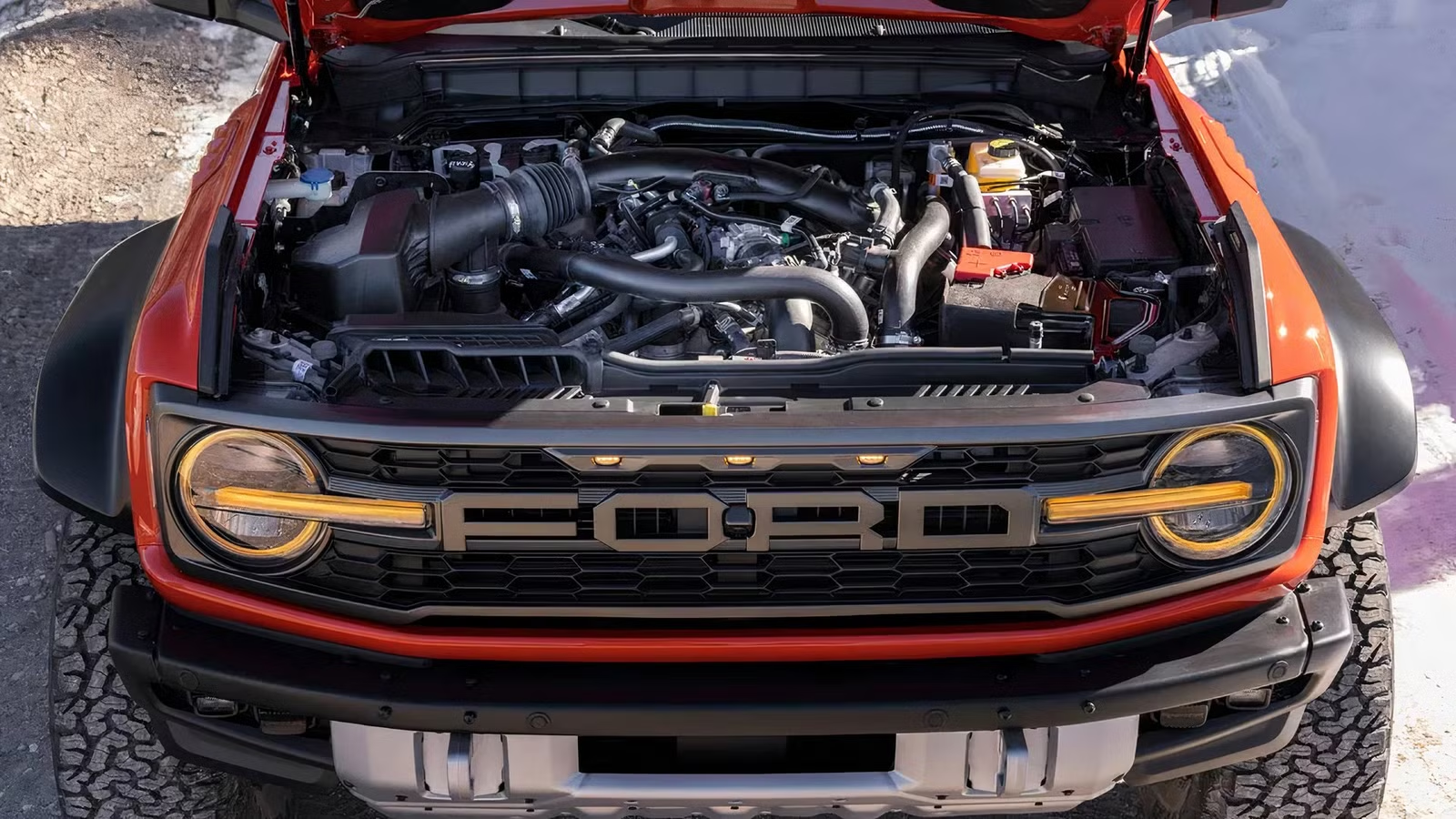
Engine trouble has a way of making even the most seasoned driver’s stomach drop. A warning light flickers on the dash, an unfamiliar sound rises from somewhere beneath the hood, or — worst case — the car simply stops dead. Most of the time, diligent maintenance keeps those moments at bay. But occasionally, a fault slips through that no amount of oil changes or tire rotations could prevent: a factory defect serious enough to trigger a federal recall. That’s exactly the situation facing a significant number of Ford and Lincoln owners right now.

The recall centers on Ford models equipped with the 2.7-liter or 3.0-liter EcoBoost V-6. Tens of thousands of vehicles — including the Ford Bronco and the Ford F-150 — are potentially affected, along with a number of luxurious Lincoln models that carry these engines.
Drawing on information from Ford, the NHTSA, and other authoritative sources, we’ve put together everything you need to know about the Ford EcoBoost intake valve failure and recall: what’s causing it, how to check whether your vehicle is included, and what Ford is doing to make it right.
The Problems And Recalls For The Ford EcoBoost Engine

The recall affecting Ford’s EcoBoost engine family has stirred serious concerns among owners of vehicles powered by the 2.7-liter and 3.0-liter variants. These engines are well regarded for their blend of power and efficiency, which makes the critical issue identified by the NHTSA all the more alarming.
The recall specifically affects certain Ford and Lincoln models that may be at risk of catastrophic engine failure due to a defect in the intake valves. Ford determined that the affected intake valves were manufactured using an alloy called Silchrome Lite, which can crack and fracture under excessive heat, potentially leading to catastrophic engine failure. Ford revised its production process in October 2021, switching to a tougher alloy called Silchrome 1. Ford also established that these failures tend to occur early in an engine’s service life, meaning that vehicles likely to fail have, in most cases, already done so.
The intake valve plays a crucial role in controlling the mixture of air and fuel entering the engine’s cylinders. The problems that a cracked or faulty intake valve on your EcoBoost engine may cause include:
- Engine Misfires and Stalling. When the intake valve is cracked, it disrupts the proper air and fuel mixture, which can cause the engine to misfire. In some cases, you may notice rough idling or even unexpected stalling, which is particularly dangerous if you are out on the road.
- Power Loss. A cracked intake valve can also trigger a sudden loss of power. This is a concern for all affected drivers, but owners of vehicles like the F-150 and the Bronco — which are frequently used for towing — may find it especially worrying.
- Complete Engine Failure. In severe cases, a cracked intake valve can lead to catastrophic engine failure. If enough air leaks through the valve, it could cause the engine to overheat, seize, or fail entirely.
The Ford And Lincoln Models That Are Affected By The Failing EcoBoost

There are potentially 90,736 vehicles affected by the Ford EcoBoost intake valve failure, though it is important to note that this concerns only 2021 and 2022 model-year vehicles fitted with either the 2.7-liter twin-turbocharged EcoBoost V-6 or the 3.0-liter turbocharged EcoBoost V-6.
The models affected by the EcoBoost recall are:
- 2021-2022 Ford F-150. Trims such as the Ford F-150 XL, XLT, and Lariat are all available with the 325-horsepower 2.7-liter EcoBoost V-6.
- 2021-2022 Ford Bronco. Both the Ford Bronco Wildtrak and First Edition come equipped with the 330-horsepower 2.7-liter EcoBoost V-6.
- 2021-2022 Ford Explorer. Ford Explorer trims like the ST, King Ranch, and Platinum all feature the 400-horsepower 3.0-liter EcoBoost V-6.
- 2021-2022 Ford Edge. The top-of-the-range Ford Edge ST boasts a 325-horsepower 2.7-liter EcoBoost engine.
- 2021-2022 Lincoln Aviator. All trims of the 2021 Lincoln Aviator, the base trim, Reserve, Grand Touring, and Black Label, all boast the 3.0-liter EcoBoost V-6.
- 2021-2022 Lincoln Nautilus. The top-tier 2021 and 2022 Lincoln Nautilus Black Label features a 335-horsepower 2.7-liter EcoBoost V-6.
Models affected don’t include the Bronco Raptor or the F-150 Raptor, as the change of materials used to produce the intake valves appears to have resolved this issue before the later release of these high-performance models.
Ford Is Now Offering You A Free Extended Warranty For Peace Of Mind

Originally, the engine failures were thought to stem from a faulty valvetrain, but a report released by the NHTSA and the ODI (Office of Defects Investigation) confirmed that the intake valve was the root cause of the problems.
The affected vehicles were built between May 2021 and October 2021, a period during which production volumes increased for both Ford and the supplier manufacturing the intake valves. Ford initiated the preliminary investigation into the engine failures, after which the NHTSA launched its own probe — one that ran for two years before concluding.
Investigators found that there were thankfully no reported fatalities or injuries linked to the engine failures. Ford had not implemented any field action for vehicles built during the critical 2021 window, but has since moved to address this by offering a 10-year/150,000-mile extended warranty covering all potentially affected vehicles.
The probe into the faulty EcoBoost engines has now been closed by the NHTSA, but it is still worth checking to see if your vehicle is affected.
How To Check If Your Ford EcoBoost Is Affected By Failures
Ford and Lincoln have likely reached out directly if your vehicle is among those affected by the recall, but if you want to confirm for yourself that you’re not driving an SUV or pickup with a potentially compromised engine, here are the steps to take.
- Check Recall Status. Visit the NHTSA website and navigate to the ‘Recalls’ page, where you can enter your vehicle’s VIN, year, make and model, or license plate to confirm whether a recall applies. Your VIN can be found on your vehicle’s paperwork or, most commonly, on the dashboard near the windshield on the driver’s side.
- Contact Ford or Lincoln Customer Services. We all know it is not the most enjoyable way to spend a chunk of the day, but the Ford and Lincoln support teams are on hand to answer any questions you have about the recall.
- Check Your Documents And Keep Records of Inspections And Repairs. By doing this, when you have any questions for Ford or Lincoln, it will make life a lot easier when trying to ascertain if your vehicle is affected by the recall.
What To Do If Your Vehicle Is Part Of The Huge List Of Potentially Affected Vehicles
If you discover that your vehicle is affected, arrange for an inspection or repair at an authorized Ford or Lincoln dealership as soon as possible. If you’d rather not drive it beforehand, limit use to only what’s absolutely necessary. Ford advises owners to monitor for any signs of trouble caused by the faulty intake valve, even at idle.
Watch for rough idling, unusual engine sounds, loss of power, and stalling. If your vehicle is exhibiting any of these symptoms and you believe it may fall within the recall, contact Ford or Lincoln immediately to schedule an intake valve inspection.
Contact your local authorized Ford or Lincoln dealer to schedule an inspection. Ford is covering the cost of these inspections, which involve a detailed examination of the intake valves and related engine components. Booking an appointment promptly means you won’t be left waiting to find out whether your engine is at risk — and avoids the far longer wait that could follow a catastrophic failure requiring a full engine replacement.
If you find out that your vehicle is one of the thousands that are affected by the recall but still need to drive before your inspection, do it very cautiously without pushing the RPMs high, avoid faster roads, and only do it when necessary. It is best not to use the vehicle at all though.
Even though the NHTSA investigation has concluded, you can stay informed about any further recalls by signing up for recall alerts from the NHTSA and Ford, just in case there are additional developments.
What Ford Plans To Do About The EcoBoost Failures
Beyond the extended warranty, Ford has a comprehensive plan in place to address the EcoBoost intake valve issue. If your vehicle is on the recall list, Ford and Lincoln are committed to either confirming your engine’s safety or fixing the problem at no cost to you.
- Thorough Valve Inspections. Authorized Ford and Lincoln dealerships will perform a comprehensive inspection of the intake valves in all affected 2.7-liter and 3.0-liter EcoBoost engines. Technicians will assess the valves for signs of cracking or wear, using specialized diagnostic tools to check valve function and inspect for any irregularities that could lead to problems. These inspections will come at no cost to you.
- Component Replacement. If technicians find any signs of wear, cracking, or failure in the intake valves, Ford will replace the affected components. Ford’s protocol ensures that only certified parts are used to maintain engine integrity and prevent future failures. This replacement process may also include adjustments to nearby engine components to restore performance.
- Preventative Maintenance Adjustments. As part of the inspection, technicians will review and adjust engine settings or perform maintenance to re-optimize the performance of your EcoBoost engine.
- Performance Testing After Repairs. After completing any necessary repairs, Ford and Lincoln dealerships will conduct a thorough test of your engine’s performance. This final stage ensures that your EcoBoost operates as it should, with no lingering issues.
Ford’s Reliability Reputation At Stake

Ford’s reliability record has been a mixed picture in recent years. The J.D. Power Initial Quality Study recorded Ford models at 167 problems per 100 vehicles (PP100) in 2022. That figure climbed to 249 PP100 in 2023 before improving significantly, with the most recent study placing Ford at 179 PP100 — comfortably below the market average of 195 PP100.
Even so, Ford continues to trail brands like the by-words for vehicle reliability, Honda and Toyota, and also lags behind its closest domestic rival GM, whose Chevrolet and Buick brands post strong PP100 scores of 160 and 164 respectively.
Ford Reliability Score: 3.5/5
While the latest recall may rattle some nerves, it’s worth keeping perspective: Ford’s overall reliability sits above the industry average of 3 out of 5, with RepairPal awarding the brand a score of 3.5 out of 5. RepairPal estimates average annual maintenance costs at $775, which is higher than the market average of $652. The likelihood of a repair being severe is 15 percent versus the market average of 13 percent, though unscheduled shop visits average just 0.3 times per year, compared to the market average of 0.4.
According to CarEdge, the five-year cost of owning a Ford from new — factoring in maintenance, fuel, insurance, loan repayments, and depreciation — works out to $54,251. That figure undercuts comparable ownership costs for Chevrolet and Cadillac, though it runs higher than Buick or Toyota.
|
Brand |
Ford |
Toyota |
Buick |
Chevrolet |
Cadillac |
|
5-Year Cost To Own |
$54,251 |
$48,881 |
$53,618 |
$56,837 |
$75,445 |
The Future Of Ford Reliability
Problems-per-100-vehicles rates have been climbing across the entire industry in recent years: 121 PP100 in 2021, 180 in 2022, 186 in 2023, and 195 in the most recent study. Much of the increase has been attributed to the rapid growth of EV production, where components rely on newer and sometimes more complex technology. Ford’s recent improvement in PP100 — even accounting for its expanding EV lineup — offers some genuine cause for optimism.
“It is not surprising that the introduction of new technology has challenged manufacturers to maintain vehicle quality. However, the industry can take solace in the fact that some problem areas such as voice recognition and parking cameras are seen as less problematic now than they were a year ago.”
– Frank Hadley, Senior Director of Auto Benchmarking at J.D. Power
The recall underscores the challenges that come with scaling production, though Ford’s response to the issue should offer some reassurance to its owners. By covering inspection costs, providing free repairs, and extending warranties, the company has demonstrated a commitment to customer trust and a transparent approach to quality concerns. The recall may also prompt Ford to invest further in preventative measures — enhanced testing protocols, stricter parts standards, and more thorough engineering reviews.
Looking ahead, Ford’s growing EV and hybrid lineup — which includes models like the Ford F-150 Lightning — will demand even higher reliability standards as new technologies are integrated into hard-working vehicles. Ford’s ability to proactively identify and resolve issues through rigorous testing and durable engineering will be central to its long-term reputation, particularly as the market places ever-greater emphasis on lasting quality. The hope is that PP100 figures for Ford models continue to trend downward despite the mounting challenges ahead.
Sources: NHTSA, Hagerty, J.D. Power, CarEdge, RepairPal, and USA Today.

Related posts

Latest Post


No Comments