
Honda’s One-Year V4 Bagger Was Too Smooth And Too Quiet For Cruiser Buyers
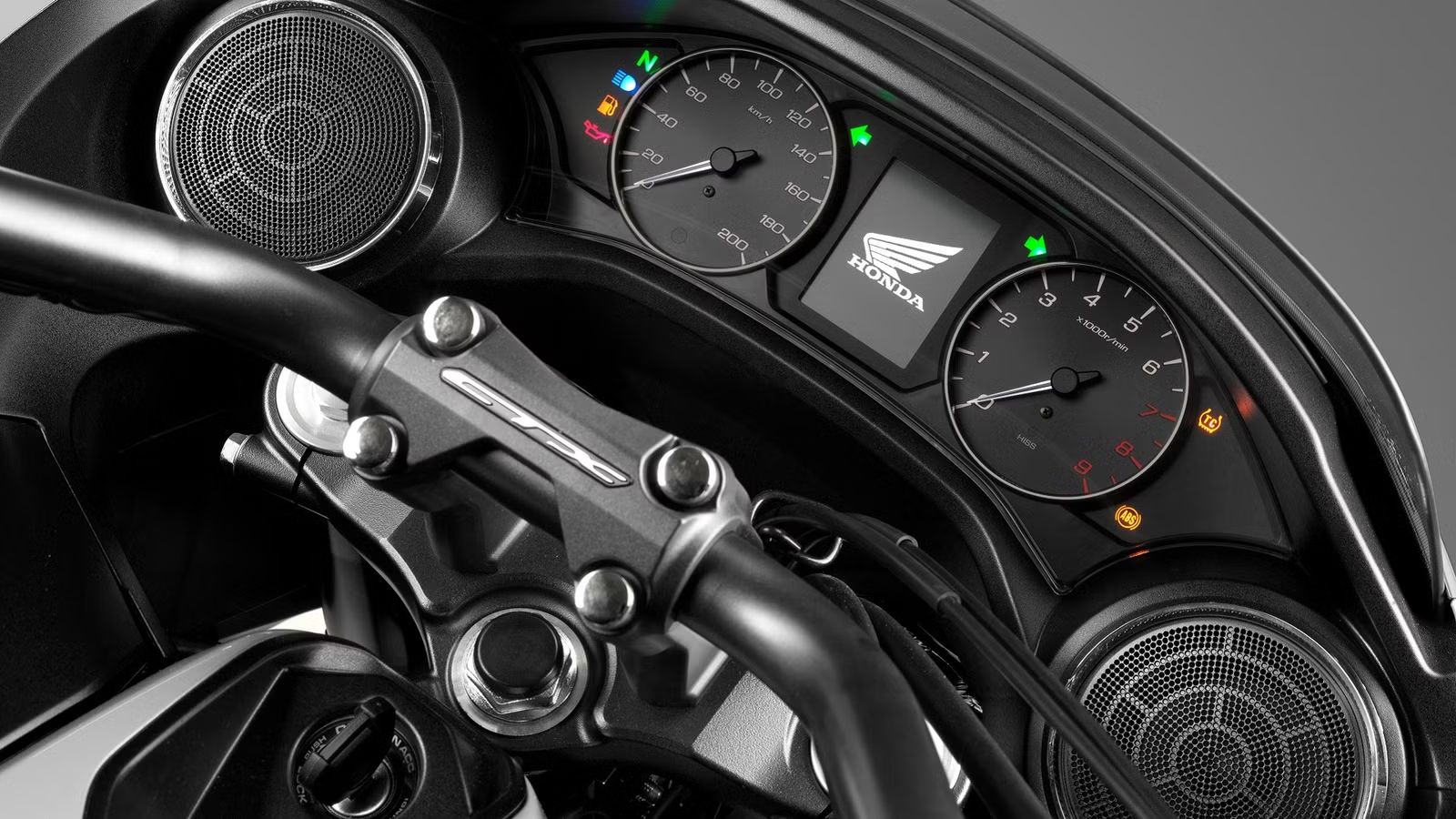
Some motorcycles fail because they are slow, uncomfortable, unreliable, or simply unpleasant to ride. Others, as weird as it sounds, face a stranger problem: they work almost too well for the people they were built to attract. In the early 2010s, Honda created a heavyweight touring cruiser with clever weight distribution, built-in luggage, modern electronics, relaxed ergonomics, and one of the smoothest large engines in the business. On paper, it fixed plenty of traditional cruiser complaints, but in practice, it also removed some of the roughness, noise, and theater that made those motorcycles desirable in the first place.
Honda Thought The Modern Cruiser Needed Fewer Rough Edges

The big-cruiser market of the early 2010s still traded heavily on personality. Harley-Davidson sat near the center of that world, and horsepower figures explained only a small part of its appeal. Riders bought the slow pulse of a big V-twin, the exhaust beat, the familiar silhouette, the acres of metal, and a brand identity that stretched far beyond the motorcycle itself. Even Harley’s heavily updated 2014 touring range kept those recognizable ingredients while adding better brakes, infotainment, cooling, and other modern conveniences. A Road King started at $18,249, while a Street Glide started at $20,399. Buyers spending that kind of money expected an experience as much as transportation.
Honda looked at essentially the same customer problem and arrived at a very Honda answer. Instead of building another imitation of the Milwaukee formula, its engineers focused on making a large cruiser-tourer easier to live with. Honda’s CTX philosophy literally stood for “Comfort Technology eXperience,” and the company described its goal as combining cruising style with real-world usefulness for riders who wanted more performance and equipment than a traditional air-cooled V-twin bagger offered. The brief favored a low seat, relaxed ergonomics, predictable response, luggage capacity, and less drama when maneuvering a very large motorcycle.
In general, that bike would treat comfort as an engineering job rather than something achieved by bolting on a sofa-sized seat. There was logic behind every decision. There was also a small problem waiting at the end of that logic: cruiser buyers do not always shop with logic wearing the helmet.

Honda Hid A Sport-Tourer’s Engineering Inside A Cruiser Shape

Honda‘s engine choice showed just how far it planned to stray from convention. A big air-cooled V-twin would have made sense – Honda had built plenty of V-twin cruisers before – but instead, the company went digging through its sport-touring parts bin and pulled out a liquid-cooled engine with four cylinders, double overhead cams, fuel injection, and the kind of smoothness that usually belonged behind a tall windshield on a European highway. The manufacturer then changed the engine’s character rather than simply transplanting it untouched.
New camshafts, altered valve timing, different valves, smaller throttle bodies, lower compression, and revised fuel mapping shifted the emphasis away from high-rpm horsepower. Peak output moved down the rev range, and the engine delivered a broad, easy spread of torque instead. The reduction in compression also brought an unexpectedly practical bonus: the motor could drink regular-grade gasoline. Honda had effectively taken a fast sport-touring engine and told it to stop showing off at dinner.
The chassis received the same treatment. Honda placed the fuel beneath the seat rather than high behind the handlebars, which pulled a significant moving load closer to the ground as the tank filled and emptied. Engineers also spent time on the airflow around the integrated panniers so the bags would not upset stability at speed. Even the basic concept reportedly grew from a striking styling sketch whose exposed-looking V4 cylinder heads and four exhaust headers pushed engineers toward that engine layout. The result looked like a cruiser, a bagger, and a spaceship arguing over the same parking space.
The Honda CTX1300 Put A Detuned V4 In A 700-Pound Bagger

That motorcycle was the 2014 Honda CTX1300, one of the strangest large Hondas of its decade. Its 1,261cc liquid-cooled, longitudinal 90-degree V4 came from the ST1300 sport-tourer, but the company rewrote its personality. In European specification, Honda rated the CTX engine at about 83 horsepower at 6,000 rpm and 78 lb-ft of torque at 4,500 rpm. The ST version made roughly 115-118 horsepower at 8,000 rpm and peaked much higher in the rev range. Honda sacrificed a large chunk of top-end output so the CTX could make its useful shove earlier. A period dyno test found 75.6 horsepower at the rear wheel and more than 65 lb-ft of torque from roughly 2,900 to 6,000 rpm.
That broad spread was a big part of the bike’s personality. Simply put, a rider did not have to chase revs or constantly search for the perfect gear – twist the throttle, let the V4 pull, and continue down the road. Honda kept a conventional five-speed manual transmission and shaft final drive, too. Despite the rise of Honda’s Dual Clutch Transmission elsewhere in the range, the CTX1300 never received DCT. The smaller CTX700 family provided the automatic option instead.
Then there was the mass. Early U.S. launch figures quoted about 724 pounds for the standard bike and 731 pounds for the Deluxe. Nobody could accuse the CTX1300 of skipping leg day, yet the weight figure only told half the story. The underseat fuel tank lowered the center of gravity, while the seat sat roughly 29 inches from the pavement. Period testers repeatedly noted how manageable the bike felt once moving and how easily shorter riders could plant their feet at a stop. Swept-back handlebars, a long wheelbase, and relaxed seating completed the cruiser posture.

Honda also packed a surprising amount of equipment into the Deluxe. It added ABS, traction control, self-canceling turn signals, blacked-out trim, and a Bluetooth-compatible audio system to the standard bike’s integrated hard luggage and LED lighting. The audio system could play music through USB or Bluetooth, though it did without a conventional AM/FM radio. Honda’s own engineers even treated the lighting, heated-grip availability, panniers, and connectivity as parts of the comfort concept rather than unrelated gadgets.
The price reflected that ambition. The standard CTX1300 cost $15,999 in the United States, and the Deluxe reached $17,499. That put the premium Honda only $750 below a 2014 Harley-Davidson Road King before options.
And there sat the CTX1300’s great paradox. The V4 behaved beautifully – it delivered power in a straight, predictable line, it barely vibrated and remained calm around town. Its dual exhausts could produce some sound when asked, but the engine never thumped through the chassis like a big traditional V-twin. Period comparisons described the Honda powertrain as almost automotive in character and noted that a rider could barely tell the engine was running without hearing it. Honda had taken an engine famous for turbine-like operation and taught it cruiser manners. It had not, and probably could not, teach that V4 to impersonate two enormous cylinders firing beneath a fuel tank.
The CTX1300 Solved Problems Cruiser Buyers Didn’t Necessarily Want Solved

As a motorcycle, the CTX1300 did plenty right. Period testers praised its stability, comfort, easy steering, broad torque delivery, slick gearbox, and surprisingly manageable behavior for something weighing well over 700 pounds. There was enough ground clearance and chassis competence to give the bike a hint of sporting ability, and many highlighted the low center of gravity and friendly low seat. It could commute, cover highway miles, carry luggage, and still handle a twisting road without behaving like a refrigerator pushed down a staircase. Those were meaningful achievements.
The trouble appeared when the CTX1300 had to explain what it actually was. Its sweeping bodywork and low stance looked too futuristic for buyers who wanted traditional cruiser cues. Sport-touring riders looking for a spiritual replacement for the ST1300 saw less horsepower, less wind protection, cruiser ergonomics, and only five gears. Bagger shoppers, in turn, encountered a quiet V4 and space-age bodywork instead of an exposed V-twin and familiar American lines. At $17,499 for the Deluxe, Honda also could not rely on bargain pricing to make the oddness easier to swallow. A buyer could spend another $750 and start with a Road King, complete with Harley’s established touring identity, air-cooled High Output Twin Cam 103, hard bags, and decades of visual continuity.

Most importantly, Honda’s greatest engineering success doubled as a sales challenge. The V4 minimized vibration, flattened the power delivery, and removed much of the mechanical theater. Those traits made perfect sense for a long-distance machine, but they made less sense in a category where riders often treated sound, pulse, and engine feel as features. The CTX1300’s argument amounted to: this motorcycle works extremely well. Traditional baggers made a more emotional pitch: this motorcycle looks and feels like the thing hanging on the garage wall of a rider’s imagination.
In the United States, the CTX1300 effectively vanished after its 2014 model-year debut. That doesn’t mean that Honda built it for only one year everywhere, however – the manufacturer still listed the CTX1300 among motorcycles entering the Taiwanese market in April 2015, and other regional lineups kept it around longer.
The Rebel 1100 Showed Honda What The CTX1300 Was Missing

Years later, the Honda Rebel 1100 offered a useful contrast. There is no need to invent a direct development line between the two motorcycles, but the important connection lies in product philosophy. The Rebel started with a shape riders already understood: low seat, exposed frame, compact body, simple cruiser stance. Honda then slipped unconventional hardware underneath it. Its 1,084cc parallel twin came from the Africa Twin, hardly the obvious donor for a cruiser. Honda changed its cam profiles, mapping, and flywheel to give the engine more pulse, then added ride modes, traction control, ride-by-wire electronics, and an optional DCT.
The difference was where Honda asked the customer to compromise. The CTX1300 asked buyers to accept a whole new visual category, a V4 without traditional cruiser throb, sport-tourer ancestry, futuristic bodywork, and premium pricing all at once. The Rebel 1100 later gave riders a familiar cruiser foundation first, then introduced the unusual engineering. Even its Africa Twin-derived twin received a 20-percent-heavier flywheel and engine changes intended to create more deliberate power pulses. The electronics supported the motorcycle instead of becoming the motorcycle’s main reason for existing. DCT buyers could have an automatic; traditionalists could order a six-speed manual. The technology hid behind an easy-to-read idea.

That makes the CTX1300 more interesting now than it looked when dealers had new ones on the floor. Honda anticipated ideas that became increasingly common later: putting fuel low in the chassis, using electronics to make large motorcycles easier to manage, adapting engines from completely different categories, integrating luggage into the body, and treating low-speed confidence as seriously as highway performance. It simply wrapped all those ideas in a machine that asked cruiser buyers to abandon too many familiar signals at once. Engineering excellence and market fit do not always arrive in the same saddlebag, and the CTX1300 proved that in one short U.S. model year.
Source: Honda, Harley-Davidson, Cycle-World

Related posts

Latest Post


No Comments