
Harley Once Built a Two-Stroke Motocross Bike That Lasted One Year
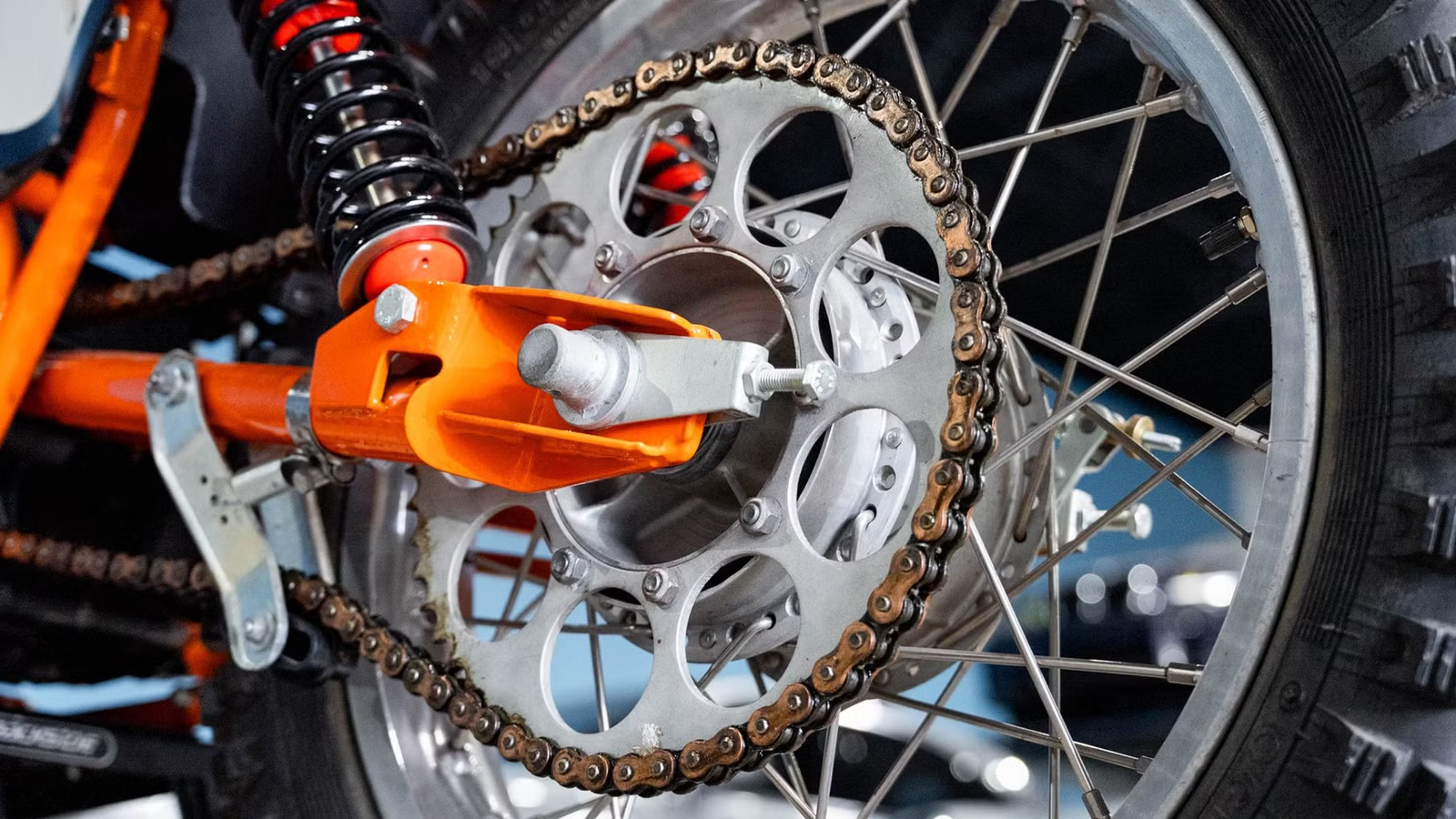
Few challenges are more difficult for an established motorcycle manufacturer than convincing buyers it belongs in a completely different segment. While expanding into new markets can attract fresh customers, success depends on far more than engineering a competitive machine.

History has repeatedly shown that some of these ambitious projects become spectacular commercial failures, only to earn cult status decades later as collectors recognize their rarity and significance. That raises an intriguing question: why do enthusiasts celebrate motorcycles today that buyers overwhelmingly rejected when they first reached showroom floors?
The Risky Gamble Legacy Brands Keep Making
Few motorcycle manufacturers can rely on brand recognition as heavily as companies with decades of heritage, yet that same legacy can become a disadvantage when venturing into unfamiliar territory. Harley-Davidson has repeatedly looked beyond its traditional cruiser market, while Ducati successfully broadened its appeal with models like the Scrambler, proving that even the most established brands must evolve to attract new generations of riders.

However, entering a new segment requires far more than engineering a capable motorcycle. Buyers in specialist categories often value years of racing pedigree, proven performance, and a reputation built specifically within that discipline. Without that credibility, even a famous badge can struggle to win over enthusiasts who already trust manufacturers that have spent decades refining their expertise and earning customer loyalty.
Harley-Davidson Wanted A Piece Of The 1970s Motocross Boom

By the mid-1970s, motocross had become one of motorcycling’s fastest growing segments, attracting younger riders with lightweight machines, competitive racing, and a rapidly expanding aftermarket. Harley-Davidson, whose reputation was built on heavyweight V-twins and highway cruising, recognized that it risked missing an entire generation of enthusiasts if it stayed within its traditional comfort zone.
During the AMF (American Machine and Foundry) era, the company already had an established corporate relationship with Aermacchi (an Italian manufacturing company), giving it access to the engineering expertise needed to pursue a purpose-built off-road motorcycle without starting from scratch.
The move represented Harley’s most ambitious attempt to compete in a market dominated by specialist manufacturers, signaling that the company wanted to prove it could build far more than large displacement road bikes, even if earning credibility among dedicated motocross riders would prove far more difficult.
Harley’s First Motocross Bike Arrived With Serious Expectations

When the Harley-Davidson MX250 debuted for the 1978 model year, it represented the company’s boldest attempt yet to establish itself in the booming motocross market. Rather than simply adding another motorcycle to its lineup, Harley hoped the MX250 would introduce an entirely new generation of riders to the brand while proving it could compete against established off-road specialists.
Power came from a 243-cc air-cooled two-stroke single-cylinder engine producing a claimed 32.4 bhp, figures that looked competitive on paper for the era. The motorcycle carried an original MSRP of $1,695, placing it within reach of serious amateur racers and enthusiasts looking for a purpose-built motocross machine. Unfortunately for Harley-Davidson, respectable specifications alone would not be enough to overcome the challenges waiting beyond the showroom floor.
The MX250 Failed Because It Could Not Satisfy Anyone

The Harley-Davidson MX250 faced an uphill battle long before riders had the chance to test its performance. Harley’s traditional customers visited dealerships looking for heavyweight cruisers and touring motorcycles, not lightweight two-stroke motocross machines. At the same time, experienced motocross riders rarely considered Harley-Davidson dealers when shopping for a competition bike, instead gravitating toward brands with established off-road reputations and dedicated dealer networks.
According to former industry insiders, Harley compounded the problem by allocating the MX250 to dealerships regardless of local demand, leaving many retailers with motorcycles they struggled to sell. The result was a product that failed to connect with either audience. Without support from Harley loyalists or acceptance from the motocross community, the MX250 became an awkward fit that never had a realistic opportunity to achieve meaningful commercial success.
Harley’s Motocross Dream Was Undone By Performance Problems

Even if Harley-Davidson had found the right audience for the MX250, the motorcycle itself struggled to justify the company’s ambitions. While its engine produced an impressive 32.4 bhp on paper, riders quickly discovered a power delivery that was difficult to exploit.
Contemporary reports described the engine as gutless below 7,000 rpm before becoming difficult to control as it approached its upper rev range. The motorcycle was also criticized for a grabby clutch and serious reliability concerns that damaged confidence among potential buyers.
Factory rider Rex Staten later recalled that early test bikes suffered failures after only around 20 minutes of use, highlighting the severity of the development challenges Harley faced. For a company trying to establish credibility in motocross, these shortcomings proved impossible to ignore.
The Racing Team Proved Harley Had Potential, But Not A Solution

Despite the MX250’s problems as a production motorcycle, Harley-Davidson’s factory racing efforts showed that the company’s motocross ambitions were not entirely without merit. Professional riders including Rex Staten and Marty Tripes were brought in to develop and race the machines, achieving respectable results against established competitors.
The factory effort even produced a podium finish at Unadilla with a modified 350-cc version, demonstrating that the basic concept had some potential when properly developed. However, success on the race circuit did not translate directly to showroom appeal. Factory motorcycles benefited from extensive modifications, specialist preparation, and professional input that were unavailable to ordinary customers.
The gap between the competitive race bikes and the production MX250 highlighted the biggest problem: Harley could create a faster machine for professionals, but it could not easily turn that into a motocross bike enthusiasts wanted to buy.
A Commercial Disaster Became One Of Harley’s Rarest Collectibles
The Harley-Davidson MX250 disappeared almost as quickly as it arrived, with production lasting only for the 1978 model year before the company abandoned the project. Estimates vary slightly, but most sources place total production at approximately 900 units, while Harley-Davidson has referenced figures of closer to 1,000 examples built.
The motorcycle’s failure in period has since become the very reason collectors value it today. With so few surviving examples, the MX250 has transformed from an overlooked mistake into one of Harley’s most unusual collector motorcycles, with average sales values reaching around $15,000 and exceptional restored examples commanding approximately $23,000. The story began even earlier with a limited prototype run of 65 hand-built motorcycles in 1975, making the MX250’s short history even more significant among Harley enthusiasts.
The MX250 Still Holds A Lesson For Modern Harley-Davidson

More than four decades later, the MX250 remains a reminder of the challenge facing heritage manufacturers when they enter unfamiliar segments. Harley-Davidson’s modern push into adventure touring with the Pan America shows that the company is still attempting to attract riders beyond its traditional cruiser audience.
Other historic brands have taken similar approaches, including Ducati with the Scrambler and Indian Motorcycle with the FTR, both expanding into categories beyond their original identities. Unlike the MX250, these newer products have benefited from improved market research, modern engineering, and stronger understanding of their target customers.
The underlying challenge remains unchanged. A famous badge can open the door, but it cannot guarantee acceptance. In the motorcycle world, authenticity cannot simply be engineered or purchased; customers must believe a brand truly belongs in a segment.
Sources: Cycleworld, Classic.com, BringATrailer, MotoCrossAction

Related posts



Latest Post


No Comments