
2008–2010 Dodge Viper: Buy Before Values Reverse
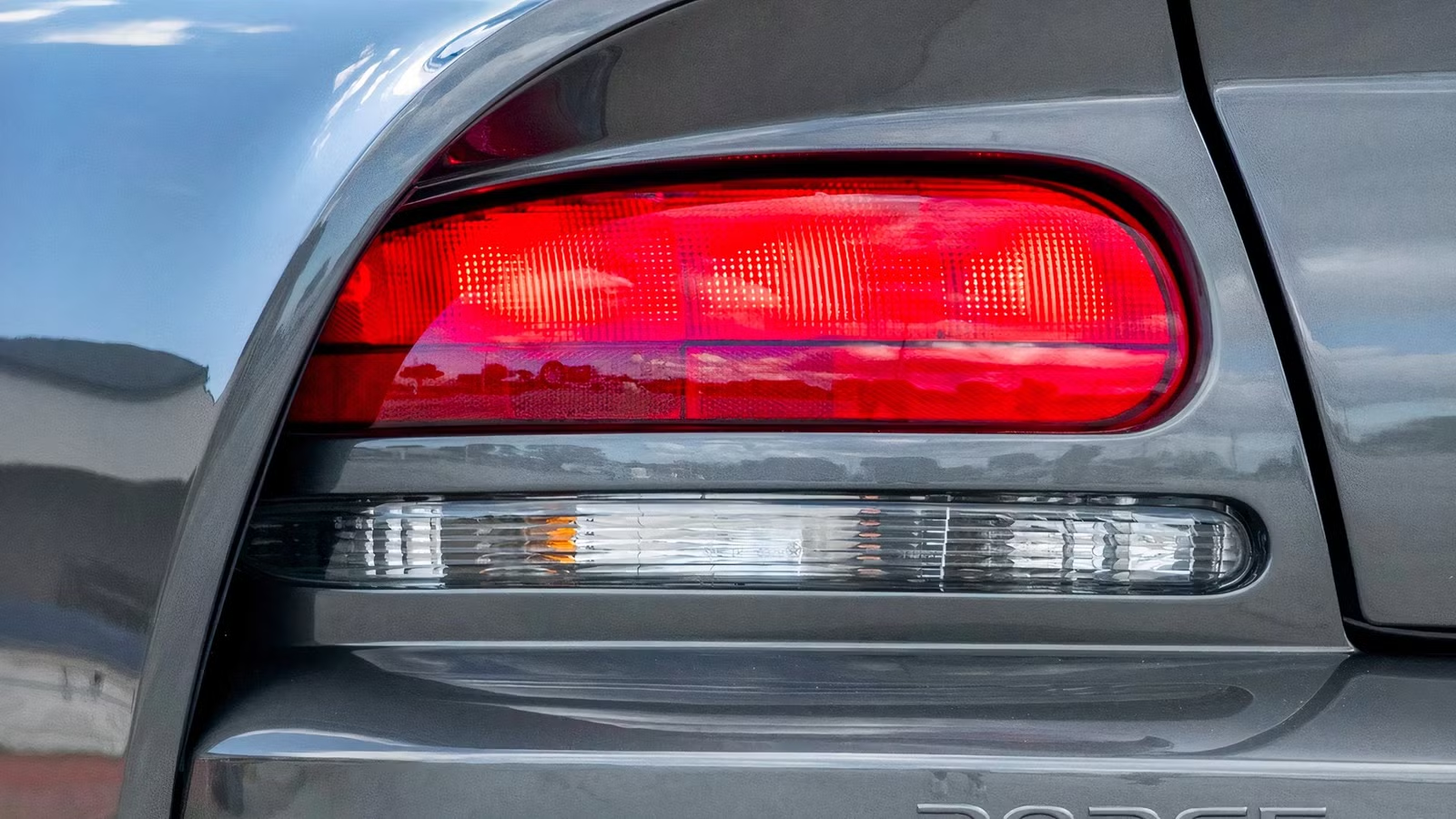
Depreciation, it’s a word that makes automotive enthusiasts and collectors alike tremble in their boots. More to the point, the rate at which a classic car’s value falls over time is very much a case-by-case affair. Better yet, it doesn’t always fall. Sometimes, depreciation stops, rebounds, and the value goes right back up again, seemingly without warning. Is it hard science, is it voodoo magic, or is it a combination of the two? Either way, there’s one American sports car on the used market deep in the throes of depreciation, but could be on the path back up pretty soon.
Sports Car Depreciation: A Strange, Unpredictable Phenomenon

Every motor vehicle, from the lowliest cheap hatchback to flagship hypercars, experiences some level of depreciation the second it rolls off the dealership lot, or the delivery truck. For an average new car, that initial drop when you leave the parking lot is at least ten percent off the MSRP. In the first year alone, expect that depreciation figure to hit anywhere from 15 to 20 percent. Rates stabilize a bit from year two to five, anywhere from eight to 12 percent on average. By the fifth year, assuming there’s no outstanding body or mechanical damage, the average new car will be worth somewhere around half of what it was when it was new.
Of course, these figures generally apply to normal, everyday gasoline cars. You know the kind, your average crossover SUVs, hatchbacks, and small economy sedans that make up the bulk of sales here in the US. Electric vehicles can depreciate far faster, namely because they tend to be priced so much higher than equivalent gas cars. Ditto for luxury cars, and for obvious reasons. It’s why you’ll often find common luxury barges once worth more than some people’s houses for sale on used car lots around five years post-production. Knowing this, one class of vehicle surprisingly resistant to depreciation, at least dependent on the brand, is sports cars.

To be clear, some sports cars, namely Italian ones, depreciate as quickly as they blitz down the highway. We’re looking at you, Maserati.And yet, continuous and ever-growing fan bases that desire certain sports cars can ironically insulate themselves against the worst of depreciation. More to the point, sports cars represent a segment of the market most resistant to modern electrification mandates. It makes one thing a certainty: semi-modern analog sports cars are in demand, which keeps prices relatively stable.

A Certain Type of Sports Car Holds Value Extremely Well

Speaking of electrification, hybrids, plug-ins, and cars of the future, it’s more apparent as each year passes that sports car buyers want something akin to the exact opposite. Never mind that Tesla finally announced the production-spec Roadster would be unveiled October 1st of this year. Why? Because the people most likely to buy a sports car appear to want the complete opposite of an EV.
They want big, bold cars with large naturally-aspirated engines. You know, the way all sports cars used to be built until the powers that be decided they were too unsafe and too environmentally problematic to remain in production. There’s a definite wow factor to these kinds of machines, ones with interiors barren of screens and ADAS systems and engine bays full of cubic displacement, not turbochargers and electric motors. It’s a type of vehicle that’s simply not allowed to exist anymore, and like anything you’re not supposed to own, that makes it more appealing to own out of spite.

If that’s the kind of car you want to own, there’s one sports car in particular that does it better than any other. It was a car built at a time when electric vehicles were just golf carts, a time when a computer was a laptop, or the ECU under your hood, not the entire centerpiece of the cabin. There’s no AI integration, no government-mandated tracking devices, and most of the time, no navigation system or much of anything that removes driver engagement from modern sports cars. It was just four wheels, a massive V10, a manual gearbox, and a place for two passengers to sit in the middle. Ironically, it’s one of the most resistant sports cars to depreciation on the market right now.
2008-2010 Dodge Viper: A Dinosaur You Can’t Help But Love

In a way, you can realistically make a similar argument for any generation of Viper up to and including the most recent Gen-V. Yet, while you can still find early SRI and SRII-series Vipers in the neighborhood of $50,000, a pristine example with numbers-matching parts can easily command six figures. Put simply, the earliest Vipers have successfully completed their depreciation freefall, rebounded upwards, and continued climbing through the late 2000s, the 2010s, and 2020s.
That’s not something you can claim about later generations, particularly fourth-generation ZB 2-series Vipers built between 2008 and 2010. Vipers of these years were even more extreme than earlier examples, with their 8.4-liter V10 producing 600 hp and 560 lb-ft of torque sent to the rear wheels alone. Paired with a Tremec six-speed manual gearbox, this was as close to an old-school sports car as you could get in the early 2010s. More hardcore than a C6 Corvette and more down-to-earth than a 997.2-series Porsche 911, this specific flavor of Viper undercut the competition when it was new, and even more so now that it’s getting up in years.

With middle-of-the-road mileage and in general lived-in condition, a Gen IV Viper can command anywhere from $63,000 to just over $100,000, according to aggregate websites like Hagerty. It’s still somewhat of a premium over the lowest point of an SRI and SRII Viper’s used value, but later 2008-2010 models are sitting at the trough of the depreciation J-curve. In effect, they’ve finally bottomed out in terms of losing value. Still, they haven’t reached an age where megafans who grew up with these cars when they were new can afford to buy them and boost said value into prohibitively expensive territory. In terms of the used market, these Vipers sit in an enviable position, a proverbial Goldilocks zone between affordable and desirable.
There May Never Be Another Like It

At the end of the day, every sports car bottoms out in value. The biggest difference between the others and a Gen-IV Viper is its dedication to the old school, its focus on the unhinged, and its unparalleled value for money. Yes, other sports cars are more refined, and most would argue a Viper isn’t a better car by any conventional standard. Even so, there’s an honesty in a car priced so far below its competitors, yet one that provides a thrill a more sophisticated car could never match.
Now that a car like the Viper can genuinely never be built again, at least without federal regulators breaking out the pitchforks, they’ll maintain a unique status in the community as the last bastion of an unhinged analog psycho machine. It’s a product of its time, a time when things felt simpler, and by most accounts, it really was a simpler time.
Sources: Hagerty, Kelley Blue Book

Related posts
Latest Post


No Comments