
Harley-Davidson Built A 98cc Two-Stroke Trail Bike In 1970 And Almost Nobody Remembers
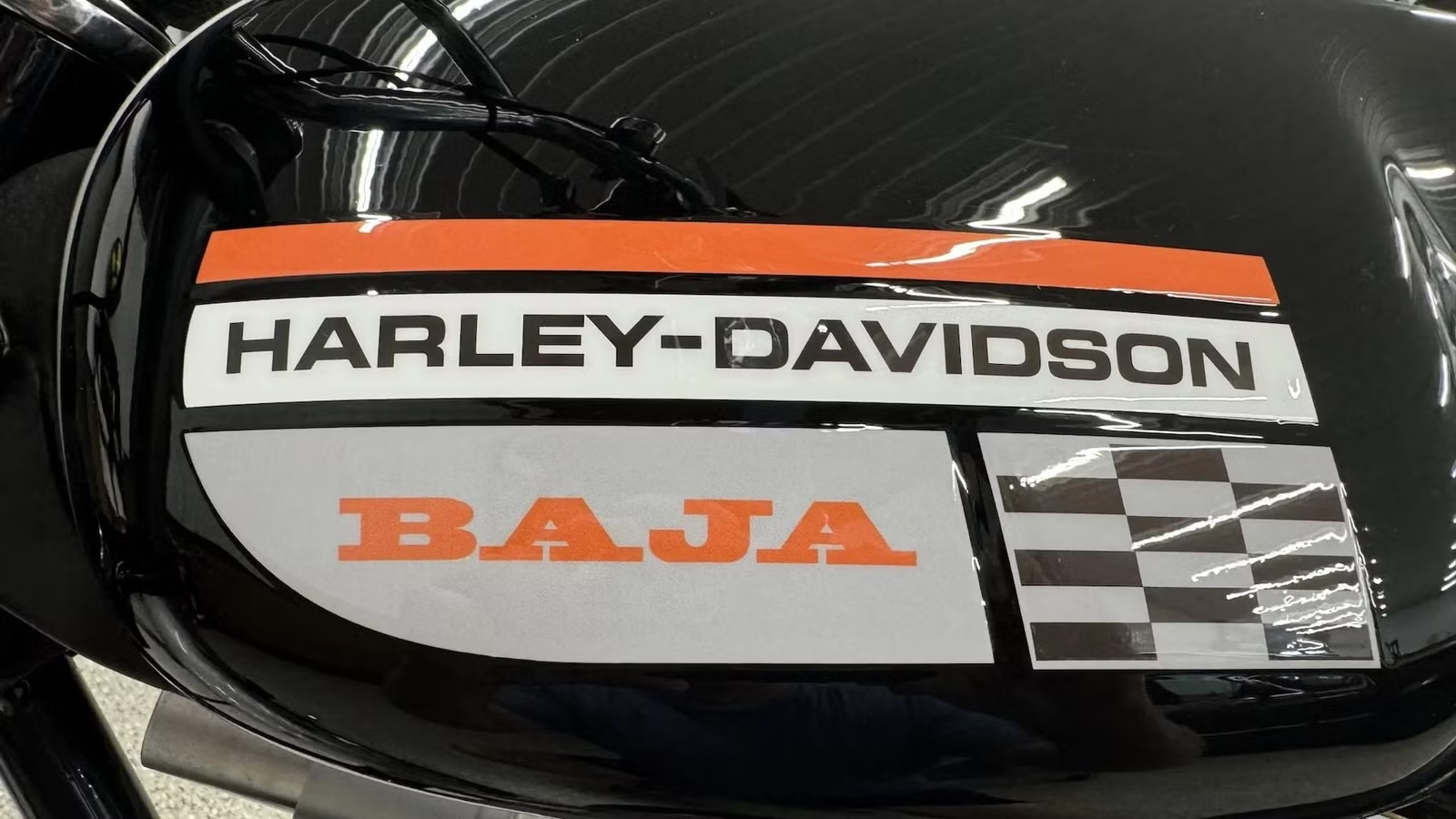
Back in the 60s, riding off-road as a pastime was exploding in popularity. Up until this point in history, the vast majority of the bikes people used to ride on local trails were simply street bikes that had been converted for off-road use (commonly known as scramblers). But, some manufacturers had identified the need for more dedicated trail bikes and were cashing in.
The Trail Bike Boom

For a time, it was mostly smaller manufacturers like Hodaka that took advantage of this particular gap in the market, but they were soon joined by the major manufacturers. Honda came out with the little CT90, which appealed to those looking for a light-duty trail bike that could also be ridden around town. But, it was simply a factory modified moped that could go off-road if you really needed it to.
Yamaha was one of the first big brands to make a move on this market with the launch of the DT-1 in 1968 (pictured above), one of the first genuine dual-sport bikes to hit the market. Even though it was designed to be road legal, it offered the same off-road performance potential as some of the more dedicated motocrossers. While Harley didn’t have much interest in developing a small displacement off-road bike, they certainly wanted to sell one.
The Harley-Davidson Baja 100 Had More Potential Than Most People Remember
Price Range: $3,000 – $5,000


AMF Harley-Davidson commissioned Italian partners Aermacchi to build the Baja 100. This was not a new strategy, as the company which Harley partly owned (and would subsequently buy outright in 1974) had built several two-stroke models for them already. In an effort to help build public interest in the model, a race version was also commissioned, and it went on to dominate the Baja 1000 in 1971.
Unfortunately, the production version of the model had little in common with the race bike, and if you had bought one back then, expectations may not have aligned with reality. Even though the model wasn’t really a commercial success, a few thousand bikes were sold between 1970 and 1973, almost exclusively thanks to Harley’s brand power. Today, it is pretty rare and hard to find. As such, bikes in good shape will set you back around $5k, which is a lot for a 50-odd year-old 100cc trail bike.
The Baja 100 Had An Italian Two-Stroke Engine
Power: 12 Horsepower

By modern standards, 12 horsepower might seem anemic, but in the early 70s this was considered adequate for a little 98cc engine. Once you were able to get the bike on the pipe, it was as fast as any of its contemporary rivals. By this time, Aermacchi was an experienced two-stroke manufacturer, and it made sense that Harley farmed out the development to them. But, as you might expect, it also allowed several famous Italian quirks to enter right through the front door.
The Baja 100 Was A Victim Of The AMF Era

At the time, desert racing had become particularly popular, and Harley wanted a bike that could compete, not only for a works team, but also for enthusiasts getting into the sport. This is one of the main reasons the bike was so tall. When compared to other dirt-bikes of the era, its 34-inch seat height really stands out. Although tall seat heights have become the norm these days, it was unusual, and to some extent, off-putting back then. It did, however, afford the little bike an impressive 11.7 inches of ground clearance.
Along with being pretty tall, it also had a relatively short wheelbase of just 51 inches. This unusual chassis arrangement delivered handling characteristics that can only be described as uninspiring. Even though it was shipped with a high-end Ceriani front fork, it was unable to compensate for these unusual dimensions. It also had a low-mount front fender, and while this made sense for dual-sport bikes like the DT-1, it made very little sense on a competition-spec desert racer where mud and rocks would jam up the front wheel (the dual-sport version, which can be seen in the video below, shipped with a high-mount fender when it came out a few years later).
All these little issues were hallmarks of a pre-production model. AMF Harley-Davidson didn’t see it that way, and rushed the model into production. They could have also corrected all these little “quirks” but chose not to. Unfortunately, all sorts of strange decisions were made in this period, and by 1973 they seemed content to dismiss the whole small-displacement desert racer idea as a failed experiment. Choosing to invest in larger displacement dirt bikes and dual-sports, which ultimately turned into an even bigger failure. The MX250 proved to be Harley’s final foray into the dirt for quite some time after only lasting one model year in 1978.
Not Quite A Harley
Much of what was done under the helm of AMF is forgettable, but the Baja 100, and by extension, the entire Aermacchi division, had far more potential than anyone ever gave it credit for. All these bikes were accessible, and for the most part, affordable. Offering new riders an entry point into the Harley-Davidson brand. Unfortunately, they looked different and smelled different, and were never welcomed into the family, so to speak.
Over the years, Harley has become increasingly suspicious of any powertrain other than a V-twin, and all these years later, we still don’t have an entry-level Harley. This is a shame because it excludes new riders who are forced to purchase something from a competitor. Naturally, there are dedicated fans who will eventually upgrade to a Harley, but it is far easier to simply stick with what you know.
While very few people remember this little dirt bike, and even fewer will be interested in owning one, it remains a significant model in the history of Harley-Davidson. A time when the brand tried, albeit in vain, to offer affordable entry-level motorcycles to the public. It was also the first genuine off-road bike to wear the famous logo, even if it was actually built in Italy.
Sources: Bring a Trailer and Cycle World Magazine (May 1970)

Related posts



Latest Post


No Comments