
Ford Built These Massive V8s, But Most Enthusiasts Have Never Seen One
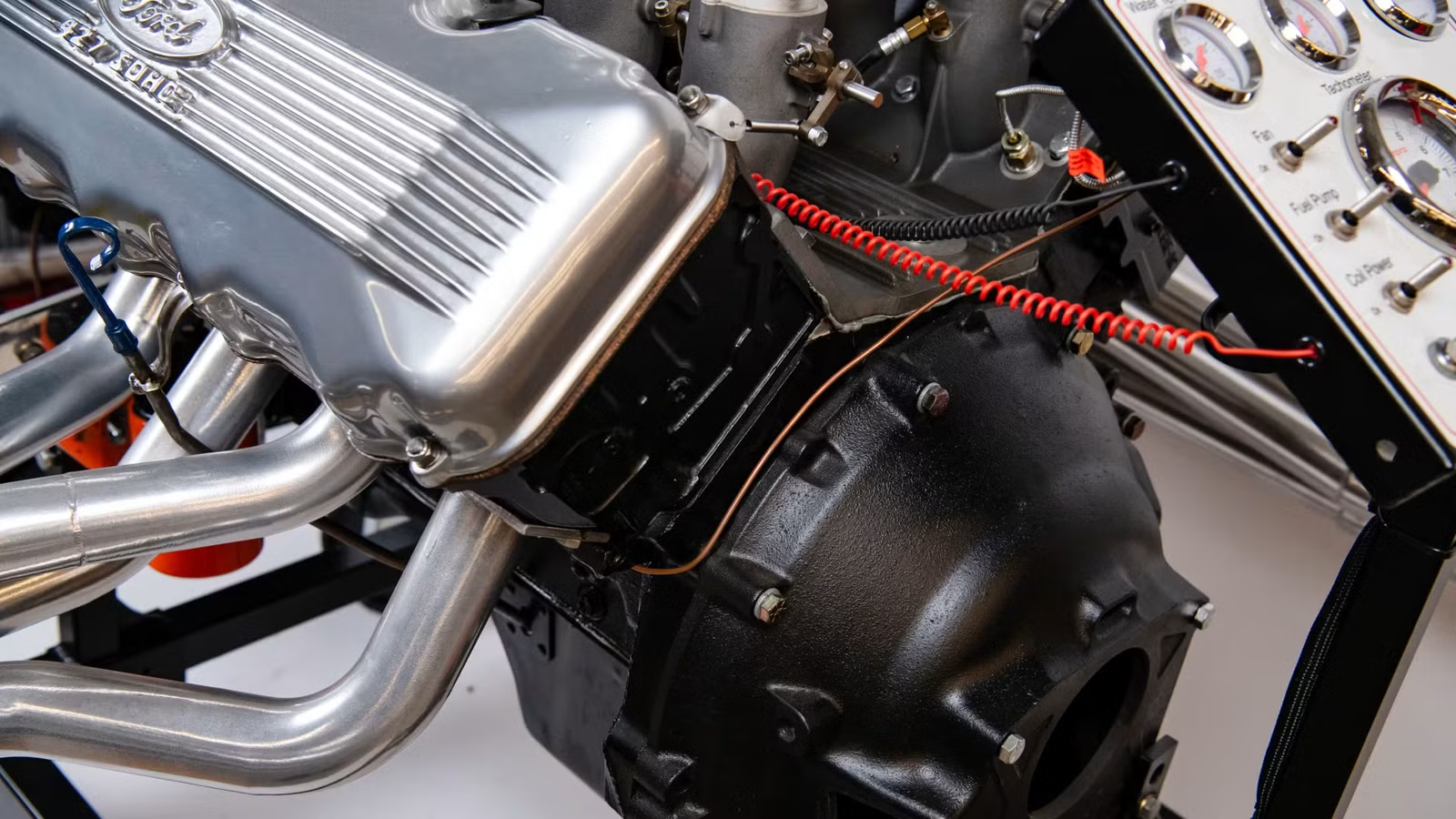
These rare Ford V8 engines have something in common. They’re massive and incredibly potent. Even the automaker’s biggest fans have never even seen a few of these elusive powerhouses. Some of the gigantic V8 monsters were built for hard work and industrial purposes. Others were designed for racing dominance with no intentions for public sales. Each unit has plenty of torque to do its intended job. Even the most dedicated collectors dream of coming across one of these unicorn finds.
5
429 Boss V8
450 lb-ft of Torque

Buckle up, because the Boss 429 V8, also known as the Boss Nine, is ready to dominate the track. The 429 cubic-inch (7.0-liter) V8 engine delivers 375 hp, but many automotive historians believe it’s underrated and actually provides closer to 500 hp. It was built to take on the Chrysler 426 HEMI engine on the NASCAR circuit. This engine is too large to fit in a standard Mustang, so Ford contacted Kar Kraft to modify the Mustang assembly lines. The engine bay was widened by two inches to make space for the large cylinder heads. Plus, the battery and plumbing for the heavy-duty oil and power steering coolers were moved to the trunk to make space.
The Hemi-Killer can accelerate from 0 to 60 mph in about 5.3 seconds and crush a quarter mile in roughly 13.4 seconds with a top speed of around 118 mph. Only 1,359 of these engines were built to meet homologation requirements, making them extremely rare. The engine itself often sells for between $30,000 and over $80,000. However, pristine Mustang Boss 429 models will sell for over $1,000,000.
4
429 Cobra Jet / Super Cobra Jet
450 lb-ft of Torque


Unlike the 429 Boss engine, the Ford 429 Cobra Jet is designed for drag racing and street dominance. The 429 cubic-inch (7.0-liter) engine churns out 375 hp, but it’s probably closer to 400 to 450 hp. The Super Cobra Jet features the Drag Pack with a four-bolt main, forged aluminum pistons, solid lifter camshafts, and a heavy-duty engine oil cooler. This massive engine was placed in a few different muscle cars, including the Mercury Cyclone, Ford Torino, and Mustang Mach 1. It was available in the Ranchero as well. Its 0 to 60 mph time hovers around 5.7 seconds, with a 13.3-second quarter-mile time and a top speed of 130 mph. As a more street-friendly and accessible option, it allowed drivers to dominate local drag strips.
About 7,657 Torino Cobra models were built in 1970, with only a handful getting the Super Cobra Jet variant. In 1971, 1,865 got the 429 Cobra Jet engine, and 613 of those were the Super Cobra Jet. While the 429 Cobra Jet sells for between $75,000 and $105,000, the Super Cobra Jet often sells for over $150,000.
3
534 Super Duty V8
490 lb-ft of Torque

Make way, the Ford 534 Super Duty V8 is coming through! It is the largest V8 engine Ford ever made for highway use, arriving in 1958 for commercial and industrial use. The 534 cubic-inch (8.8-liter) engine provides between 226 and 266 hp. It’s built for low-end torque and hauling rather than high-speed performance, and has a reputation for being exceptionally durable.
This engine can be found in buses, dump trucks, C-Series cab overs, and heavy-duty trucks like the F-1000 and F-1100. It weighs approximately 1,050 to 1,300 lbs, making it far too heavy for passenger cars and light-duty pickup trucks. They can run for about 3,000 to 5,000 hours before needing a rebuild.
The workhorse features enormous 5.25-inch bore spacing, coolant-jacked spark plugs, and sodium-filled exhaust valves. It has a front-and-rear thermostat design to control an intricate three-stage cooling system with a massive water pump that circulates up to 12,600 gallons per hour. The Ford 534 V8 remained in production until 1981. As a bare, used core, it sells for between $500 and $2,100, but in a running truck, it can go for over $122,000.
2
427 SOHC “Cammer”
575 lb-ft of Torque

The Ford 427 SOHC or ‘Cammer’ V8 engine was designed in only 90 days as a quick response to the 426 HEMI when it was introduced in 1964. Chrysler was dominating NASCAR, so Ford set out to answer the challenge. The 427 cubic-inch (7.0-liter) engine produces 675 hp with a dual four-barrel carburetor setup. It features hemispherical combustion chambers with a chain-driven overhead camshaft, allowing it to effortlessly rev past 7,000 RPM.
This engine flies, accelerating from 0 to 60 mph in 4.3 seconds and covering a quarter mile in about 12.2 seconds, with a top speed of over 200 mph. The 427 engine was banned from NASCAR for being too powerful and advanced, before it could even race. However, it still terrorized the streets and ruled the drag strips in the Ford Galaxie, Falcon, Mercury Cougar, and Shelby Cobra.
Automotive historians estimate that between 300 and 500 complete units were built between 1964 and 1965. But including engines and kits sold over the counter increases this figure to between 500 and 1,000. This engine is considered a holy grail find, and complete original examples fetch between $70,000 and $140,000.
1
GAA 1,100-cubic-inch Tank V8
1,050 lb-ft of Torque
TEN-HUT, soldiers — the Ford GAA 1,100-cubic-inch V8 is a proud veteran. The 1,100 cubic-inch (18-liter) tank engine pumps out 500 hp on the battlefield. It was used to power the M4A3 Sherman tank and M10 tank destroyers. You could say it helped win the war as the largest-production V8 engine of all time. It’s an all-aluminum ‘War-Hemi’ and was a lightweight alternative to heavier diesel engines of the era. This massive engine weighs in at 1,470 lbs. It has a four-valve-per-cylinder layout with 32 valves total to enhance airflow into the cylinders. Dual ignition is provided by dual spark plugs and dual magnetos per cylinder. Plus, the timing chains were replaced by robust shafts and gears to drive the DOHC build.
After the war, it was placed in tractors, heavy-duty commercial vehicles, and marine applications. It is highly adaptable and can be modified to produce over 2,000 hp. It dominated the drag strips in the 1940s and 1950s until it was banned. Based on condition, these engines typically fetch between $15,000 and over $40,000 at auction.
Source: Supercars, Hagerty

Related posts

Latest Post



No Comments