
Dodge Offered A 425-Horsepower Hemi Wagon But 1960s Drivers Didn’t Want It
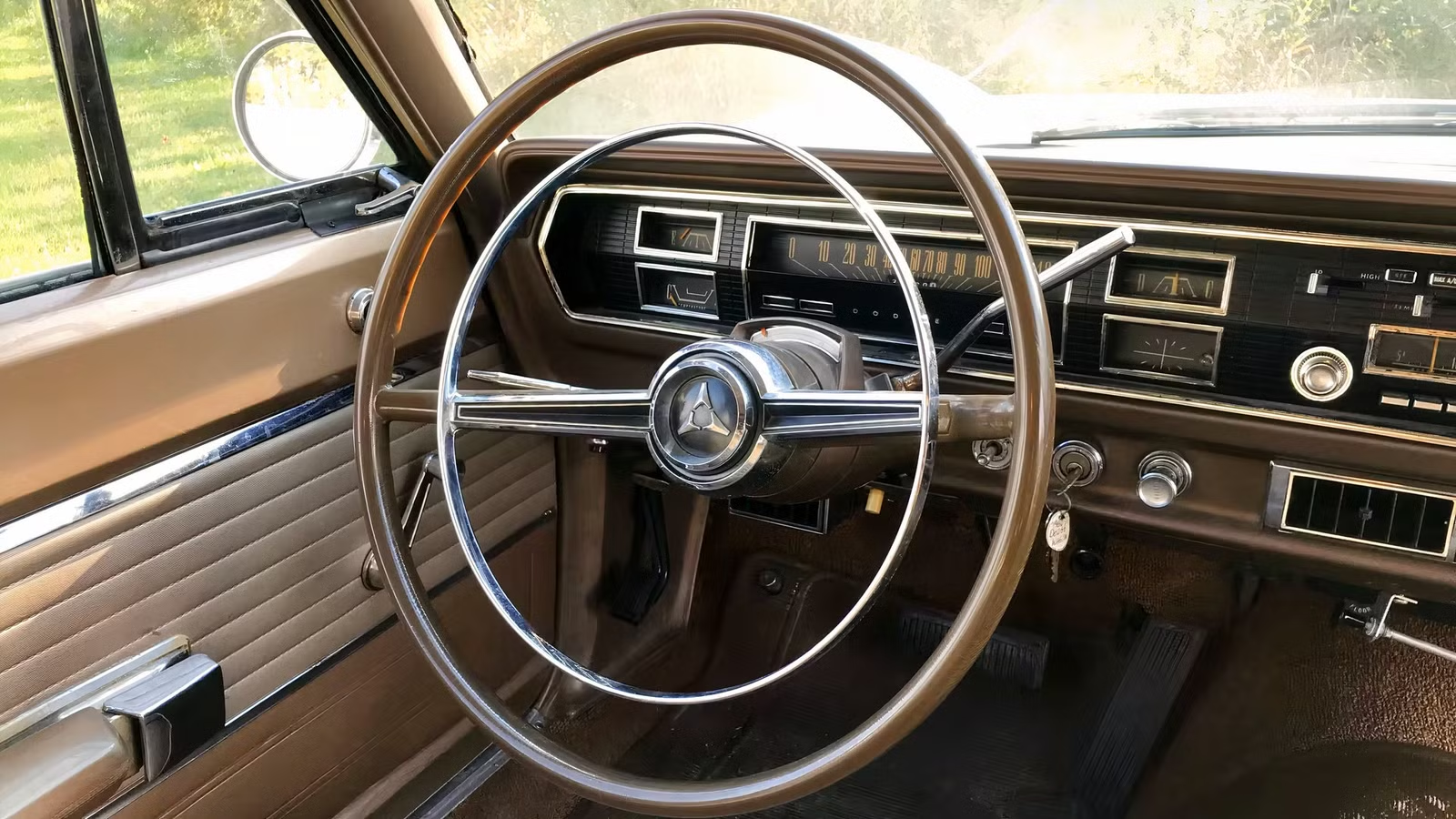
It’s 1966. You need room for the kids, luggage, maybe the dog, so you walk into a Dodge dealership shopping for a wagon. Then you notice Chrysler’s new 425-horsepower 426 Street Hemi. Suddenly the family-car purchase has taken a hard left toward terrible decisions. Here is the full story of the very first Hemi-powered Dodge wagons.
Mopar Built Muscle Wagons From The Jump

Muscle wagons are already one of Detroit’s great bad ideas: take the longest roof you can stamp, add another row of seats, then see how much engine you can cram up front. And they’re as old as the muscle car itself. In 1959, Dodge let Sierra wagon buyers order the Super D-500 package, installing a 383-cubic-inch Wedge V8 topped with a dual-quad carburetor setup in the humble family hauler. The engine was rated at 345 gross horsepower and 420 lb-ft, and the Sierra could carry six or nine people depending on configuration.
Dodge did not sober up when the fins disappeared. The company’s wagons raided the same parts bin as its fastest sedans and coupes. Mopar built 426 Wedge-powered longroofs before the Street Hemi arrived. By 1969, drivers could order a Dodge Polara wagon with a four-barrel 440 and dual exhaust. Chrysler recognized that many customers wanted cargo space and cubic inches in the same vehicle.
The 426 Street Hemi Brought Race-Car Power To The Dealership


Chrysler Corporation first experimented with hemispherical combustion heads during WWII: the resulting V16 was engineered for an experimental P-47 Thunderbolt. The company reintroduced hemispherical heads on its FirePower V8 in Chrysler’s 1951 lineup. The second generation of the Hemi, the 426, was a tool built for a single purpose: dominate the 1964 NASCAR season.
Dodge and Plymouth combined claimed 26 wins in NASCAR’s 62-race 1964 season, while Richard Petty scored nine victories and his first championship. For 1965, NASCAR tightened its production-car homologation rules, effectively sidelining the non-production Race Hemi until Chrysler released the Street Hemi for 1966. The civilian version’s factory ratings were 425 gross horsepower at 5,000 rpm and 490 lb-ft at 4,000 rpm, with 10.25:1 compression and two four-barrel carburetors. Dodge buyers could find it in familiar Coronet and Charger configurations, while Plymouth sold Hemi-powered Belvederes and Satellites. Later Hemis would appear in cars such as the GTX, Road Runner, Challenger, and ’Cuda.
Dodge Offered Its Coronet As A 426 Hemi-Powered Muscle Wagon

For the 1966 model year, Dodge offered the Street Hemi as an option across its Coronet lineup. That lineup, of course, included the Deluxe and 440 trims in both six- and nine-passenger wagon configurations. Historians have yet to find a factory brochure specifying that the 426 Hemi (engine code H) was not available in the wagons (body style codes 45 and 46). What’s more, Dodge’s own service bulletin described the Hemi as available in “the Dodge Coronet models” without excluding its 45- and 46-code wagon body styles.
A buyer optioning a Coronet wagon with a Street Hemi would have ended up with quite the machine. A 1966 Coronet 440 wagon rode on a 117-inch wheelbase and stretched 207.9 inches long overall; a regular six-passenger V8 wagon had a 3,585-pound shipping weight before Hemi hardware. Known Hemi wagons had shipping weights of around 4,100 to 4,118 pounds. At 425 horsepower, this theoretical family hauler could have boasted a ratio of 9.6 to 9.7 pounds per horsepower. “Are we there yet?” would have been a very short conversation.
Dodge Offered The Ultimate Sleeper And Apparently Nobody Wanted It

Most early Hemis went in two-door coupes, or even flashy convertibles. But Dodge customers ordered some absurd Street Hemi combinations. The 1966 production breakdown includes multiple basic four-door Coronet sedans with the Street Hemi and automatic transmissions. The FBI ordered another anonymous four-door Coronet sedan with a Hemi hiding under the hood. So how many Dodge buyers opted for a Hemi car equipped with a tailgate, and perhaps even a third row of seating?
No authenticated customer-production Street Hemi Coronet wagon is known among surviving examples or documented in the factory paperwork historians have studied. But some Hemi-powered wagons were assembled. A few were by Dodge, nonetheless.
Plymouth Drivers Are A Different Breed

Every automotive brand family has one company that marches to the beat of its own drum. Enter Plymouth, and its adventurous drivers. Mopar fans will not be shocked that Chrysler Corporation production records show five 1966 Belvedere wagon special orders had Street Hemi V8s installed at the factory. Specialist Mopar production research breaks them down as two base Belvedere I wagons and three Belvedere II wagons. Three were automatics, and two had four-speed stick-shift transmissions. Even wilder: these Belvederes also had cousins wearing Dodge badges.
Dodge engineers actually beat Plymouth to the punch. Years before the Hemi-powered Belvederes, Chrysler engineers set about assembling the perfect drag racing car. The wagon body put more weight over the rear axle, helping the rear tires hook up. So the team dropped a fully tuned racing Hemi into a Dodge wagon. A year later, the company was trying to tune a Hemi for street use. It actually used another four-door wagon as the “test mule” to get some street time with the new Street Hemi. So at least two Dodge station wagons got true second-gen Hemi engines. But when Chrysler Corporation offered something similar to Dodge buyers, they said “no.”
Sources: Stellantis, Dodge, Over-drive Magazine, For A-bodies Only forum

Related posts

Latest Post


No Comments