
The Motorcycle That Feels Built For Every Skill Level
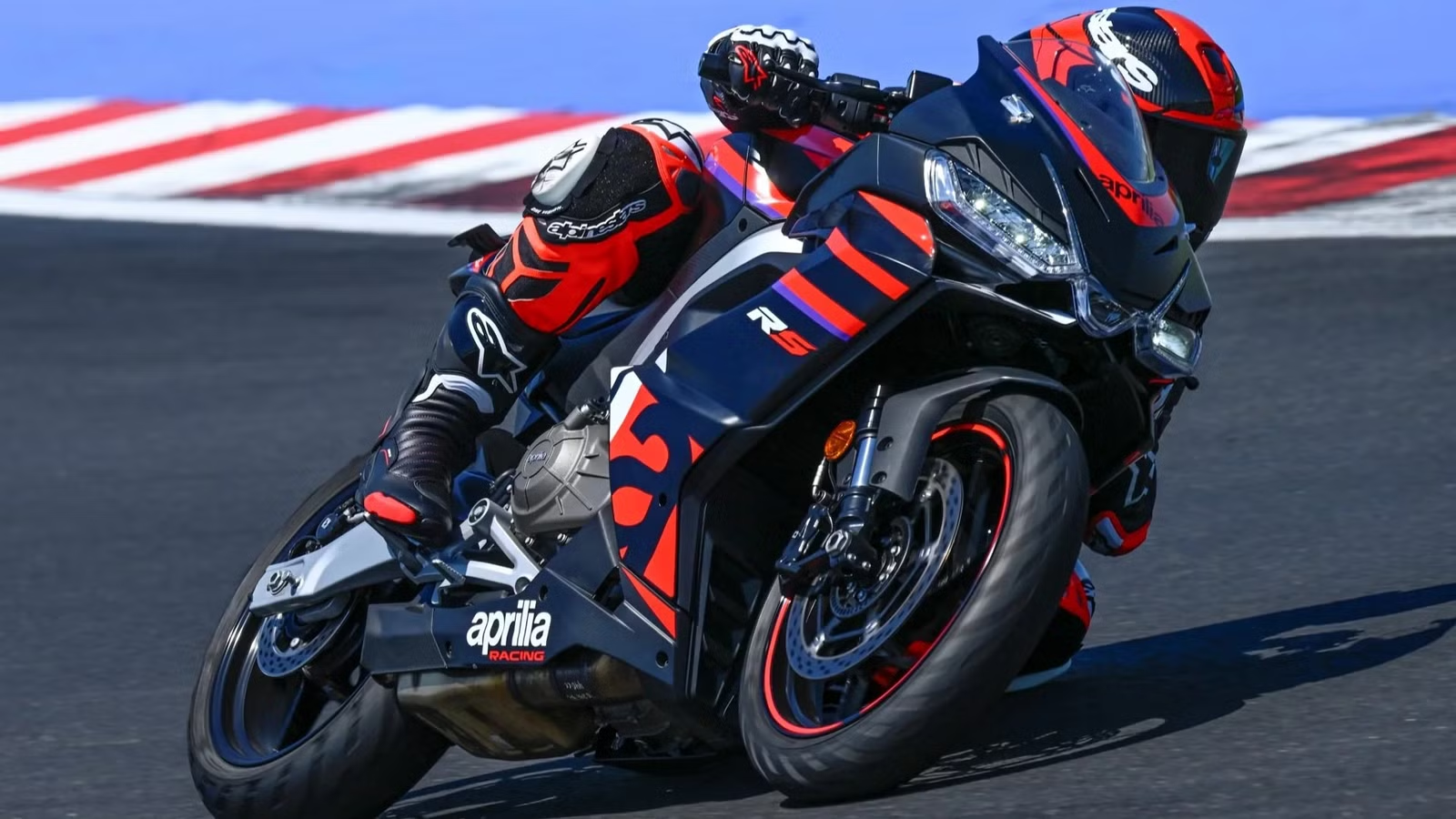
The motorcycle industry has us all buying into a myth that bigger numbers automatically yield better motorcycles. This belief isn’t limited to the motorcycle industry, because if you look around, today’s market has machines with overwhelming horsepower figures and tech that would make the space shuttle proud. All of this makes these motorcycles feel too extreme for riding on ordinary roads. For the average enthusiast, the extra horsepower and tech only lead to intimidation. Sure, you get spec-sheet bragging rights, but you lose accessible engagement. This leaves a gap for a machine that prioritizes confidence over numbers that you can flex.
How The Lightweight Sportbike Segment Settled For Mediocrity — Until Aprilia Stepped In

Today’s sportbike segment consists of polar-opposite types of products. On one end of the spectrum are track-focused weapons that give your wrists and back a workout on the commute. On the other end are budget-focused entry options that are often derived from standard motorcycles and therefore lack the agility of a true sportbike. Manufacturers assume that the entry-level segment means that cheap switchgear and basic suspension are compromises that buyers are willing to make. As a result, enthusiasts have a very difficult choice. Aprilia saw that gap and decided to fill it.
Bridging The Gap With A Wholly Unexpected Shift Of Philosophy

The real sweet spot in sportbike design is where light weight, an agile chassis, and linear power intersect. These are the exact tenets that define what Aprilia chooses for its fully faired products. When a bike can communicate at road-going speeds, it teaches novices how to ride better while engaging seasoned veterans without them having to ride at light speed. Being an accessible sportbike does not mean being a dull one. It just needs to be one that offers great feedback, feels natural, and makes every corner a fun learning lesson.
Aprilia’s Championship Pedigree Shines Through Even In The Beginner Segment

Aprilia is no stranger to the beginner sportbike segment. The Noale manufacturer didn’t forge its reputation on liter-class missiles, but on tiny two-stroke weapons like the RS 125 and RS 250. Even today, given the right road and rider, these sportbikes will keep up with much larger and quicker motorcycles. Aprilia has applied these very lessons to a new product that echoes the greatness of those sportbikes while also looking to the future. In doing so, it has forced everyone in the segment to rethink their philosophy for the beginner sportbike, and this is the motorcycle that feels built for every skill level.

The Aprilia RS 457 Is The Motorcycle That Will Reward Every Rider

The RS 457 is a recent addition to Aprilia’s global lineup, and it has been designed with the aim of appealing to all markets, whether developing or developed. As a result, Aprilia found a way to keep costs low by manufacturing it in India, while giving it the same attention to detail that has made icons like the RSV4 what they are today. The RS 457 might look like a stepping stone to bigger, better things, but if you value purity of feedback and minimal intrusion via electronics, it can be a lifelong choice because this is the motorcycle that feels built for every skill level.
This Is An Expensive Machine For Its Class, But Well Worth It

The RS 457 has only one mechanical variant with all the bells and whistles, and it is priced at $6,849 for the 2026 model year. They also added a different paint scheme called the GP Replica, which mimics the MotoGP livery, priced at $7,499. This makes the RS 457 easily the most expensive motorcycle in this class and dangerously close to the next step up in performance, because bikes like the CFMoto 675SS cost $7,999. Despite the figures, the RS 457 punches far above its price. At that price, every component choice has to earn its place — and it starts with an engine decision no other legacy brand in the segment was willing to make.
The Only Legacy Brand With A 270-Degree Parallel Twin Engine

There used to be quite a bit of variety in this space before, but now it is parallel twins across the board. There is still a divide between the 180-degree crank and the 270-degree crank, and Aprilia is the only legacy brand with the latter, the other being CFMoto. Whatever the specs might read like, the RS 457 is beginner-friendly, but it never feels like a compromise. This engine displaces 457 cc and generates 47 horsepower at 9,400 RPM and 32 pound-feet at 6,700 RPM. Power is sent through a six-speed gearbox with an assist-and-slipper clutch, and a two-way quickshifter is optional.
Aluminum Twin-Spar Chassis Is Unique In Segment

The RS 457 has the segment’s only twin-spar aluminum frame that uses the engine as a stressed member. It also has a steel double-sided swingarm that is mounted directly onto the engine crankcase for weight reduction. The suspension consists of 41 mm inverted forks and a direct-mount single shock at the rear. Both ends are adjustable for preload, offering 4.7 inches of travel at the front and 5.1 inches at the rear.

This small sportbike’s light weight means it does not need anything more than a single 320 mm floating brake disc at the front, yet it pairs that with a radial ByBre four-piston caliper. At the rear, there is a 220 mm disc with a single-piston caliper. The wheels are 17-inch alloy units shod with sticky tubeless tires. It might be ‘slow’ but it teaches you to ride like a pro.
At 385 Pounds Wet, It’s Among The Lightest In Its Class By A Meaningful Margin
The RS 457 is Aprilia’s smallest sportbike, so it stands to reason that it is quite compact. It is 77.2 inches long and 31.3 inches wide, the seat height is 31.5 inches, and it weighs 385 pounds wet, which is among the lightest in its class by a fair margin.
RS 660 TFT Display, By-Wire Throttle, And Switchable ABS — At Entry-Level Money

Given its focus on being light and sporty, you might expect Aprilia to ignore everyday usability with a slimmed-down feature set, but you would be wrong. This might be a budget bike but it has class-leading features. It has the same five-inch TFT instrument display from the RS 660 with Bluetooth and navigation. It also has braided steel brake lines for its brakes, all-LED lighting, and backlit switchgear. Among the optional equipment are adjustable billet-aluminum levers, racing footpegs, and the aforementioned two-way quickshifter. It also has a segment-leading electronics suite. The by-wire throttle enables three ride modes, and there are four levels of traction control, including off. Similarly, the rear-wheel ABS can be switched off and offers two levels of intervention.

By and large, sportbikes in the segment are geared toward beginners and casual riders. The RS 457 can be a mundane everyday public road workhorse, so there is no distinguishing it from its peers in that regard. Where it pulls ahead is in places like the racetrack, where you can customize its electronics, and its light weight and aluminum twin-spar frame prove their worth. This is why we will have to leave out the Kawasaki Ninja 500 ABS and the Honda CBR500R despite their ability to build rider confidence; they represent much better value, yes, but with their 180-degree parallel twins, higher curb weight, non-adjustable suspension, and focus on being good beginner bikes, they cannot keep up with the Aprilia.

KTM’s RC 390 would give it something to worry about, but it has been discontinued this year. That leaves the CFMoto 450SS, which might be an entry-level sportbike, but doesn’t feel cheap. The Chinese bike costs $5,699, which is more than $1,000 less than the base Aprilia. However, you do not get the same kind of frame and racing pedigree that Aprilia brings to the table, although if you are on a budget, it is very difficult to argue against the CFMoto.
Source: Aprilia USA

Related posts

Latest Post


No Comments