
Chevrolet’s Camaro SS 1LE: The Track-Rat Bargain Everyone Forgot
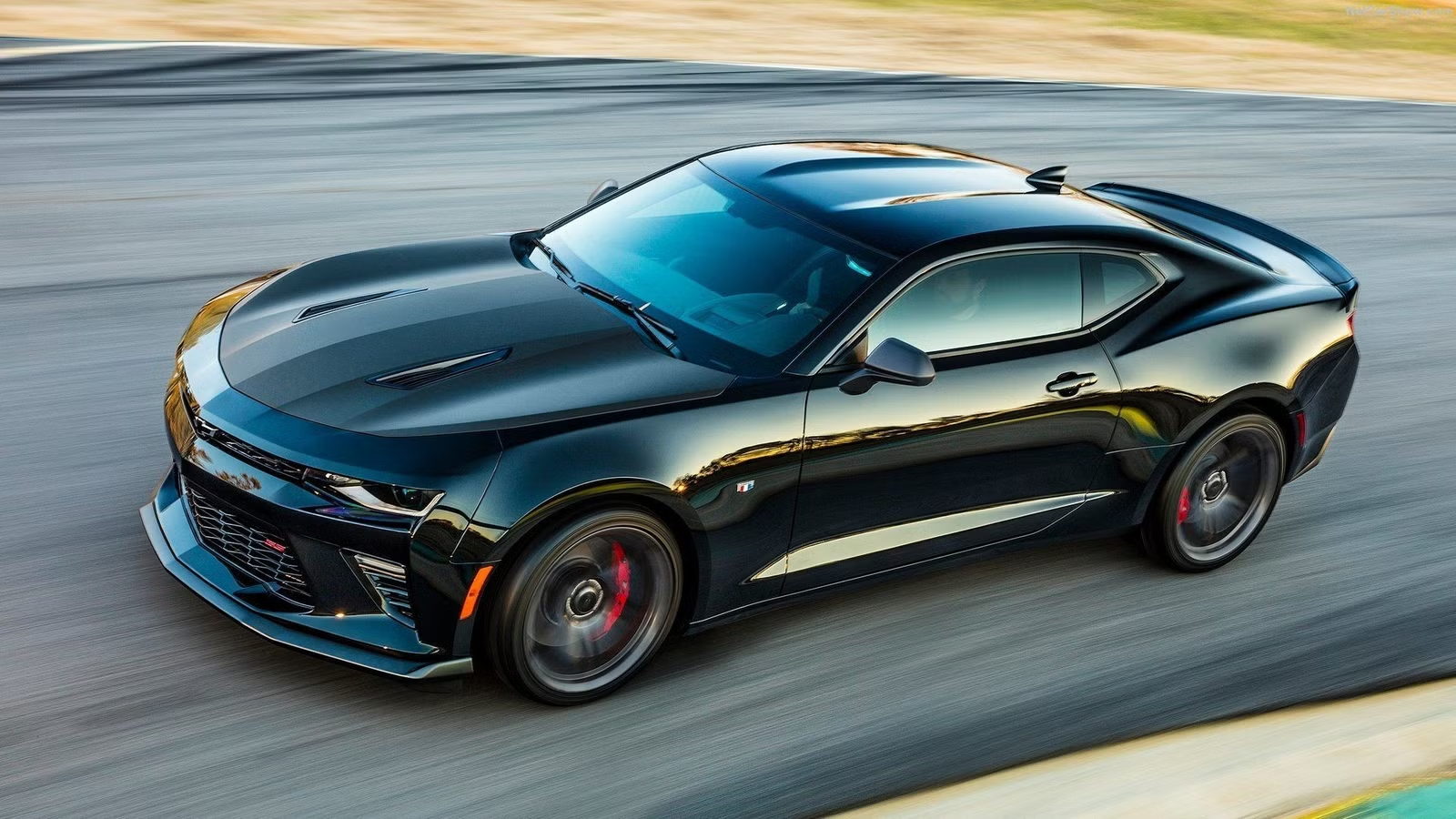
Somewhere in a used-car listing right now sits a two-door American V8 that lapped tracks within seconds of cars costing nearly twice as much when new. Its owner has probably described it in three lines, parked it beside base trims, and waited weeks for a call. Under the hood is a 455-horsepower muscle car engine. Behind the wheels are brakes from a serious motorsport catalog. Between them is a chassis tuned by engineers who cared more about lap sheets than brochure copy. Enthusiasts moved on anyway. Their loss is your opportunity, if you know what to look for.
The Camaro’s Final Years Created A Used-Performance Sweet Spot
The sixth-generation Camaro arrived for 2016 on GM’s lightweight Alpha platform, and it was a huge step forward. It was stiffer, lighter, and sharper than the car it replaced, and the 6.2-liter LT1 V8 in the SS made 455 horsepower and 455 pound-feet of torque. The 1LE package joined the SS lineup for 2017 and stayed through the final 2023 model year.
Then the spotlight moved. Sales of the Camaro slid against the Ford Mustang, the crossover wave swallowed showroom traffic, and the enthusiast conversation shifted to electrification and whatever came next. Buyers who wanted a track-ready Chevy were already pointing at the halo car, the supercharged ZL1 and its 1LE variant, which made the SS 1LE feel like a supporting act.

And that is where things get interesting. Depreciation has done its usual work on a car that never had the buzz to hold its value, and the 1LE hardware that once demanded a real premium now comes at a much smaller one. The result is a sweet spot: a proper track-focused car with a modern chassis, a bulletproof-reputation V8, and a price that sits closer to a well-optioned family SUV than a new sports car.

Magnetic Ride Control And Brembos Turn The SS 1LE Into A Track Weapon

Let’s start with the dampers. The Chevy Camaro SS 1LE uses Magnetic Ride Control (MRC), GM’s system in which the shock absorber fluid contains tiny iron particles. A magnetic field changes the fluid’s viscosity in milliseconds, so the dampers can firm up or relax as conditions demand. A standard SS uses conventional passive dampers that are always a compromise between comfort and control. MRC reads the road and the driver’s inputs constantly, giving you a supple ride on a broken commuter road and tight body control when you lean on the car through a fast corner.
The brakes matter just as much. The SS 1LE carries Brembo six-piston calipers clamping large rotors — 14.6 inches front and 13.3 inches at the rear. These shed heat far better than the base SS hardware. On track, the difference is felt in consistency. Ordinary brakes fade after a few hard laps as pads and fluid overheat, and the pedal grows longer and softer. The Brembo package resists that, so the fifth lap feels much like the second.

Add an electronically controlled limited-slip differential, extra cooling for the differential and engine oil, and a front splitter that adds aerodynamic bite, and the picture becomes clear. This is not a base SS with stickers. Chevrolet built a package that survives sustained abuse, which is precisely what track-day drivers should want.
Sticky Rubber And Sharper Geometry Unlock The Camaro’s Real Potential

Tires are the cheapest way to make any car faster, and Chevrolet knew it. The SS 1LE rides on 19-inch forged wheels wrapped in Goodyear Eagle F1 tires, 285 millimeters wide up front and a hefty 305 in the rear. The rubber compound is far stickier than the all-season-leaning stock SS tires, and it shows up in lateral grip figures that sit north of 1.0 g in published testing, a number that used to belong to exotics.
Stickier tires alone can make a car twitchy, so the geometry got attention too. The 1LE sits lower than a standard SS, which drops the center of gravity and cuts body roll. Revised suspension tuning keeps the tires flat on the pavement through corners, instead of letting the outer sidewall fold under load. In plain terms, the car rolls less, changes direction quicker, and tells you what the tires are doing before they let go.

That last part is the real secret. A track car you can trust is a track car you can push. The SS 1LE’s steering is quick and communicative, and its chassis communicates through the seat, so approaching the limit feels progressive rather than sudden. New track drivers get a forgiving platform. Experienced ones get a tool with real headroom. On paper, the numbers are compelling. A base SS with all-season tires is a strong car. Add the 1LE’s rubber, suspension, and cooling, and lap times fall by seconds at a typical road course, which is a gulf in this game. Some of that comes from the tires alone, but the rest comes from a chassis that finally lets you use them.
The SS 1LE’s Used-Price Advantage Has Quietly Grown More Compelling

Let’s talk money, because this is where the argument gets sharp. Prices move constantly, so treat the following as ballpark figures and check current listings before you shop. Clean 2017 to 2023 SS 1LE examples generally trade in a broad band from the mid-$30,000s for older, higher-mileage cars up to the high $40,000s for late-model, low-mileage ones. Base SS models sit only modestly below. When new, the 1LE package added roughly $6,000, but today the price gap over a comparable SS is often smaller than that, and sometimes much smaller. The premium has compressed while the hardware advantage has not.
Now put that against newer alternatives, built from published specs and lap-time databases rather than any head-to-head test, because none exists. A new Ford Mustang Dark Horse brings 500 horsepower, its own track-focused suspension tuning, and a sticker price in the low $60,000s before options. A BMW M240i xDrive is quicker on a wet, twisty road and beautifully finished, but its 382 horsepower and a starting price near $50,000 mean you pay more for less power and less track-day hardware.

By the numbers, the SS 1LE trails the Dark Horse on power and outright modernity. But it costs perhaps half as much, and its track hardware is not far behind. If your goal is seat time per dollar, the math is hard to argue with. You could buy a clean 1LE, budget for tires, fluid, and pads, and still have money left over compared to a new Dark Horse.
That leftover money can be spent on track days, which is where you actually learn to go fast. The ZL1 1LE explains why nobody noticed. At 650 horsepower, with its bespoke dampers and a Nürburgring lap of 7:16.04, it stole every headline. The SS 1LE became the sensible sibling that got forgotten, and that is why it costs what it does.
Consumables Matter When Buying This Forgotten Track-Day Bargain


A cheap purchase price does not mean a cheap season. Track use burns through parts, and the 1LE has appetites you should plan for. Brake fluid comes first. The Brembos can handle serious heat, but fluid absorbs moisture and boils at lower temperatures as it ages. Most track drivers flush it before every event or at least once a season, using a high-temperature racing fluid.
Pads and rotors will wear quickly too, and a set of track-oriented pads is a worthwhile early upgrade. Tires are the second major cost. Those wide Goodyear Eagle F1s are sticky and expensive, and the rears wear fastest under a heavy V8 with lots of torque. A few hard track weekends can use up a set, and replacements cost several hundred dollars per corner. Check tread depth and date codes on any car you inspect, and negotiate accordingly.

Cooling deserves a close look. The car has extra coolers for good reason, because sustained track sessions cook oil, differential fluid and coolant. Confirm the cooling system is healthy, ask for service records, and change the oil more frequently than the manual suggests if you plan to lap regularly. For used examples, inspect for signs of hard use. Look for uneven tire wear, worn front-end components, curb damage, and a car that has been modified beyond recognition. A one-owner car with documented maintenance beats a cheaper mystery machine every time. Also verify the 1LE package on the build sheet, since not every lookalike is genuine.
The SS 1LE is not cheap to run hard, but it is cheap to buy, and it delivers more real track capability per dollar than almost anything on the market. Find a clean example, budget for consumables, and enjoy a car that everyone else forgot. Buyers who do their homework will find the SS 1LE a rare thing: an overlooked performance bargain that is genuinely worth buying if you are an enthusiast.
Sources: Chevrolet U.S., Motortrend, Cars and Bids, KBB

Related posts


Latest Post


No Comments