
Can Porsche’s Electric Boxster Keep Up With BMW’s 838-HP M3?
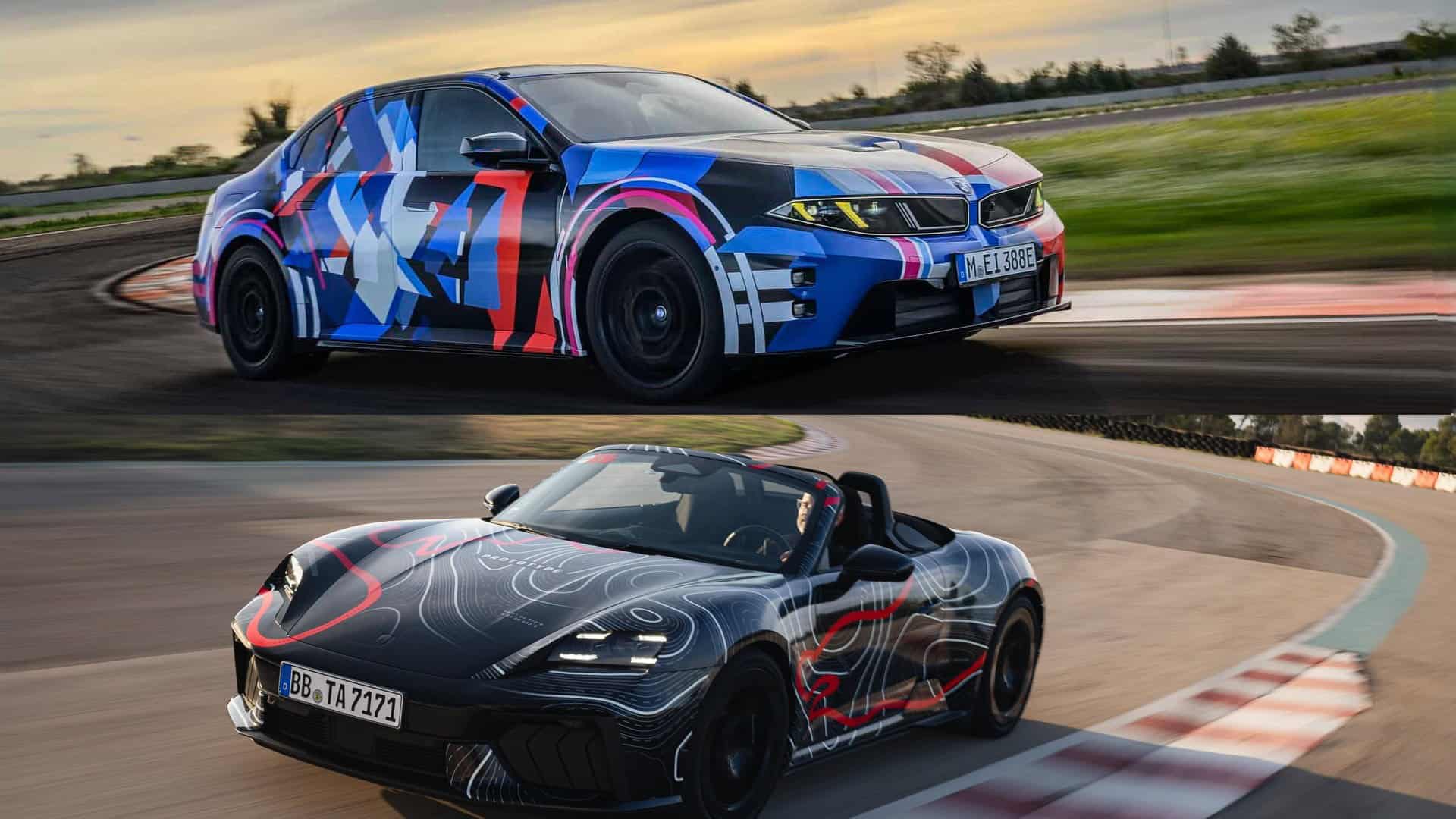
BMW M3
The electric M3 drives all four wheels. Porsche says its quickest 718 Boxster can hit 62 mph in under three seconds on rear tires alone.
Article Summary
- The four-motor BMW M3 is expected to hit 62 mph in under three seconds, the same benchmark Porsche claims for its flagship electric Boxster.
- Porsche puts the battery where the Boxster’s engine used to sit, giving the roadster a 60 percent rear weight bias, while BMW targets a 50:50 split.
- The M3 gives drivers six paddle-selectable stages, while the Boxster pairs seven virtual PDK gears with the sound of a 981 Boxster GTS flat-six.
As legacy automakers eye the future, it seems some of our favorite nameplates will soon have electric equivalents. Porsche is next, lowering—but not completely removing—the blinders on its 718 Boxster EV and allowing select journalists a peek behind the curtain and inside the cockpit on a recent media event. Like BMW—who lets its electric M3 retain the simple “M3” badge, with no further identifiers—Porsche introduces the electrified Boxster as simply the 718 Boxster, identical nomenclature from last year’s model. But the similarities pretty much stop there, with one distinct exception.
Porsche Boxster EV and Electric M3 Agree on Speed

We still don’t have all the information. And, admittedly, there’s only so much a four-door could or should share with a dedicated sports car platform. But one statistic stands out at a glance: both cars should achieve 0-62 mph in under three seconds. Of course, an 838-hp BMW M3 with a motor at each wheel ought to be pretty handy from a standing start. Interestingly, Porsche matches that sprint time despite its car only powering the rear wheels. It’s the first obvious difference in philosophy between these two cars.
| Preliminary specifications | Electric BMW M3 (ZA0) | Electric Porsche 718 Boxster |
|---|---|---|
| Driven wheels | All-wheel drive, with one motor per wheel | Rear-wheel drive, single motor |
| Horsepower | 838 hp/625 kW | >500 hp/368 kW |
| Torque | 885 lb-ft/1,200 Nm | >350 lb-ft/475 Nm |
| 0–62 mph | Under 3 seconds | Under 3 seconds |
| Top speed | Undisclosed | Over 155 mph |
| Curb weight | ~4800 lbs/2177 kg | 3724 lbs/1690 kg |
| Weight distribution (front/rear) | Undisclosed | 60% rear |
| Electrical architecture | 800-volt Neue Klasse platform | 800-volt E-Core platform, with the battery behind the seats |
| Usable battery capacity | Over 100 kWh | Undisclosed |
| Driving range | About 300 miles (BMW target on the EPA cycle) | Undisclosed |
| Simulated gear changes | Six virtual gears with paddle shifters | Seven virtual gears with paddle shifters |

Like BMW’s M3, Porsche bills its new EV Boxster as the most powerful 718 ever. Porsche is keeping the horsepower figure to itself, but calling this the most powerful 718 ever gives us a number to beat. The Cayman GT4 RS made 493 hp. So, north of 500 hp is essentially a given, and likely it’s closer to 600. However you slice it, that’s down from the 838 ponies in the M3, but it’s clearly accounting for a huge weight disparity. The Boxster EV test car draws heavily on the current-gen 911 (992.2), and officials state its weight “overall similar to” the current 911 GTS Cabriolet T-Hybrid. That translates to around 3724 pounds (1690 kg). As for the BMW, the i3 50 xDrive First Edition already weighs 4,861 pounds. We’d be surprised if the four-motor M3 came in significantly lower.
Where the weight sits is equally important. In the Boxster EV, an 800-volt battery goes directly behind the seats, right where you’d expect to find the engine in your old Boxster. That keeps the driver low and puts 60 percent of the car’s weight over the driven wheels. A single motor powers the car. The M3’s battery essentially operates as the floor of the vehicle and powers four motors, one at each wheel. BMW targets tried-and-true 50:50 weight balance for the M3.
Shifting Gears
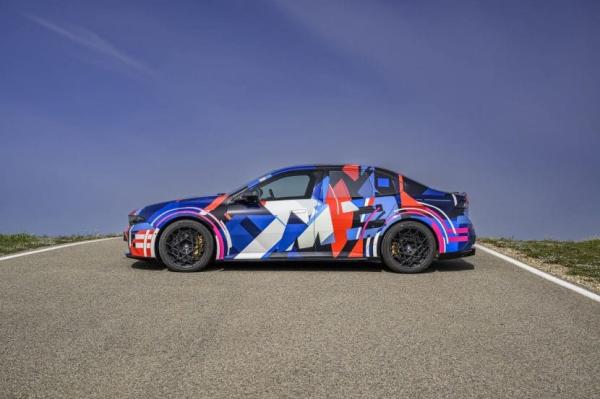
It isn’t as dramatic as power figures, but there’s one number Porsche is happy to put up against BMW’s. Pull a paddle in the M3 and you can work your way through six simulated gears. Or, stages, as BMW refers to them. The Boxster gives you seven, complete with a soundtrack modeled on the flat-six in the 981 Boxster GTS. So the Porsche has the BMW beat by one imaginary gear. Sadly, that doesn’t really indicate for sure which one will ultimately make it quicker from 0 to 62 mph, or which will post the higher trap speed. Both companies claim acceleration remains unchanged when you use the paddles.
Of course, there are other decidedly more important differences. BMW plans to offer a next-gen gas version of its M3, although it won’t be the Neue Klasse car. Closer to the source material, BMW will likely also spin off wagon/Touring variants of the electrified Neue Klasse M3. Neither statement can currently be attributed to Porsche’s 718 Boxster. Meanwhile, the 718 definitely has novelty on its side: this marks, to my recollection, the first convertible EV since the Tesla Roadster back in the mid-2000s. Well, aside from MINI’s production-limited Cooper SE Convertible, but I’m not 100% sure that counts.
The differences illustrate one thing, itself a similarity: the M3 and 718 Boxster share goals. Both aim to make driving an EV a truly fun experience. Both offer synthesized engine sounds recalling the best internal combustion engines of their breed. And, based on the acceleration figures, we can be reasonably well-assured that there will be at least some charm to driving these electrified beasts off the showroom floor. But they go about achieving it in drastically different ways. BMW’s full reveal of the M3 comes in January. Porsche, sometime undetermined next year. Until then, speculation is about all we have.

Related posts

Latest Post


No Comments