
BYD Australia Sold Customers MY26 Cars That Were Actually MY25s—And Now Owes Refunds
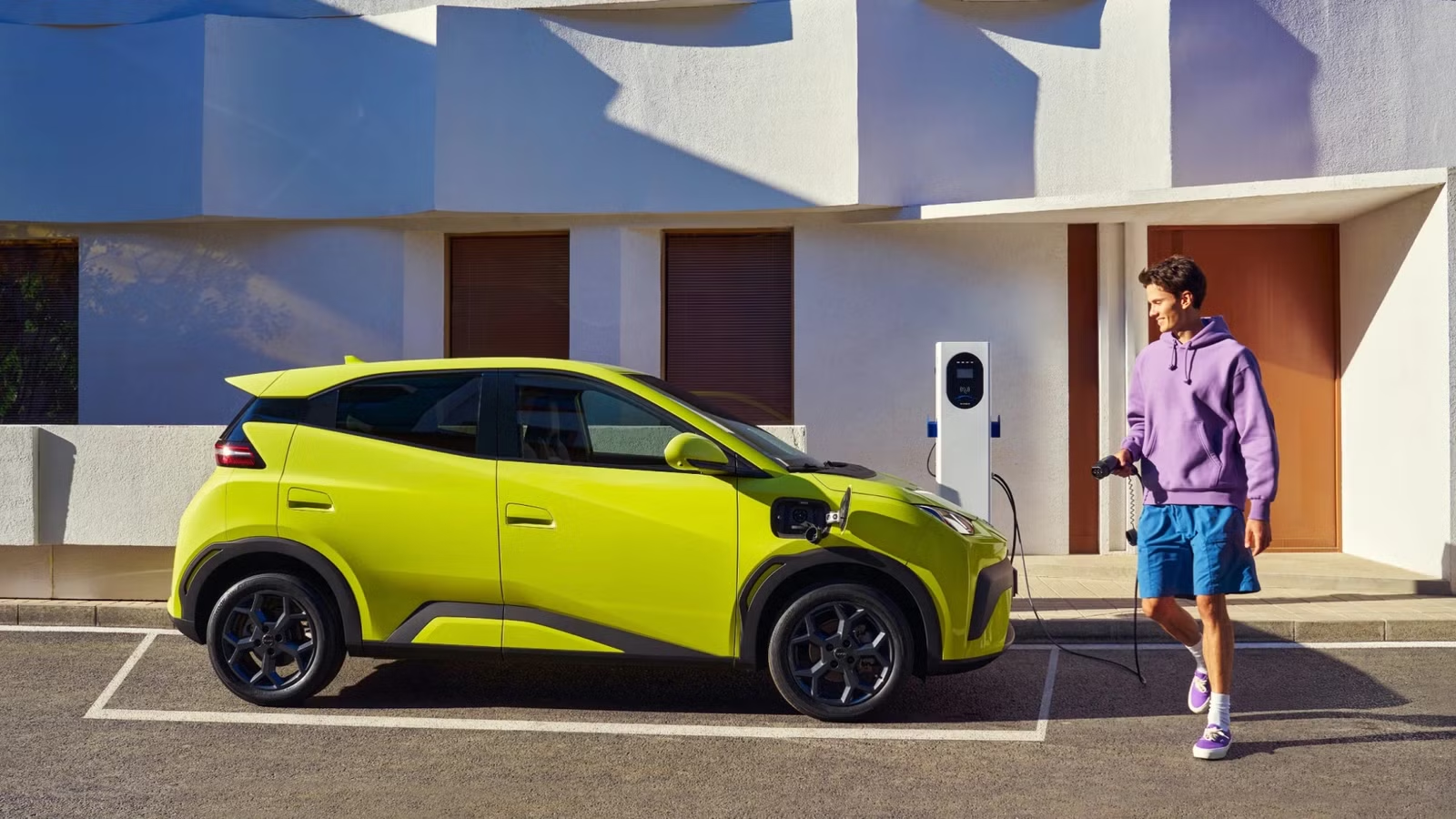
BYD Australia has confirmed a significant administrative error in which customers who ordered and paid for 2026 model-year vehicles were instead delivered 2025 units. The mix-up, reported today, has triggered a formal refund process—but the financial and practical consequences for affected buyers go beyond a simple paperwork correction.

For EV shoppers, a model-year gap isn’t just a number on a sticker. It can mean real differences in battery specifications, software features, available trim levels, and ultimately the price a car fetches on the used market. Buyers who unknowingly accepted MY25 vehicles when they contracted for MY26 models may be sitting on a car that’s worth less, equipped with less, and covered differently than what they paid for.
What The Model-Year Gap Actually Means For BYD Buyers
In the Australian market, the distinction between a 2025 and 2026 model-year BYD matters in concrete ways. Manufacturers typically use annual model-year transitions to introduce updated battery chemistries, revised driver-assistance packages, new connectivity options, or refreshed trim structures. A buyer who contracted for an MY26 vehicle had reason to expect those updates—and a seller who took payment on that basis was obligated to deliver them.


The practical stakes include resale value. Used-car pricing in Australia, as in most markets, is sensitive to model year. An MY25 vehicle, all else being equal, will depreciate faster and command a lower trade-in or private-sale price than an equivalent MY26. For EV buyers in particular—a segment already navigating steeper-than-average depreciation curves compared to petrol equivalents—that gap compounds over time. Affected owners didn’t just receive the wrong year; they received a car with a shorter effective life on the right side of the depreciation slope.
BYD’s Refund Process And What Owners Are Owed

BYD Australia has acknowledged the clerical error and confirmed that a refund process is underway for affected customers. The core question for those owners is whether a refund of the price difference between MY25 and MY26 vehicles fully compensates them—or whether the remedy needs to go further.
Warranty coverage is one area that deserves scrutiny. If MY26 vehicles carry an extended or updated warranty relative to MY25 units, affected buyers may have received a shorter coverage window than they contracted for. That’s not a minor administrative inconvenience; it’s a material difference in the product delivered. Owners should verify whether BYD’s remediation includes warranty alignment—either extending the MY25 vehicle’s coverage to match MY26 terms, or offering a full vehicle exchange where that’s feasible.

Australian consumer law provides a clear framework here. Under the Australian Consumer Law, goods must match their description at the point of sale. A vehicle sold as a 2026 model year that is in fact a 2025 unit does not match its description—which gives affected buyers grounds for a remedy beyond a goodwill gesture. That remedy can include a repair, replacement, or refund depending on whether the difference constitutes a major or minor failure.
What This Reveals About Dealer And Manufacturer Oversight

The BYD Australia situation is a reminder that model-year administration—the process of matching vehicle identification numbers to the correct model-year designation in ordering and delivery systems—is more consequential than it might appear. For a brand that has grown rapidly in Australia and recently overtaken Tesla as the top-selling EV brand in the market, the error points to growing pains in back-end logistics that haven’t kept pace with front-end sales volume.

Affected buyers are in a reasonable position to push for full transparency: a written confirmation of the vehicle’s actual build year, a clear statement of how the MY25 and MY26 specifications differ for their specific model and variant, and a documented remediation offer that addresses both the price differential and any warranty gap. BYD’s willingness to move quickly and completely on those points will say a great deal about how the brand handles accountability as it scales in a market where consumer trust is still being built.
For anyone currently awaiting a BYD delivery in Australia, this is a good moment to confirm the model year on your purchase contract and cross-reference it against the VIN documentation provided at handover. If there’s a discrepancy, Australian Consumer Law is on your side.

Related posts




Latest Post


No Comments