
BMW’s Most Complete Motorcycle Isn’t Its Most Expensive
You’ll surely find some of the most technologically advanced, and even the most expensive, motorcycles under BMW’s roof today. Ask most riders which BMW represents the brand at its peak, and they’ll point to one of two extremes: either a carbon-winged superbike built for tracks, or a six-cylinder tourer built to swallow hundreds of highway miles in armchair-like comfort. Honestly, they aren’t wrong, but it’s not the whole story either.

Be it a GS, a K-Series model, or one wearing an M badge, each of these is exceptional at doing a single job. None of them are built to be everything at once. But away from the distraction of high price tags, the Bavarian bike maker also has a motorcycle in its lineup that actually pulls off sporty performance, touring comfort, and a big bike feel, basically delivering completeness at a cost far less than those mighty BMWs.
BMW’s Most Expensive Bikes Force You To Pick A Lane — And Stick To It
A die-hard track rat would, without any hesitation, choose the M 1000 RR. Someone planning cross-country trips will give you lists of why the K-Series bikes are perfect. A rider dreaming of Cape Town to Cairo will always have a GS parked in their head. This suggests that BMW has an answer for everyone.

However, try swapping their bikes for a weekend. The track rat will sweat fighting the tall, top-heavy GS through a set of tight corners. The tourer’s wrists would be filing complaints by hour two on the M 1000 RR. Every one of BMW’s premium badges asks for a premium price because it nails one job completely, and expects you to accept that it won’t do anything else quite as confidently. This is the exact opposite of what the modern rider demands from a motorcycle: versatility.
The Gap BMW’s Flagships Leave Wide Open

BMW’s priciest offerings bring extreme specialization, but they also leave a big gap wide open. It is something that riders have been asking for: a true one-bike garage, a machine that blends performance and comfort without compromising on either. Achieving that doesn’t require a halo-model price tag; it requires precision engineering, and BMW already has an answer. But does a motorcycle that tries to do everything actually succeed at any of it — or does BMW just end up with a compromised machine that riders quickly outgrow?
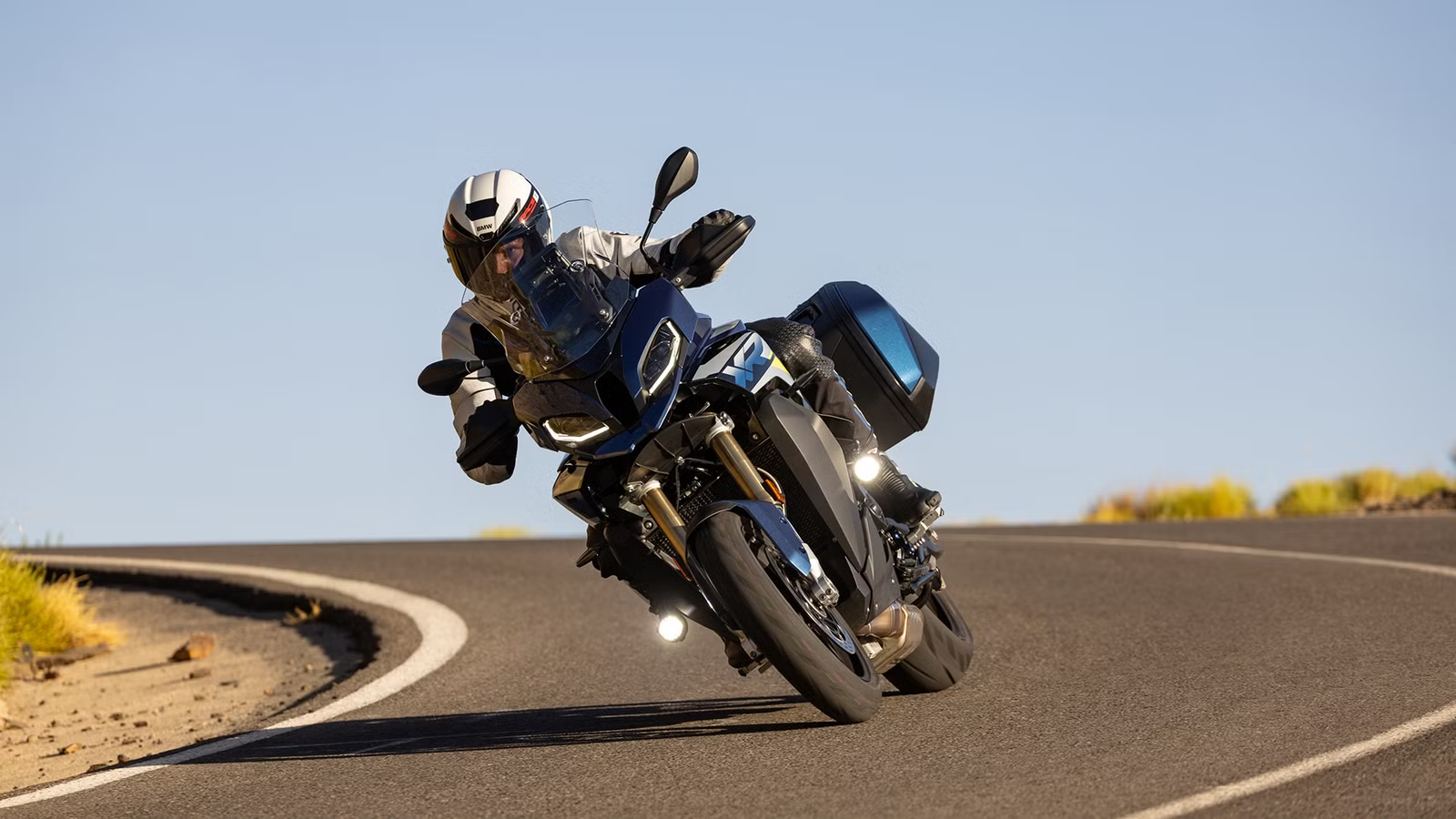
The BMW S 1000 XR Fills The Gap Between Extremes

There’s a genuine debate around the BMW S 1000 XR: is it an adventure bike, a sports bike, or a tourer? The truth is, there’s no clean answer, and that’s kind of the point. Unlike BMW’s flagships, each built to dominate a single lane, the S 1000 XR exists precisely in the space between them, borrowing a bit of DNA from each rather than committing fully to any one.
It picks up the upright stance and all-day comfort that make the GS so easy to live with, the outright performance and sharp dynamics lifted from the S 1000 RR, and the everyday accessibility of the S 1000 R naked bike. Rather than picking a lane like everything above it, the S 1000 XR quietly stitches the best parts of all three together, landing exactly where riders have been asking BMW to build something all along.
At $18,825, The S 1000 XR Costs Half What The M 1000 RR Does

Here’s the part that makes the deal even more interesting. Unlike the expensive BMW models, the base model of the S 1000 XR starts at $18,825, which is roughly half the price of the brand’s most expensive motorcycle, the M 1000 RR. However, the base model doesn’t mean a stripped-down machine. It includes a strong list of standard equipment and a superbike-derived engine, making it BMW’s most well-rounded motorcycle at a substantially lower price.
The S 1000 XR Feels Like Two Motorcycles For The Price Of One

The S 1000 XR offers an opportunity to own a really practical superbike. It is a motorcycle with a sports bike’s heart for performance and a tourer-like comfort for munching miles on a weekend. It also impresses as a commuter; just don’t expect high fuel efficiency, but rather a thrilling ride. That’s basically the magic of this crossover – the ability to change the character depending on the rider’s input and the road ahead.
Powered By A Sport Bike Engine Tuned For The Real World

At the heart of the BMW S 1000 XR sits the legendary 999cc inline-four cylinder engine derived directly from the S 1000 RR superbike. However, rather than chasing the unusable top-end speeds that make sense on a racetrack, the Bavarian bike maker re-tuned this mill for real-world performance. It omits the RR’s titanium valves and ShiftCam technology, and offers massive mid-range punch.
The XR’s retuned engine pumps 170 horsepower, which is 35 horsepower less than the S 1000 RR. However, it delivers similar torque to its sports bike sibling at 84 pound-feet. A six-speed manual gearbox with an assist and slipper clutch feeds power via a chain to the wheel.
Supported By An Aluminum Chassis For Sharp Handling

Backing the engine is a cast aluminum twin-spar frame that uses the engine as a stressed member, paired with a conventional 45mm inverted fork up front and a link-type monoshock at the rear, fully adjustable at both ends. Adding to the package is BMW’s Dynamic ESA electronic suspension, which adjusts damping in real time based on load and riding mode, making the bike feel sharp when ridden around solo and composed when loaded. Braking duties are handled by twin 320 mm discs at the front with standard radial four-piston fixed calipers, and a two-piston floating caliper at the rear.
A neutral riding position, wet weight of 500 pounds, seat height of 33.5 inches, and solid wind protection from the fairing round out a chassis built for multi-day rides, not weekend blasts alone.
A Six-Axis IMU And Full Rider Modes Suite Without Paying M Package Money

The S 1000 XR is offered with a good list of standard equipment. The cockpit features a 6.5-inch TFT color display that is Bluetooth and navigation-enabled. It also gets a keyless ignition function, electronic suspension, adaptive headlamps and an emergency calling feature for more safety. Additionally, a USB socket comes in handy during long rides. The six-axis IMU also opens the door to BMW’s Riding Modes Pro, allowing customization of hill start assist, cornering traction control, cornering ABS, and cornering engine brake control.
However, if you want anything beyond the standard feature set, you would need to pay for the ‘M Package’. By paying a few thousand extra, you get considerably more, including the GPS LapTrigger, M forged wheels, Akrapovic muffler, tinted windshield, M endurance chain, and a different seat.
The Most Complete BMW Has Its Hands Full With Japanese Rivals

With more riders seeking a versatile bike, the sport-touring segment has become significantly competitive. Several Japanese bike makers have already entered this segment, going up directly against the BMW S 1000 XR.

This is arguably the closest thing to real competition here, and not just on paper — it’s priced practically identically to the BMW. It pulls 152 horsepower from an engine layout and displacement nearly identical to the S 1000 XR’s, built from the same liter sport bike lineage. But it doesn’t carry the S 1000 XR’s premium badge or quite the same performance edge, and that gap shows up the moment the road gets technical.

The Kawasaki Versys 1100 is a genuinely capable bike for 500-mile days, but that same focus works against it in this context. It takes a different approach entirely, one built around comfort rather than outright pace. The Yamaha Tracer 9 GT is a lighter, more playful machine in its own right, just not one built to match the BMW’s performance ceiling. The S 1000 XR pulls off a genuine superbike engine and chassis wrapped into a shape built for the everyday, a combination that is hard to beat.
Source: BMW Motorrad

Related posts


Latest Post


No Comments