
BMW M2 Track Kit Hits Goodwood Festival of Speed 2026
Article Summary
- The M2 with the M Performance Track Kit ran Goodwood’s hillclimb days after lapping the Nürburgring in 7:20, half a second quicker than the M2 CS record it broke.
- The gain came entirely from aero and suspension — the S58 engine is untouched — and the kit costs €23,500 before tax when it goes on sale this month.
- The M2 wasn’t entered in Goodwood’s Timed Shoot-Out, so no official hill time exists; the BMW M3 Touring 24H was the brand’s timed entry, finishing fifth at 46.54 seconds.
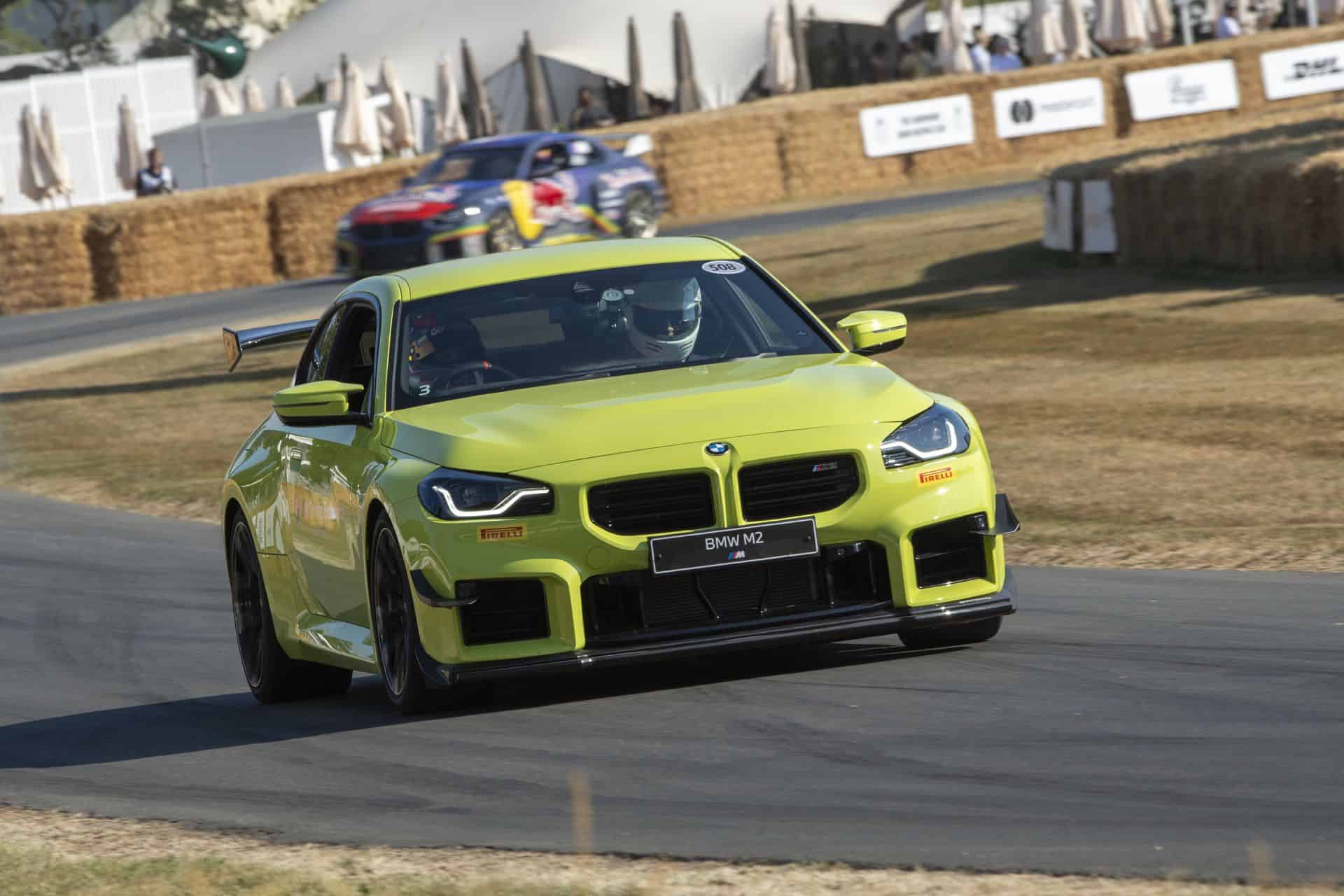
BMW brought two very different M cars up Goodwood’s 1.16-mile hill this year: the one-off M3 Touring 24H race wagon, and a regular G87 M2 wearing the new M Performance Track Kit. The M3 Touring 24H had a number attached to its run. Driven by Jordan Pepper in Sunday’s Timed Shoot-Out, the wagon posted 46.54 seconds, good for fifth outright behind Romain Dumas’s winning Ford Super Mustang Mach-E at 41.97 seconds, a Formula E Gen4 car at 42.46 seconds, a Shadow-Chevrolet DN4 at 46.30 seconds, and a Volkswagen Polo WRX at 46.31 seconds. The outright hill record, set by Max Chilton’s McMurtry Spéirling fan car in 2022, still stands at 39.08 seconds.
The M2 didn’t run in that session. BMW entered it as one of the demonstration cars that climb the hill throughout the weekend rather than qualify for Sunday’s shootout, so there’s no timing sheet to point to for its runs, only the sight of it working its adjustable front splitter and swan-neck rear wing on the way up. That’s a fair trade for BMW. The car’s real credential arrived twelve days earlier and 500 miles away, on a stretch of German asphalt that matters far more to the M2’s reputation than a hillclimb ever could.
What Beat The M2 Around The Nürburgring? Another M2

About a year ago, the M2 CS lapped the Nürburgring Nordschleife in 7 minutes and 25.5 seconds, becoming the fastest production car in the compact segment and knocking the Audi RS3 off the top of the leaderboard. BMW went back to the Green Hell on May 22 for another attempt, this time with a standard M2 wearing the Track Kit rather than the pricier, lighter CS. The result: 7 minutes and 20 seconds, a half-second improvement over the car that set the record in the first place.
BMW says the run came in demanding conditions, with high ambient and asphalt temperatures and oil traces reported in the T13 section. There was more time on the table.
Half a second doesn’t sound dramatic across a 20.8-kilometer lap, but the context is what makes it worth noting. BMW didn’t touch the S58 3.0-liter twin-turbo inline-six to find that time. Every tenth came from aerodynamics and suspension, on the car with less power than the CS it beat.
What’s In The M Performance Track Kit
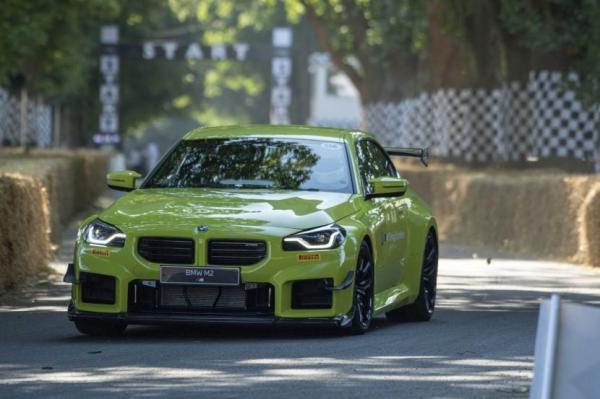

The Track Kit goes on sale this month in Germany at €23,500 before tax and installation. The centerpiece is a carbon-fiber swan-neck rear wing pulled from the M4 GT4 and M4 GT3 customer racing cars, paired with a manually adjustable front splitter. Both are meant for the track only. On the road, BMW requires the aero elements to stay in their standard position.
The rest of the kit is chassis hardware: a coilover suspension with four-way adjustable rebound and compression damping, which BMW calls the first road-legal motorsport-derived damper system of its kind, plus a ride height that drops by up to 20 mm at both axles, adjustable support bearings, and a set of aero flicks alongside the wheel arch diffusers and front splitter. All of it is StVZO-compliant, so a Track Kit car stays road legal even with the hardware fitted.
Where This Goes Next
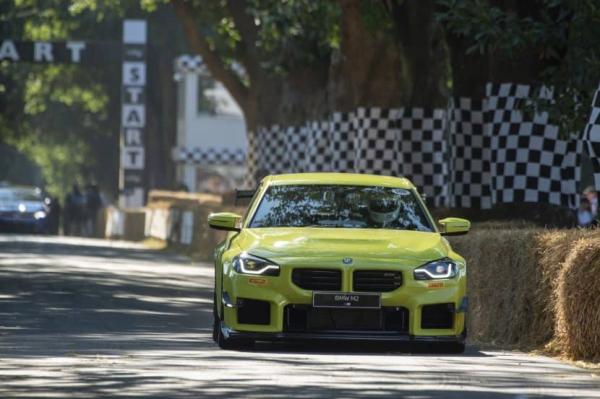
The obvious question is whether BMW puts the Track Kit on an M2 CS and goes back to the Nordschleife. The CS’s extra power and lower weight would make a strong pairing with the aero and suspension gains already on the books, and BMW hasn’t ruled anything out. The new M2 xDrive, which just went live in the configurator, seems a less likely candidate. All-wheel drive adds weight, and nothing about the Track Kit’s development suggests BMW built it with a heavier car in mind.
The G87 M2 is expected to stay in production through the end of the decade, which leaves BMW M plenty of runway to keep working the formula. An M2 CSL has been floated as a possibility before, and every half-second the current car finds only makes that case easier to argue.
[Photos by Hardy Mutschler / BMW Classic ]

Related posts

Latest Post


No Comments