
The Bike That Makes Owners Stop Looking For Upgrades
Every rider knows the itch. A new motorcycle arrives, and for a few months, it feels perfect. That is, until the newness wears off. And the throttle loses its excitement. Before you know it, you’re back on the online classifieds late at night, convincing yourself that you need something new. That’s not your fault, though. It’s a cycle the motorcycle industry thrives on. Every time a new model rolls out with more horsepower and more electronics, it tempts you to trade in your keys, only to discover that more power isn’t actually the cure. But a few rare motorcycles actually break that cycle. These aren’t the ones with the flashiest spec sheets, yet they still make riders feel excited every time they ride them. There’s one middleweight in particular that’s built an entire reputation on doing exactly that.
Chasing The “Best” Rarely Leaves A Rider Satisfied

Who wouldn’t feel the urge to upgrade when we see a new bike that has more power, better suspension, and modern riding aids than ours? “It would surely be the best motorcycle,” is the first thought that pops into our heads. But that’s a trap. The flashier spec sheets are actually the spiral that pulls us in every time, and later, we trade this motorcycle for something better. And this chase becomes never-ending.
We climb from lightweight commuters to 600cc sports bikes, and eventually to 200-horsepower superbikes, convinced that maximum displacement is the ultimate destination. But as we eventually discover, buying a bike solely for its impressive numbers rarely results in a machine you actually want to keep in your garage forever.
Maximum Not Always Means Forever

Surely, a liter-class sports bike would bring more fun, but that doesn’t guarantee keeping the first-day excitement alive years down the road. It might be engaging on the racetrack, but you can’t even use 75 percent of its power in the real world. This makes the chase of finding the forever bike more stressful.

The bikes that actually get ridden year after year tend to be the ones that never tried to win a numbers war in the first place. They’re tuned for how a rider feels in the fifth year of ownership, not just the first ride home from the dealership. That’s a much harder trick to pull off, and very few manufacturers have managed it more than once.
The Suzuki GSX-R750 Stops The Search For Better

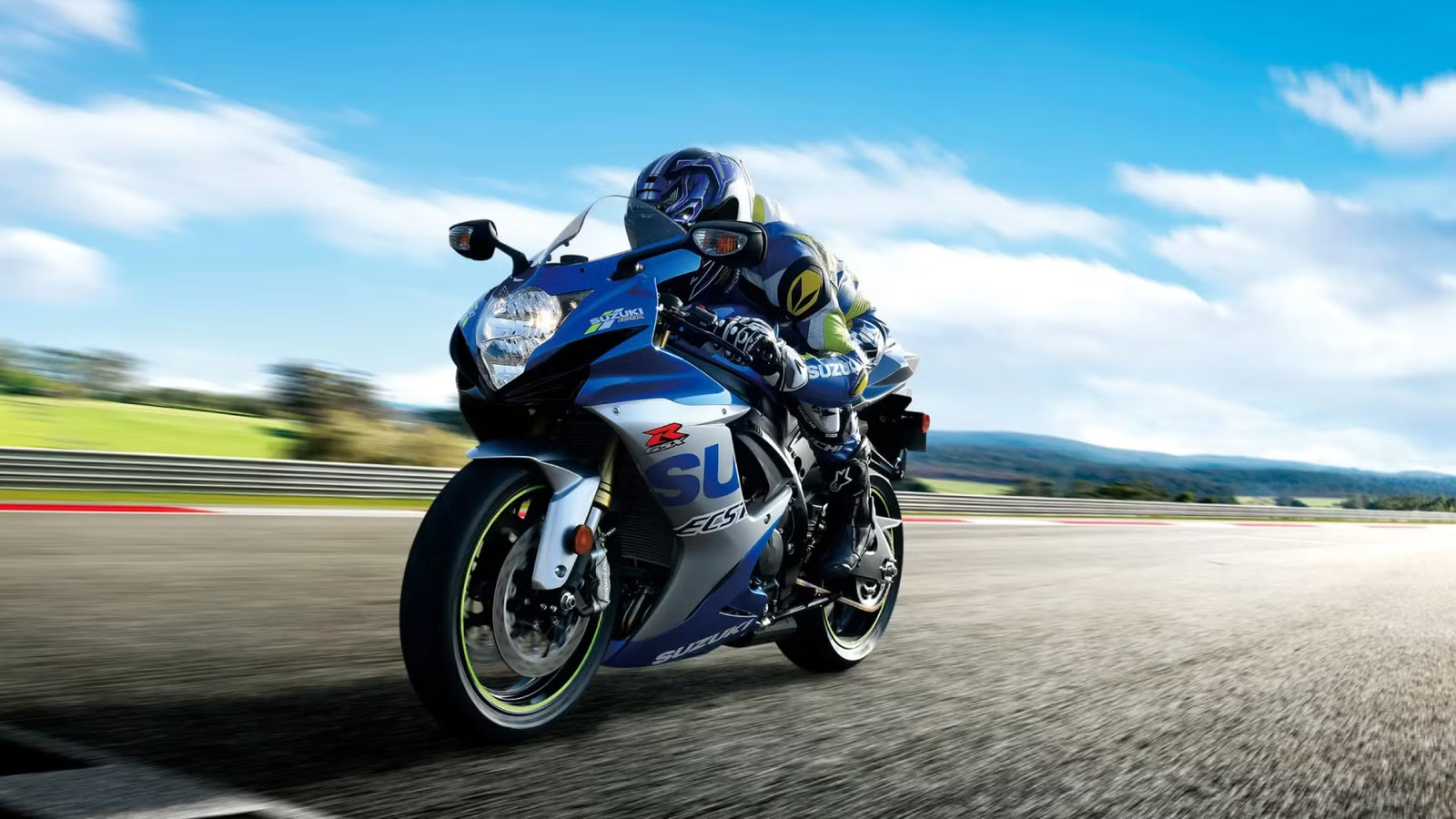
One such bike that stops your search for the best is the Suzuki GSX-R750. Compared to current motorcycle standards, this Suzuki might feel a bit outdated. It lacks modern riding aids and even a TFT display. It might feel like a compromise, but this simplicity actually elevates its unique riding experience, making it quite a perfect bike for seasoned riders. That said, setting the features aside, you still get a hardcore, track-going sports bike paired with bulletproof reliability, everyday efficiency, and incredibly low running costs.
At $13,249, It Offers An Excellent Power-To-Price Ratio

The Suzuki GSX-R750 carries an MSRP of $13,249. That’s a genuinely accessible price you’d pay for a sports bike that provides a race-proven four-cylinder experience that most of its class simply doesn’t offer anymore. It is one such high-performance machine that provides liter-class-like fun. Additionally, the Suzuki is quite cheap to maintain too, which is a big plus. Many prior owners have claimed that their bikes need only routine maintenance and can easily rack up 30,000 to 50,000 miles, with plenty of life left.
This Mid-Weight Brings Liter-Class-Like Fun

The Suzuki GSX-R750 is slotted between the GSX-R600 and the GSX-R1000. Why did we mention that? The R750 takes the lightweight, compact frame of a 600-class sports bike, and stuffs a 750cc engine inside it. This combination gives the Suzuki 600cc-like agility, while the 750cc engine delivers engaging performance. This allows it to hit a sweet spot its siblings miss out on.
Take the GSX-R600, for example. Its high-strung engine needs to be revved hard to find the fun on public roads. It lacks torque in the lower half of the rev range. On the flip side, the modern GSX-8R is simply too street-biased and lacks the raw, aggressive supersport DNA to even enter the conversation. The GSX-R750, for that matter, is a bike that borrows the best traits of two completely different categories rather than settling in the middle of both, eventually ensuring the rider never outgrows it.
The 750cc That Keeps Entertaining For Long

At the heart of this mighty Suzuki is a 750cc liquid-cooled, inline-four engine. It is the last of its kind and a fierce one at that. It pumps out 148 horsepower and 63.7 pound-feet of torque. This mill is claimed to produce strong power delivery higher in the rev range, and feel calm, smooth, and completely non-threatening at lower speeds, giving the bike a best-of-both-worlds advantage. Power is sent to the rear wheel via a six-speed manual gearbox with a slipper clutch and a final chain drive. With that, it becomes an exciting motorcycle for beginners looking for an upgrade, while also keeping seasoned riders entertained.
Racing DNA In The Chassis Department

The 750cc engine hangs in a twin-spar aluminum frame that offers a perfect balance between weight and strength for a sharp riding experience. The chassis rides on race-developed, fully adjustable Showa suspension, with a 41 mm Big Piston fork up front and a monoshock at the rear. Braking duties are handled by dual 310 mm fully floating discs with Brembo monoblock four-piston fixed calipers at the front, and a 220 mm disc coupled to a Nissin single-piston fixed caliper at the rear.
The bike rides on 17-inch lightweight alloy wheels at both ends. Speaking of lightweight, the aluminum frame helps keep the bike’s wet weight at a low 419 pounds. It’s the kind of specification sheet that keeps rewarding a rider long after the first few thousand miles, rather than one that’s exhausted after the first weekend.
Simple Electronics Keep The Raw Feel Alive

In an era where new supersport bikes arrive loaded with cornering ABS, wheelie control, launch control, and multiple riding modes, the GSX-R750 offers a comparatively direct, unfiltered connection between rider and machine. This Suzuki uses an analog tachometer on the instrument panel, while the speed, ride mode, and gear position are displayed via an LCD screen.
Other notable rider aids are an electronic steering damper and the Suzuki Drive Mode Selector (S-DMS), which simply lets you toggle between unleashing 100 percent or a dialed-back 70 percent of the engine’s total power. The Suzuki’s 750cc engine delivers power progressively, which is why there is no absolute need for a traction control system or a wheelie control.
No Midweight Sports Bike Matches The Appeal Of The GSX-R750

While the Suzuki GSX-R750 feels dated due to lacking modern features, the picture becomes clear when we put this model next to its closest rivals. Take the Ducati Panigale V2, for example. It is built around a 890cc V-twin producing 120 horsepower and 69 pound-feet of torque. All of this at an MSRP of $16,995. It is a genuinely accomplished middleweight that delivers lightweight, punchy performance, but it asks for a premium price and offers less peak power than the Suzuki.

MV Agusta’s F3 R packs in a 798cc triple that produces 147 horsepower, which is similar to the GSX-R750. But just like the Panigale V2, the F3 R comes with a high price tag. This ultimately gives the GSX-R750 a far superior price-to-power ratio.

The Yamaha YZF-R9 undercuts the GSX-R750 on price at $12,499, powered by an 890cc three-cylinder engine, producing 117 horsepower. It’s a genuinely fun bike and a strong value, but the GSX-R750’s inline four-cylinder engine offers much more power and less weight. While each bike provides its own unique value, nothing comes close to the GSX-R750’s blend of proven racing pedigree, four-cylinder character, and everyday usability, all at an accessible price.
Source: Suzuki Cycles

Related posts



Latest Post


No Comments