
Arkla Handywagon: America’s First CVT Pickup Truck
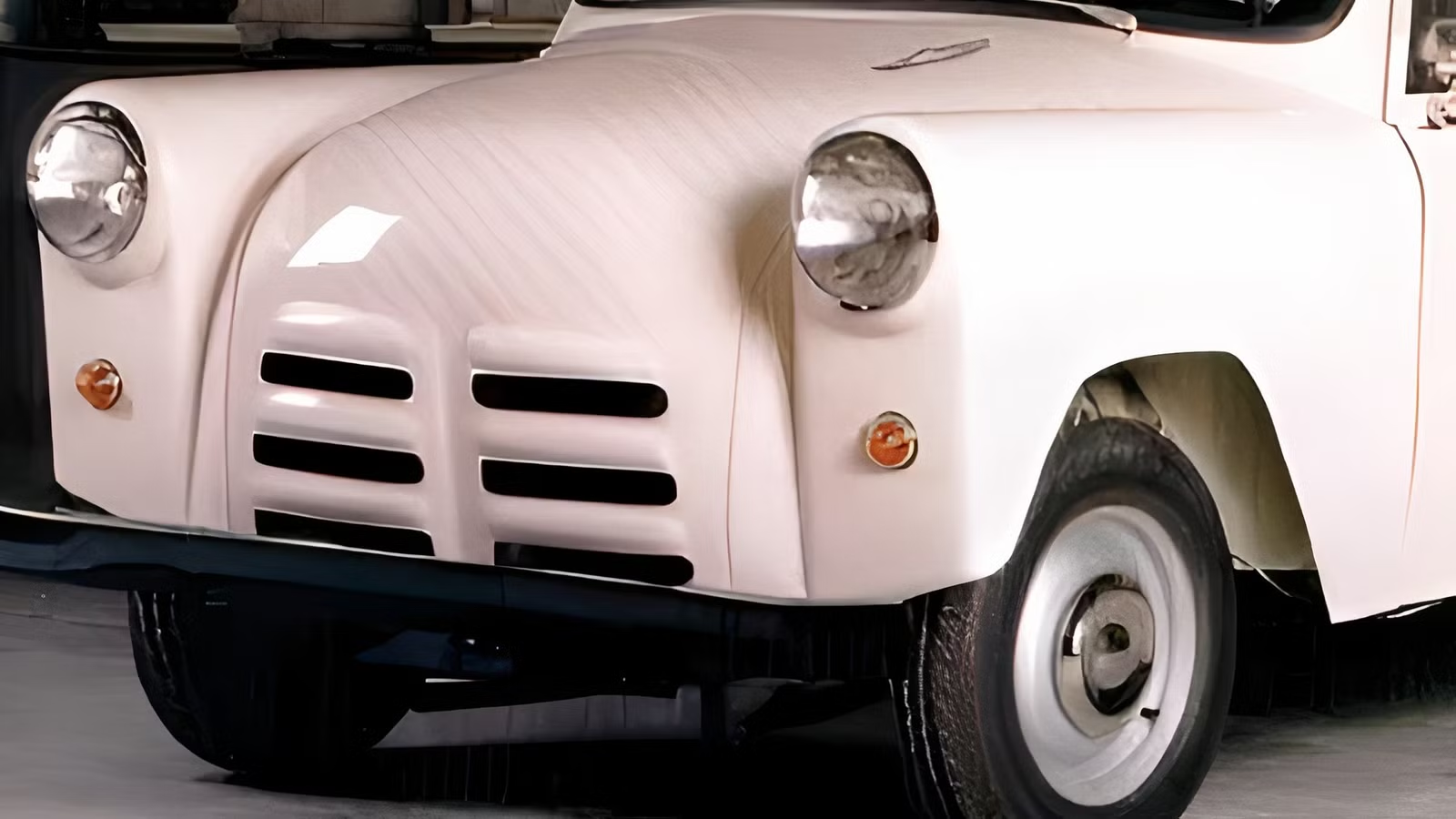
Ah, CVTs. You know them, and you probably hate them. Mostly, because they’ve infiltrated basically every automotive form factor that isn’t a truck or a big SUV while kicking normal automatics to the curb. It seems like a plague, as if every OEM decided in unison that CVTs were better for the bottom line, and that consumers didn’t have a say in it anymore. Funnily enough, CVTs started as something altogether different. In the beginning, they were an ingenious and advanced method of squeezing the most performance out of not very much. Decades ago, a tiny firm in Arkansas proved it in real time.
From Humble Beginnings in Arkansas

When you hear the name “Arkansas Louisiana Gas Company,” or Arkla for short, you don’t automatically think “carmaker,” do you? You wouldn’t be wrong, as the company was just your typical natural gas supply company, founded in 1934 via the merger of several smaller pipeline installers and servicers in Arkansas and neighboring Louisiana, the earliest of which dated back to 1905. For its first three decades of operation, there was no indication whatsoever that the company would be anything more than a copy-and-paste private utilities company like any other in the United States. That was, until 1963, when a humble gas utility company turned into something “more.”
The impetus for this profound change came from none other than Arkla’s Chairman and leading man, a man named Wilton “Witt” Stephens. A native of a small farming community in Grant County, Arkansas, Stephens rose to prominence operating one of the largest stock brokerage firms outside of Wall Street. His father, A.J. “Jack” Stephens, served two terms in the Arkansas House of Representatives, something Witt himself would also do while concurrently serving as a senior executive at Arkla. Witt Stephens stepped into the gas business after World War II, where his sales repertoire, honed selling odd things like belt buckles, jewelry, and bibles earlier in life, was put to great use selling natural gas across multiple states.

So great were his skills in sales that Stephens even made a profit during the Great Depression. It was only in 1963 that a peculiar idea came into his brilliant mind. Years of operating heavy V8 utility trucks from brands like Ford, Dodge, and Chevrolet proved that they were overkill for the task of checking gas meters and delivering light loads day in and day out. Put simply, they were a waste of fuel, even at a time when gas or diesel cost pennies on the dollar. At a time when the concept of the light truck wasn’t really a fully formed idea, it was Witt Stephens who figured that taking the idea to its logical endpoint would cut operating costs in a meaningful way. From there, he assembled a team, and boy did they have some ambitions in mind.

Building a CVT Light Truck From Scratch

Stephens’ team consisted of just three men: himself, his corporate lawyer Ray Thornton, and Arkla pipeline construction foreman and all-around mechanical whiz Ed Handy. It sounds like the cast of a decent buddy comedy, but Stephens’ list of requirements was anything but funny. Rather, sticking to a strict limit of a 900-lb payload capacity and a curb weight of under 3,000 lbs or 1.5 tons was simply non-negotiable. Crazier still, the truck needed to pull no less than 35 miles per gallon. Given that the muscle car wars were set to kick off any minute by 1963, that kind of efficiency was simply unheard of. Even by 2026 standards, that’s pretty darn good for a non-hybrid.
To get there, the team designed a truck with a custom body-on-frame steel chassis welded together at Ed Handy’s private shop, near the premises of Arkla’s executive HQ in Little Rock. The fiberglass body, on the other hand, needed to be outsourced. Specifically, to the Razorback Boat Company in nearby Malvern, which Arkla had purchased outright in 1959. The boat manufacturer designed the fiberglass cab and bed from scratch on-site, right next to the same production line where it built fishing boats. The powertrain? Well, that was a different matter entirely.

In theory, Arkla could have used something like a motorcycle engine or even one out of a large riding lawn mower. And yet, the group decided to import a 746cc air-cooled flat-twin engine from the Dutch automaker DAF. With 30 horsepower, the motor was the perfect pairing for DAF’s “Variomatic” transmission. Consisting of a set of rubber V-belts mounted to a pair of adjustable pulleys driving each rear wheel independently, the system did not use a conventional reverse gear. Rather, a switch in the cab changed ratios until the truck could reverse just as quickly as it could drive forward. Compared to modern ECU-controlled hydraulic steel-belt CVTs, the Variomatic was remarkably straightforward. When it all came together, what resulted was nothing short of stunning.
The Arkla Handywagon: The Purest Form of American Light Truck

On first impressions alone, the Arkla Handywagon almost doesn’t look real. Rather, it looks like something you’d see in a children’s cartoon, its charm almost anthropomorphizing the truck with its peppy front grille and adorable headlights. Make no mistake, it was a true-to-form work vehicle. Just one that wouldn’t cost the modern equivalent of hundreds of dollars per week in fuel costs to check gas meters and replace pipes.
With performance just sufficient enough to tootle around Arkansas backroads and the occasional highway, the Handywagon fulfilled its promise of being more efficient than big V8 gas hogs. Not that it had to struggle much to do so, as the average fuel economy for an American half-ton V8 pickup like a Ford F-100 or Chevy C10 was lucky to hit low-teen mpg. Under constant load, it often hit single digits. Even better, Arkla could manufacture Handywagon trucks at a fraction of the cost of Ford, GM, or Chrysler. It’s widely believed the projected production price per item was expected to be $1,000 in 1963/64 money. Adjusted for inflation, that’s roughly $10,200 in 2026 money.

Take note, Slate. People lose all perspective when a manufacturer claims a bare-bones EV pickup will sell for well past double that. If nothing else, it proved how thoroughly consumers are being fleeced in the modern truck market. The only problem was that Arkla couldn’t actually manufacture Handywagons for the price tag they’d aimed for. The lowest they could reduce it to without taking a significant loss on each internal sale was $1,240, or $12,700 in modern money. Whether that alone was enough to kill the project remains a subject of debate. What’s more certain is, while a steady production pace of one unit per day seemed promising, the project ground to a screeching halt after only 97 units were built. Considering the initial goal was no less than 1,000 units, this was well short of expectations.
The First and Only American CVT Truck for 60 Years

Each of those 97 Handywagons lived fruitful lives in Arkla service, staying in company hands for at least a decade. Ironically, they all left service just as a massive oil crisis that killed the muscle car era would have made a vehicle like the Handywagon an instant hit. Legend has it that Witt Stephens expressed deep regrets that he didn’t soldier on with production.
One shudders to imagine an alternate timeline in which it was Arkla, not Tesla, that became America’s fourth major automaker, simply by virtue of offering a unique American vehicle that consumers actually wanted to buy. Believe it or not, we came closer to that reality than most people will ever admit, or even be aware of. Simply fitting a sedan body to the same chassis reveals the potential latent within. On the list of all-time great “what ifs” in American automotive history, that’s got to be right up there with the Tucker Model 48 and the Chrysler Turbine car.

Today, only three Handywagons survive: two in the US and one at the DAF Museum in the Netherlands. Meanwhile, an American OEM would not build another CVT-equipped pickup truck until the Ford Maverick Hybrid hit the market in 2022. Fifty-eight years ahead of the curve. That’s the kind of foresight that people usually get medals for.
Source: Encyclopedia of Arkansas, DAF Museum, DAF Club Netherlands

Related posts

Latest Post


No Comments