
America’s Next Great Hot Hatch Could Be The 2028 Dodge GLH
Dodge has confirmed that the GLH name is coming back, and the gameplan sounds pretty simple: build an affordable entry point into Dodge performance. If current projections hold, the new muscle hatch should arrive for the 2028 model year with around 300 horsepower.

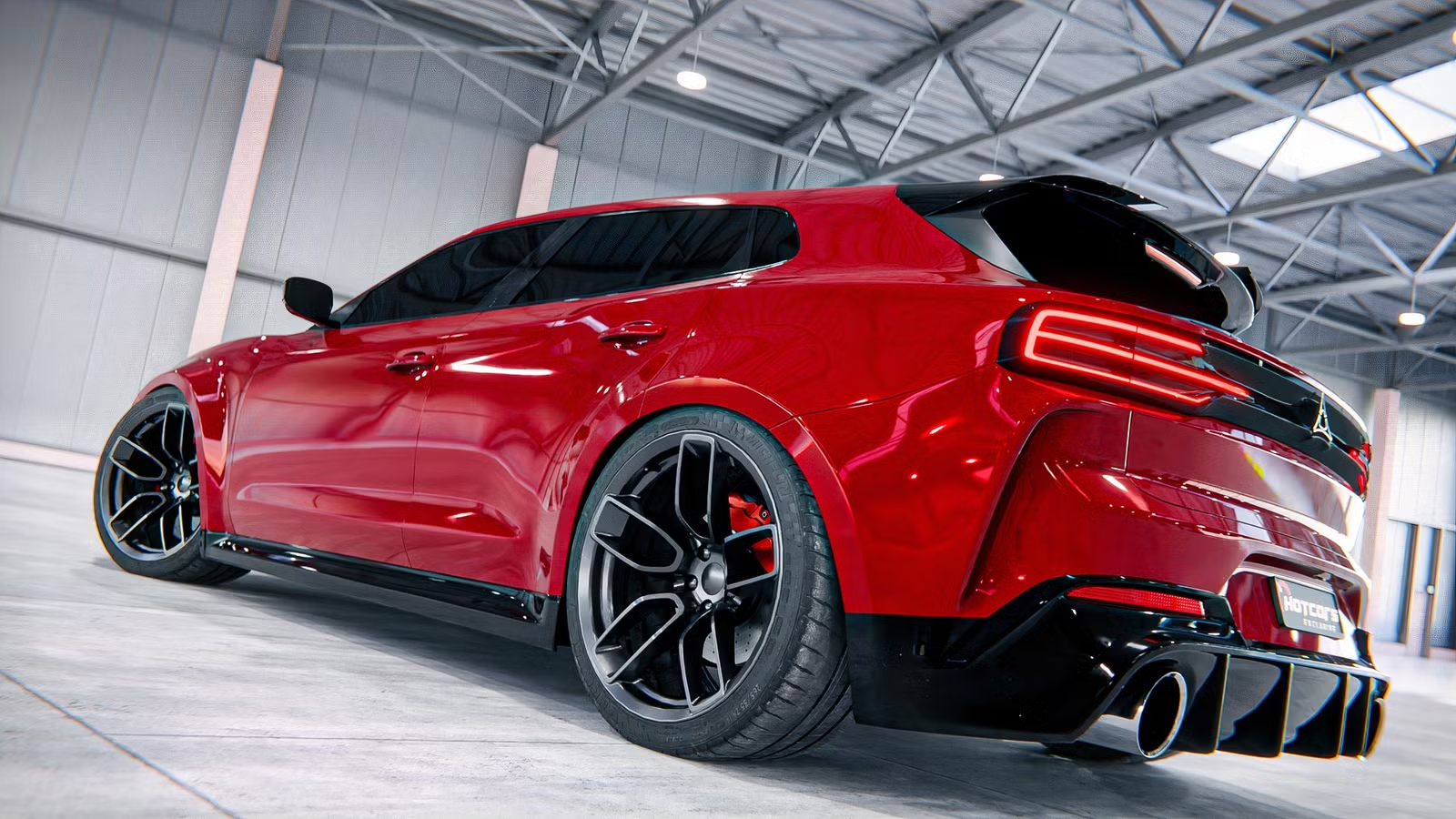
Our reimagining nudges that idea along, turning the upcoming Dodge GLH into a low, wide SRT hatch that looks ready to make the daily commute considerably more fun.
The 2028 Dodge GLH Brings Muscle Car Attitude To A Hot Hatch
Dodge has described the new GLH as a ‘muscle hatch’, which is key. The production model’s expected to replace the Hornet’s role in the lineup, but Dodge has already suggested the formula will change substantially. Tim Kuniskis has characterized it as the next gen Hornet done the way Dodge should have done it originally, while the brand has positioned the GLH as an entry-level performance vehicle. In all, that points toward something more focused than a normal compact crossover with a hotter trim level attached.

That gives this 2028 Dodge GLH plenty of room to get aggressive, especially the way we’ve imagined it. The body sits lower than a conventional crossover, with a stretched roof, heavily blistered fenders, slim LED lighting, and a planted stance that reads more hot hatch than SUV. Up front, a deep center intake and prominent hood scoop push the design toward SRT territory, while the black grille panel gives the nose a clear Dodge performance identity. Large wheels, meaty tires, and oversized brakes complete the visual argument without turning the car into a strange one.
As for the rear, a full-width lighting graphic sits beneath the glass, with a roof spoiler above and a huge diffuser below. Two oversized exhaust outlets leave little doubt about the intended powertrain, while the SRT badge makes the purpose pretty obvious. Too much? Well, Dodge has confirmed that the revived GLH will get an SRT version, so that badge is part of the plan. The production model may end up taller and less extreme, but the idea of a GLH SRT with this sort of visual aggression fits the brief perfectly.
Underneath, the new Dodge GLH is expected to use Stellantis’ STLA One architecture, shared with the upcoming Chrysler Airflow. The platform is designed to support internal combustion, hybrid, and electric powertrains. For American buyers, that flexibility could also help Dodge give the GLH the practicality the Hornet struggled to deliver, including a roomier back seat and more useful cargo space.
The 2028 Dodge GLH Could Make More Than 300 HP

Official 2028 Dodge GLH specs haven’t been released, but Dodge has already given us a useful target. Stellantis CEO Antonio Filosa has discussed an engine making roughly 300 horsepower, and current expectations center on the turbocharged 2.0-liter Hurricane 4. In the Jeep Grand Cherokee, that engine produces 324 horsepower and 332 lb-ft of torque, showing what the hardware can already support.
It doesn’t take a genius, then, to figure a smaller, lighter Dodge GLH with similar output could be properly quick. The Grand Cherokee weighs nearly 4,900 pounds yet can reach 60 mph in 6.3 seconds with the Hurricane 4. The GLH should carry considerably less mass. Front-wheel drive remains possible for an entry-level model, while higher-performance versions are expected to favor all-wheel drive and an automatic transmission. Dodge could also use chassis tuning, quicker steering, bigger brakes, and firmer adaptive dampers to give the GLH a personality that horsepower alone can’t provide.
Where A Modern Hatch Should Sit

Then there’s the Dodge GLH SRT. Its horsepower remains unknown, but a higher-output Hurricane 4 tune seems like the simplest answer. STLA One also leaves open the possibility of hybrid assistance, which could add torque and push the SRT beyond the regular model. Around 300 horsepower would already put the GLH near the 315-hp Honda Civic Type R and 328-hp Volkswagen Golf R. The Charger’s Hurricane inline-six, however, has effectively been ruled out because it won’t fit beneath the GLH’s hood. That keeps the focus where a modern hot hatch should be: compact dimensions, usable power, and a chassis that can exploit both.
Dodge Can’t Afford To Get The GLH Wrong

The GLH badge has history to live up to. The original Dodge Omni GLH arrived for 1984 with a 110-hp 2.2-liter four-cylinder, firmer suspension, upgraded brakes, sharper steering, and aluminum wheels. Carroll Shelby later turned up the boost, and the 1986 GLH-S reached 175 horsepower and 175 lb-ft of torque. Just 500 examples were ordered for the Shelby transformation. GLH meant ‘Goes Like Hell’ while GLH-S, quite naturally, became ‘Goes Like Hell S’more’.
The new car will be bigger, heavier, safer, and vastly more powerful, but the old formula still gives Dodge a useful roadmap. The GLH worked because it started with affordable transportation and concentrated its upgrades where enthusiasts could feel them. A modern Dodge Omni GLH successor doesn’t need outrageous horsepower. It needs usable space, real chassis tuning, strong turbocharged power, and a price that brings younger buyers into the brand.
Living Up To What Mattered

An official 2028 Dodge GLH price hasn’t been announced just as yet, but current projections suggest the regular model could start below $39,000, possibly as low as roughly $32,000, while the GLH SRT may land around the $40,000 mark. The STLA One platform is expected to launch in 2027, with the Dodge GLH projected to reach showrooms for the 2028 model year and sales potentially beginning in late 2027.
Given that, it leaves Dodge an opportunity to create more than another Hornet. This render shows one compelling direction: a five-door American hot hatch with muscle car stance, around 300 horsepower to start, and an SRT model waiting above it. If Dodge keeps the price within reach and gives the chassis as much attention as the styling, the 2028 Dodge GLH could become exactly what the badge once represented: practical enough to use, affordable enough to matter, and fast enough to justify the name.

Related posts






Latest Post


No Comments