-
 Bring a Trailer
 -
 Bring a Trailer
 -
 Bring a Trailer

A Twin-Turbo LS1 Mid-Engine C2 Corvette Built In 2007 Just Sold On BaT, And It Beat The C8 By 13 Years
4 minutes reading
Sunday, 13 Sep 2026 12:00 0 7 autotech
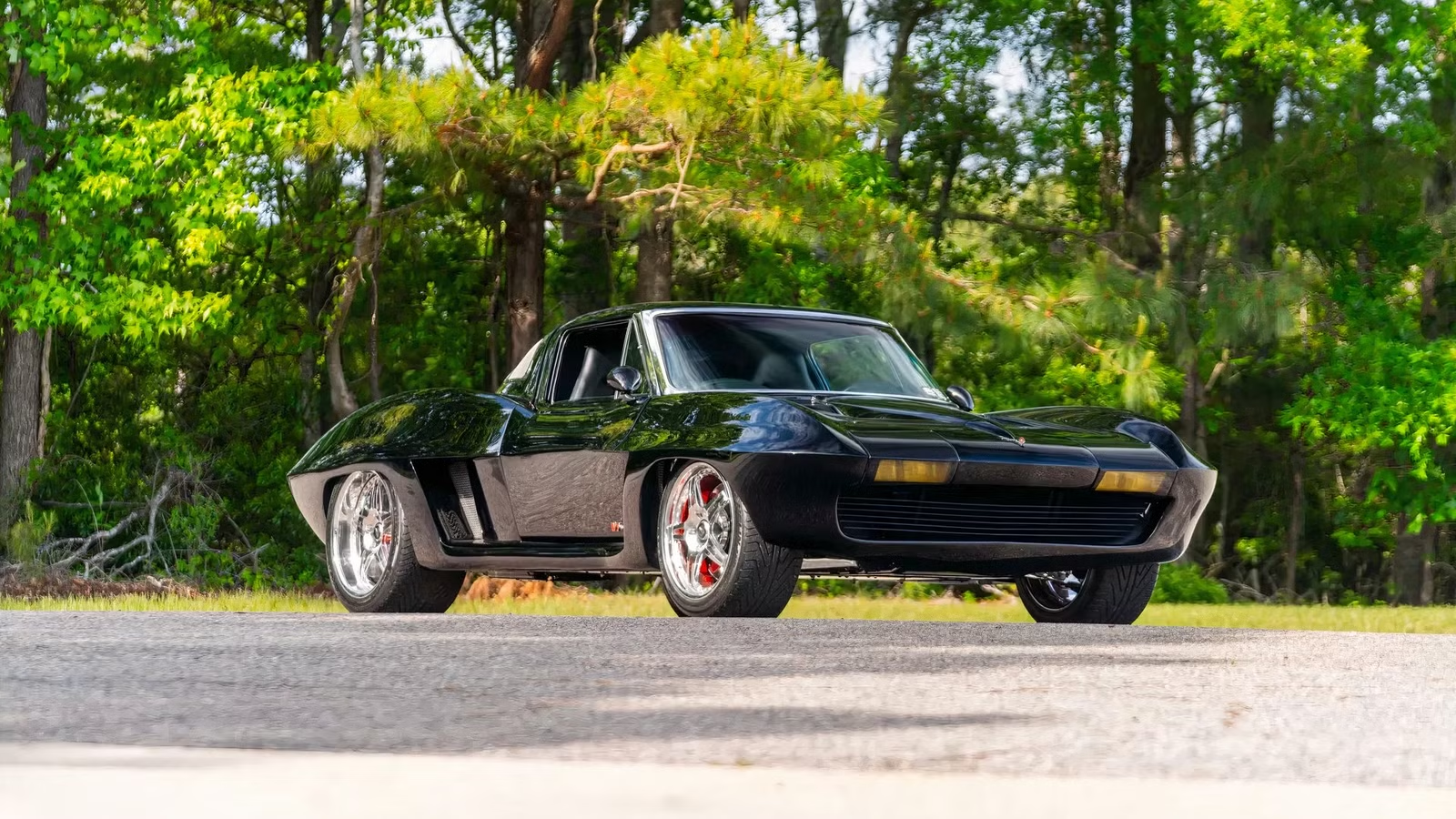
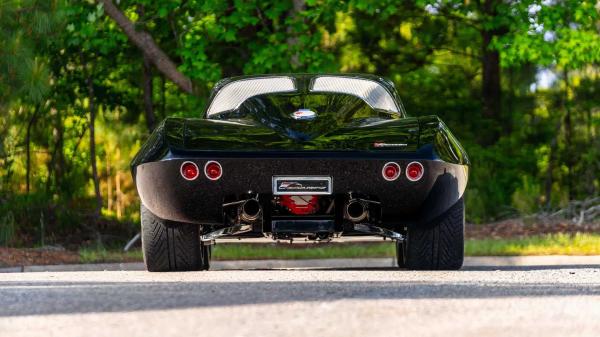
Long before Chevrolet’s engineers signed off on the C8, one builder had already solved the mid-engine Corvette problem — with a twin-turbo 395 CID LS1, a custom ladder frame, and a Mendeola transaxle tucked behind the seats of a C2 body. The car was completed in 2007. The C8 debuted in 2020. That’s a 13-year gap, and it just closed on Bring a Trailer for $65,500.

38 autotech
The auction result puts a concrete number on a question the Corvette community has been quietly asking since the C8 arrived: when the factory finally catches up to what private builders already built, what happens to the value of the original? That question doesn’t have a clean answer — but $65,500 for this level of engineering is at least a starting point for the conversation.
What It Took To Move The Engine Behind The Driver
Relocating a Corvette’s engine to the middle of the car isn’t a bolt-on exercise. The builder here started with a C2 body — specifically one wearing the iconic split-window roofline that Chevrolet offered for exactly one model year in 1963 — and essentially reimagined every structural dimension around the new layout.

33 autotech
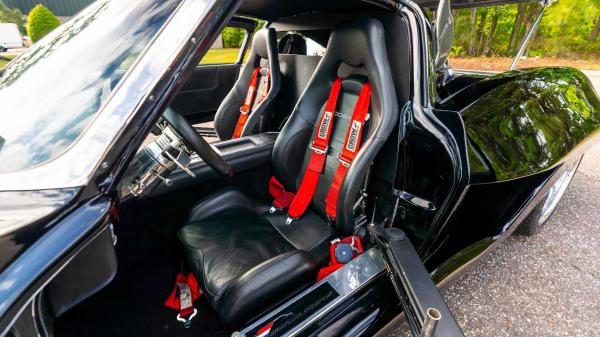
The cabin was moved forward two feet to clear space for the engine bay behind the seats. The body was widened by 10 inches and shortened by three inches. A custom high-strength ladder chassis replaced the original frame entirely. Up front and out back, the suspension is fully independent, with Penske adjustable shocks at all four corners and Baer disc brakes on every wheel. The rear tires are 345/30-R19 — wide enough to hint at the power waiting behind the driver.
The Mendeola five-speed sequential gearbox sits adjacent to the engine in a true transaxle layout, housing the differential in the same unit. That arrangement eliminates the long driveshaft run of a traditional front-engine, rear-drive setup and delivers power to the rear wheels with far less mechanical loss — exactly the geometry Chevrolet would eventually adopt for the C8 Stingray.
The Engine: A 395 CID Twin-Turbo LS1 Built For Serious Output

The powerplant is a stroked LS1 displacing 395 cubic inches, built around the Hot Rod Project Blueprint program — a structured framework for high-performance engine builds that specifies exact components and tolerances. Inside, a Lunati forged crankshaft handles the rotating assembly. Fueling is handled by electronic injection rather than a carburetor.
Force-feeding the whole package are two 77mm turbochargers from Re-Source, cooled by a custom liquid-cooled race Aero intercooler. The builder did not publish official horsepower figures, and the Bring a Trailer listing doesn’t supply them either — so any number here would be a guess. What’s not a guess is that 77mm turbos on a built 395 CID LS1 represent a serious commitment to output, well beyond what a stock C8 Stingray’s 6.2-liter LT2 produces from the factory.
The C8 Arrived, And Now The Resale Question Gets Complicated
The C8 Corvette launched in late 2019 as a 2020 model and validated everything this builder had already done: engine behind the occupants, cabin pushed forward, transaxle at the rear, wider track than any previous Corvette. Chevrolet’s version starts well under $70,000, comes with a factory warranty, and is available at dealerships.
That context makes the $65,500 BaT result worth examining carefully. On one hand, it’s a strong result for a one-off restomod with no documented horsepower figures, no factory backing, and the inherent unknowns that come with any custom build. On the other hand, a buyer spending that money now has a genuine choice: a bespoke piece of fabrication history that predated GM’s own solution by over a decade, or a new C8 with full support infrastructure. The 43,506 views and 1,930 watchers the listing attracted suggest the market found the car genuinely compelling — but whether the C8’s existence put a ceiling on what a build like this can fetch is harder to say.
What’s clear is that the builder wasn’t waiting for Chevrolet’s permission. In 2007, the mid-engine Corvette was still a rumor, a concept car footnote, and an engineering debate that GM had been circling for decades. This car was already on the road.
For Corvette enthusiasts and restomod builders, the $65,500 sale is worth tracking as a data point — not just for what this car is worth, but for what it represents. Custom builders have been ahead of the factory before, and they’ll be ahead again. The question is whether the collector market rewards that foresight once the factory catches up.
Source: Bring a Trailer

Related posts





Latest Post


No Comments