
The Performance Sedan From The ’90s That Deserves More Attention
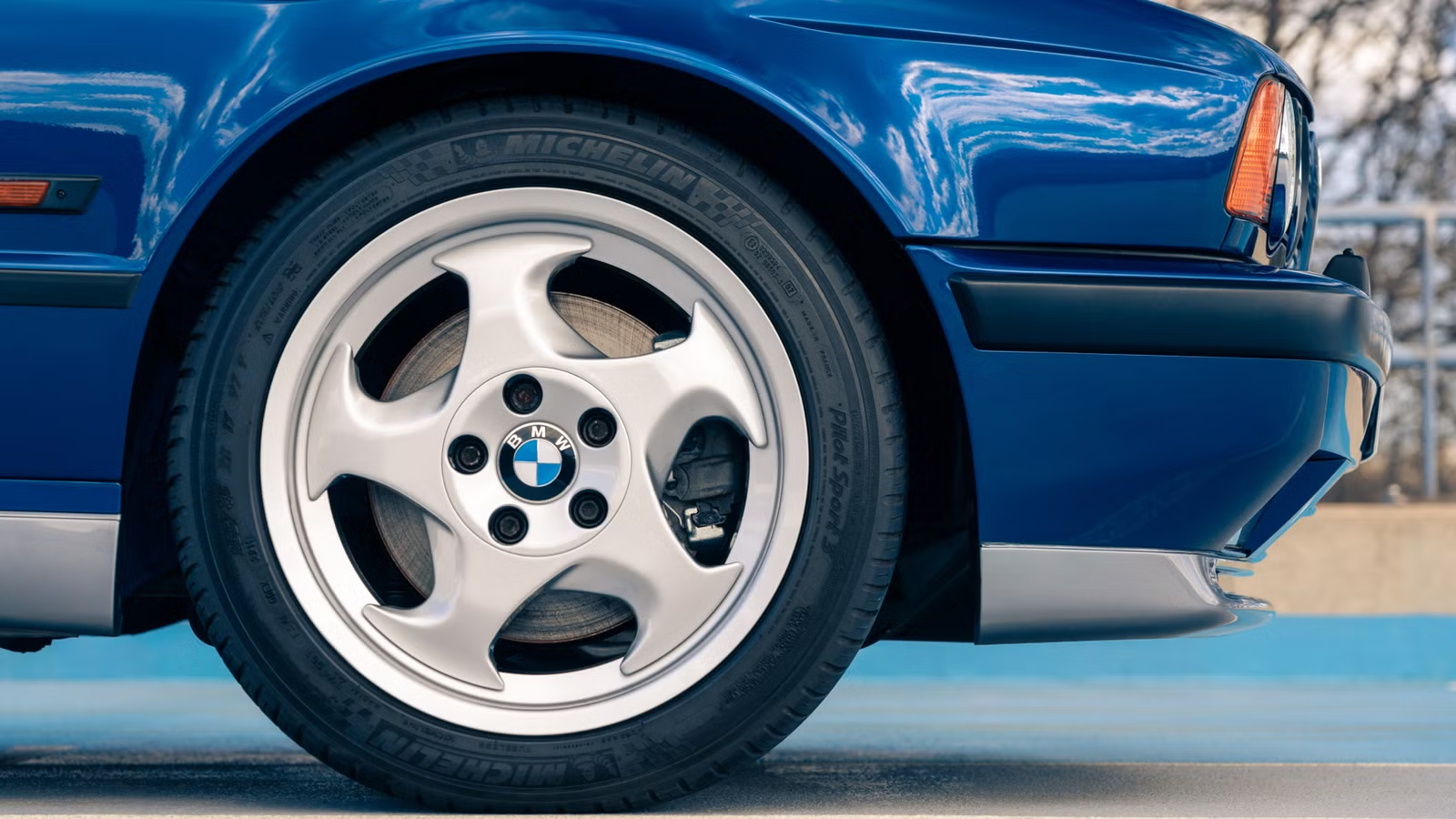
The 1990s transformed the performance sedan. Manufacturers chased more power, better refinement, and increasingly sophisticated technology, turning what had once been compact, motorsport-inspired four-doors into high-speed executive expressways. Buyers expected leather, luxury, and long-distance comfort without sacrificing the ability to attack a winding road.

Some manufacturers responded by reinventing the formula. One chose a more measured path, refining what already worked instead of starting over. The result was a sports sedan that rarely dominated conversations about the decade, yet quietly laid much of the groundwork for what enthusiasts would later celebrate in its successor.
Most ’90s Performance Sedans Chased Luxury, This One Refined The Formula
By the early 1990s, the segment had become fiercely competitive. Luxury brands were no longer content with simply offering powerful engines; they wanted performance sedans to double as everyday executive cars. Bigger cabins, improved refinement, advanced safety systems, and more equipment became just as important as acceleration figures.

That shift created a dilemma. Build a softer, more luxurious sedan and risk alienating driving enthusiasts, or cling to an uncompromising formula while competitors evolved around you. One European manufacturer chose a middle ground. Rather than chasing headline horsepower or dramatically altering its design philosophy, its engineers concentrated on balance. Suspension tuning, chassis rigidity, steering precision, and long-distance composure all received as much attention as outright performance.
That approach didn’t generate dramatic showroom headlines, but it produced a sedan that aged remarkably well. Looking back, it represented the point where old-school mechanical involvement met modern refinement without either overwhelming the other.
The World’s Most Reliable BMWs With a Manual Transmission
These unassuming BMWs hide one of the most reliable manual engines ever built, racking up miles while others have long since retired.
It Was Hand-built At A Time When Performance Cars Were Becoming Mass-Produced

During the late 1980s and early 1990s, specialist performance divisions still operated differently from the parent companies that owned them. Low-volume production allowed engineers and technicians to spend time refining details that rarely survived mainstream manufacturing.
One particular sports sedan embodied that philosophy. Instead of moving straight from a conventional production line to a dealership, each example underwent additional assembly by specialist technicians who installed performance-specific mechanical components, completed interior finishing work and carried out extensive quality inspections before delivery. That process wasn’t simply about exclusivity. It reflected an engineering culture that prioritized craftsmanship over production speed, treating each car more like a specialist build than a mass-produced model. It also meant the engineers responsible for the car could implement unique components without redesigning an entire production line.
As the decade progressed, rising demand and more efficient manufacturing techniques gradually made this approach financially difficult to justify. The sedan at the center of this story would become one of the final examples of that philosophy before high-performance executive cars fully embraced modern volume production.
Meet The BMW M5 E34

BMW revealed the second-generation M5 in 1988, and it remained in production until 1995. Known internally as the BMW M5 E34, it built on the foundation established by its predecessor without abandoning the principles that defined BMW M’s original performance sedan. Bodies were prepared through BMW M GmbH’s specialist operation in Garching before final assembly, reflecting the division’s low-volume manufacturing philosophy during this period.
Early cars used a 3.6-liter version of the S38 naturally aspirated inline-six, itself descended from the M88 engine family that traced its roots to the BMW M1. European models received a larger 3.8-liter evolution in 1992, accompanied by chassis revisions and, later, a six-speed manual transmission that broadened the car’s grand-touring ability without diluting its character. BMW also introduced the first M5 Touring, demonstrating that outright performance and estate-car practicality no longer had to exist in separate segments.
Powertrain Specifications

|
Engine |
Power |
Torque |
Transmission |
Drivetrain |
|
3.6-liter (3,535 cc) S38 inline-six; later 3.8-liter (3,795 cc) S38 inline-six |
310 hp (3.6); up to 335 hp (3.8 European specification) |
266 lb-ft (360 Nm); up to 295 lb-ft (400 Nm) on later 3.8-liter models |
Five-speed manual; later European models received a six-speed manual |
Rear-wheel drive |
BMW built just over 12,000 units of the M5 E34 across its seven-year production run, making it considerably rarer than the generation that followed. The Touring accounted for only a small fraction of total production, further reinforcing the model’s appeal among collectors seeking originality and factory-correct specifications.
The Inline-Six Comeback Nobody Expected That’s Beating V8s
After writing off the inline-six for twenty years, now every major brand is rushing back to it.
Its Engineering Was More Sophisticated Than Most People Remember

The S38 engine’s specifications tell only part of the story. Individual throttle bodies gave each cylinder its own dedicated airflow, producing sharper throttle response than a conventional single-throttle arrangement. Double overhead camshafts, four valves per cylinder, and careful balancing allowed the inline-six to deliver its performance progressively rather than relying on sudden surges of torque. The result rewarded drivers who explored the upper reaches of the rev range while remaining tractable in everyday traffic.
Chassis development received equal attention. Engineers refined suspension geometry, spring and damper rates, anti-roll bars, and steering calibration to produce a car that remained composed during sustained Autobahn speeds without feeling detached on narrower roads. Contemporary road tests consistently praised its steering for communicating front-end grip with unusual clarity while maintaining reassuring stability at high speed.

Weight distribution also played a central role in the car’s behavior. By keeping mass close to an even front-to-rear balance, BMW M created a sedan that responded predictably during cornering rather than relying on electronic intervention to mask its dynamics. The Touring variant added a self-leveling rear suspension system, preserving ride height and chassis composure even when carrying passengers or luggage.
Those engineering decisions explain why many enthusiasts continue to value the E34 M5 less for its outright performance figures than for the way every component works together. Modern performance sedans can accelerate faster and generate higher cornering forces, but few deliver their performance with the same mechanical transparency. The naturally aspirated inline-six, manual transmission, hydraulic steering, and carefully developed chassis combine to create a driving experience that reflects engineering priorities rather than marketing targets.
The World’s First 500-HP Super Sedan Is Now Selling For Peanuts
The first production sedan to officially cross the 500-hp mark is now a massive V10-powered bargain.
The E39 M5 Stole The Spotlight, But The E34 Built The Foundation

The arrival of the BMW M5 E39 in 1998 transformed public perception of the M5 badge. Its naturally aspirated V8, higher production numbers, and widespread media acclaim established it as the benchmark performance sedan of its era. For many enthusiasts, it became the definitive M5, leaving its predecessor in a comparatively quiet position within the model’s history.
That reputation can obscure the role played by the E34. It bridged two distinct chapters of BMW M’s development. The earlier E28 retained much of the raw character associated with the original M5, while the E39 embraced greater power, electronics, and broader market appeal. The E34 demonstrated that refinement did not have to come at the expense of driver involvement, proving BMW could evolve the concept without abandoning its engineering principles.
Collector interest increasingly reflects that perspective. Buyers searching for original, well-documented examples place growing emphasis on unmodified cars with complete service histories, particularly those equipped with the later 3.8-liter engine or produced as Touring models. Maintaining an S38-powered M5 requires commitment, from regular valve adjustments to attentive cooling-system maintenance, but owners generally accept those demands as part of preserving one of BMW M’s most technically focused road cars.
The BMW M5 E34 deserves more attention not because it was overlooked during its own lifetime, but because it represents the final expression of BMW M’s original performance sedan philosophy. Its hand-built construction, naturally aspirated inline-six, and engineering-first development approach closed one chapter before larger engines, increased production volumes, and changing market expectations reshaped the M5 for the decades that followed. That context makes the E34 more than a bridge between two famous generations—it stands as the point where BMW M perfected its original formula before choosing a different path.
Source: BMW M Magazine, BMW Group Classic, and BMW Group Archive

Related posts




Latest Post


No Comments