
Motorcycle Tire Speed Ratings Explained: What Those Letters Really Mean
Motorcycle tires carry plenty of information on their sidewalls, but one small marking deserves particular attention: the speed rating. Whether it’s H, V, W, Z, or (W), the letter identifies a tire’s speed capability under specified test conditions. Choosing an inappropriate rating can compromise performance and safety, so it’s worth understanding those markings before buying replacements.
What Those Letters On Your Motorcycle Tires Actually Mean
Reading The Numbers And Letters On Your Tire Sidewall

A motorcycle tire’s speed rating is a standardized classification shown as a letter in its service description, usually after the load index. For example, 180/55ZR17 73W has a load index of 73 and a W speed rating. The ZR in the size designation identifies a high-speed radial tire category, while the service description provides the more specific load and speed information.
Speed ratings matter because tires generate heat as they roll, and their construction must withstand the stresses of sustained speed. However, the rating isn’t a recommended riding speed or a guarantee that a motorcycle can safely travel that fast. It describes the tire’s tested capability under specified conditions, not the motorcycle’s maximum safe speed.
Breaking Down H, V, W, Z, And (W)
Understanding The Speed Scale

Each letter corresponds to a speed category. The ratings most relevant to this article are:
|
Rating |
Speed classification |
|
H |
130 mph |
|
V |
149 mph |
|
W |
Up to 168 mph |
|
Z |
Above 149 mph; no specific upper limit indicated |
|
(W) |
Above 168 mph |
The H rating is common on motorcycles that don’t require higher speed capabilities. The Harley-Davidson Street Glide uses factory-specified 61H front and 80H rear tires. The Honda Africa Twin also uses H-rated tires, with 54H front and 70H rear specifications on its standard 21-inch front-wheel configuration. These examples show that H ratings aren’t limited to cruisers.
Next up is the V rating. The BMW R 1300 GS provides a current example. BMW specifies a minimum V speed category, equivalent to 149 mph. That’s a higher classification than the Africa Twin’s H rating, even though both are adventure motorcycles.
The distinction between W and (W) is important. A W rating indicates a maximum speed classification of up to 168 mph. When the W appears in parentheses, as in (W), it indicates a tire designed for speeds exceeding 168 mph. The parentheses distinguish the higher, unbounded speed category from the standard W classification, so the parentheses aren’t just decoration. They mean something.
When The Speed Rating Gets Less Straightforward

Z is more complicated. Historically, Z indicated a tire capable of speeds exceeding 149 mph without specifying an upper limit. You’ll also see ZR in tire size designations: Z identifies the high-speed category, while R indicates radial construction.
The Yamaha YZF-R1, for example, specifies ZR17 radial tires. Z doesn’t mean unlimited speed; the tire’s actual capabilities depend on its complete specifications and the manufacturer’s guidance. That’s why ZR alone doesn’t tell the whole story. The accompanying service description identifies the tire’s specific load and speed classifications, making it important to read the complete marking rather than relying on ZR by itself.
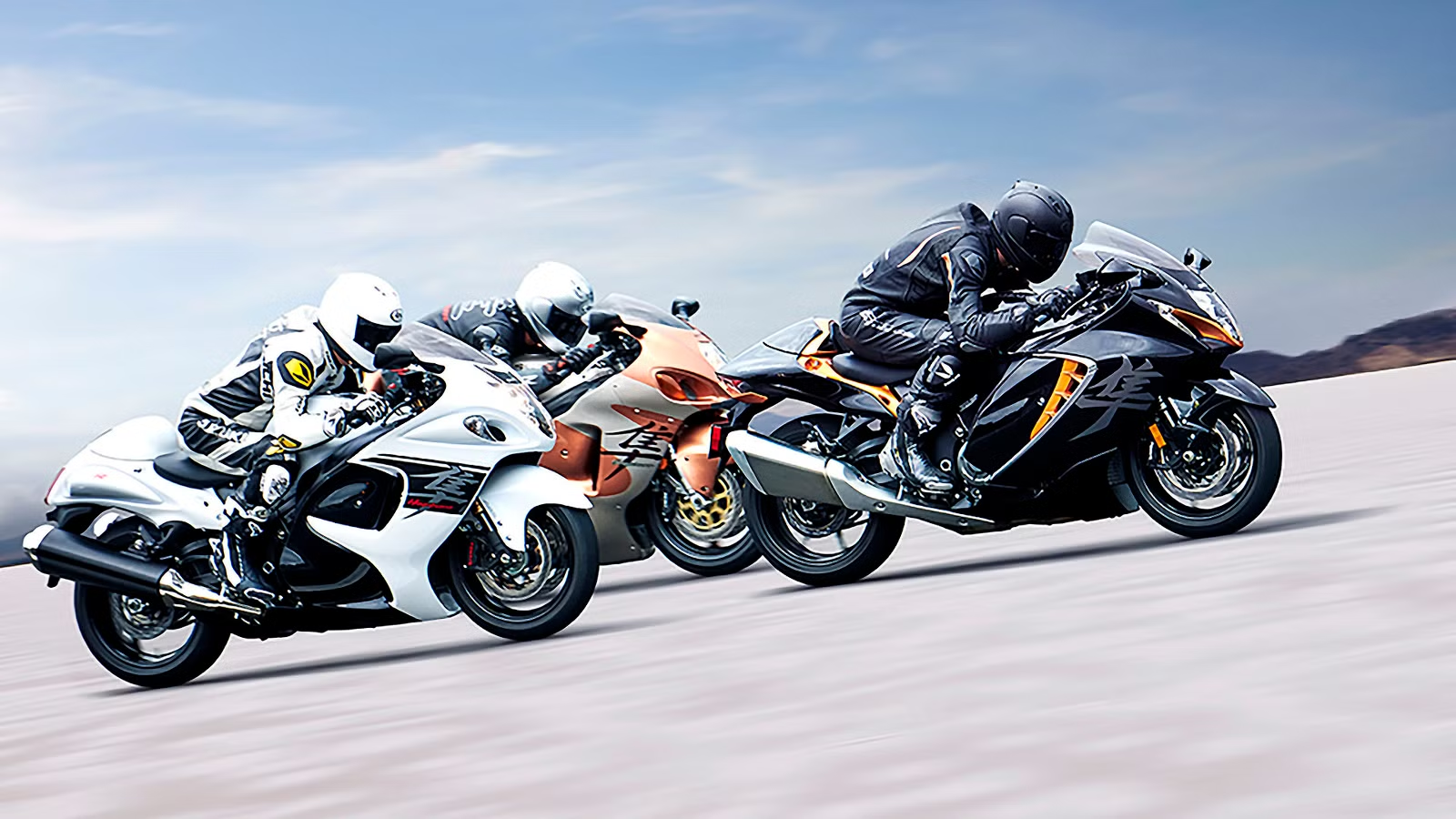
The Suzuki Hayabusa illustrates this and the difference between W and (W). Its factory-specified front tire is 120/70ZR17M/C (58W), and its rear is 190/50ZR17M/C (73W). The ZR designation identifies the high-speed radial category, while the parenthesized service descriptions provide the load and speed classifications.
Why Your Motorcycle Needs The Correct Speed Rating
Choosing A Tire That Meets Your Motorcycle’s Requirements

A higher speed rating isn’t automatically better. Motorcycle manufacturers specify tire ratings to suit each model’s performance and operating requirements, so those specifications should guide replacement choices.
Installing a tire with a lower speed rating than the manufacturer specifies can compromise the motorcycle’s intended operating capability. Even if you rarely ride fast enough to approach the rating, the tire still needs to handle the stresses associated with the motorcycle’s design and intended use.
A higher-rated tire may be an acceptable replacement, but only if it also meets the manufacturer’s requirements for size, load capacity, construction, and other specifications. A more impressive letter doesn’t automatically make a tire suitable.
Speed Isn’t the Only Number That Counts

Load capacity matters just as much. The tire must support the combined weight of the motorcycle, rider, passenger, and luggage within its rated limits. Speed and load ratings work together, and exceeding either can create dangerous conditions.
Inflation pressure is part of the equation, too. Speed classifications are established under specified loading and inflation conditions. Underinflation, overloading, excessive heat, or tire damage can reduce a tire’s ability to withstand high-speed operation.
A tire’s speed classification assumes it is operating within its specified load and inflation limits. Those conditions matter even when you’re nowhere near the tire’s rated maximum speed. Check the owner’s manual or the motorcycle’s tire information label before buying replacements, and follow the specified ratings rather than assuming a higher one is an upgrade.
Speed Ratings Are Only Part Of The Picture
More Than Just Speed: What Makes A Good Motorcycle Tire

Two tires with the same speed rating can have very different characteristics. Construction, rubber compounds, tread patterns, and intended use all influence how a tire behaves. A sportbike tire and a touring tire, for example, might share a speed rating while prioritizing different things: grip and responsiveness on one hand, stability, wet-weather performance, and tread life on the other.
Construction matters as well. Motorcycle tires can be bias-ply, bias-belted, or radial, and manufacturers design their motorcycles around particular tire specifications. Substituting a different construction type can affect handling and stability, so riders should follow the manufacturer’s recommendations when choosing replacements.
Why Load Capacity Still Matters

Don’t focus on speed rating at the expense of the load index, either. A tire that meets the required speed category but can’t support the motorcycle’s intended load isn’t an appropriate replacement.
The right tire isn’t necessarily the one with the highest speed rating or most aggressive tread. It’s the one that meets the motorcycle manufacturer’s specifications and provides the performance characteristics suited to the way you ride. Those sidewall letters aren’t just technical details; they’re part of what keeps your tires operating within their designed capabilities.
Source: Michelin, Bridgestone, Harley-Davidson,. Yamaha, BMW Motorrad, Suzuki, Honda

Related posts






Latest Post




No Comments