
The Motorcycle From Japan That America Still Doesn’t Appreciate Enough
Japanese motorcycle makers sent shockwaves through America when they entered the U.S. market in 1969. They made a serious dent in the market share of then-traditional British and American brands. Heavyweights like Harley-Davidson saw a massive sales drop of roughly 90 percent by the late 1970s. The U.S. government imposed heavy tariffs to protect homegrown brands.

But Japanese marques fought back by localizing production. These factors strengthened faith in Japanese motorcycles and contributed to their heritage in America. In fact, many Japanese cruiser bikes replicate American charm while offering superior refinement, reliability, and a lower price tag. Still, the appreciation is lukewarm.
Japan Has Given Us Some Amazing Motorcycles Over The Years
Japan showed us that a motorcycle can balance raw performance, everyday reliability, and mass-market innovation. The earliest landmark Japanese motorcycle is the 1960s Honda CB750. It is widely considered the original superbike. The CB750 introduced the transverse, air-cooled inline-four engine, an electric starter, and a front hydraulic disc brake to mainstream mass production. It was an eye-opener for many, as this Honda set the blueprint for the Universal Japanese Motorcycle (UJM) and made expensive, notoriously unreliable European bikes seem obsolete at the time.

Another example is the 1970s Kawasaki Z1. It packed a massive 903 cc inline-four engine that produced over 80 horsepower and could do over 130 mph. This was Kawasaki’s arch-rival to the Honda CB750, escalating the 1970s horsepower wars by combining brute force with striking, clean styling. The Honda Gold Wing remains a nameplate that stands out as a sophisticated yet supremely reliable luxury touring bike.
Over the years, it transitioned from a flat-four to a smoother flat-six engine, offering car-like torque. The package is completed by plush two-up seating comfort, massive luggage capacity, and a unique chassis and suspension setup that adds a surprisingly sporty edge. Other examples include the 1980s Kawasaki GPz900R, which kick-started the iconic Ninja nameplate; the 1990s Suzuki Hayabusa, a speed demon that shattered production top-speed records; and the recent Kawasaki Ninja H2, which mass-produced the first-ever supercharged motorcycle engine.
But Not All Get The Appreciation They Deserve

Many other Japanese motorcycles over the years pushed engineering boundaries but didn’t get the appreciation they deserved at the time. Today, these icons have quietly become cult classics. The fifth-gen Honda VFR800FI was sidelined because it was too expensive for its time. But it was because this sport-tourer packed a lot of bleeding-edge features.
It features gear-driven camshafts that eliminate the need for a cam chain. This in turn gives the engine an ultra-durable, turbine-like whine for added character. Honda derived its V4 engine from the RC45 race bike. Other notable features include fuel injection, a single-sided swingarm, and side-mounted radiators.

Another forgotten icon is the Honda CX500. This middleweight standard bike attracted a lot of attention for its blunt styling. But it quickly faded because it was an unusual departure from what Honda made in the 1970s and 1980s. The CX500 is powered by a liquid-cooled, transversely mounted 497 cc V-twin with a final shaft drive.
Though it was mocked early on as a “plastic maggot,” the CX500 has since earned a massive following among custom builders for its rock-solid reliability and unique V-twin note. Other lesser-appreciated Japanese motorcycles include the Yamaha XS650 (packing the brand’s first major four-stroke parallel-twin engine), the Suzuki RE5 (an experimental rotary-engined motorcycle), and the Honda Fury (a reliable take on a wild custom cruiser bike).
America Chooses Home-Grown Big-Twin Cruisers Over “Better” Metric Counterparts

This is mainly because of the emotional advantage American brands have. Cultural heritage, branding, and relatable sensory characteristics win over engineering refinement, reliability, and affordability. Brands like Harley-Davidson and Indian invented and defined the American V-twin ethos over a century ago.
American riders view home-grown motorcycles as the “real deal” compared with pragmatic imports. The V-twin’s unique sensory note comes from 45-degree V-twins tuned for maximum torque at low RPMs. The early surge of torque, when coupled with nostalgia-inducing sound, vibration, and character, creates an emotional, visceral experience. This is what riders call “soul.”

Furthermore, owning an American V-twin cruiser bike comes with an extensive cultural ecosystem including rallies, club communities, custom aftermarket parts, and a distinctive aesthetic identity. American cruisers often retain stronger resale value despite having notable downsides in refinement and reliability compared with metric cruisers. Suzuki, however, managed to create a larger-than-life cruiser that checked most of the boxes America loved in a big-twin cruiser. It was well ahead of its time in the 2000s and remains the most powerful cruiser bike under $20,000.
The Suzuki Boulevard M109R Is The Most Powerful Japanese Cruiser Bike Today
Price: $15,799 (25MY)

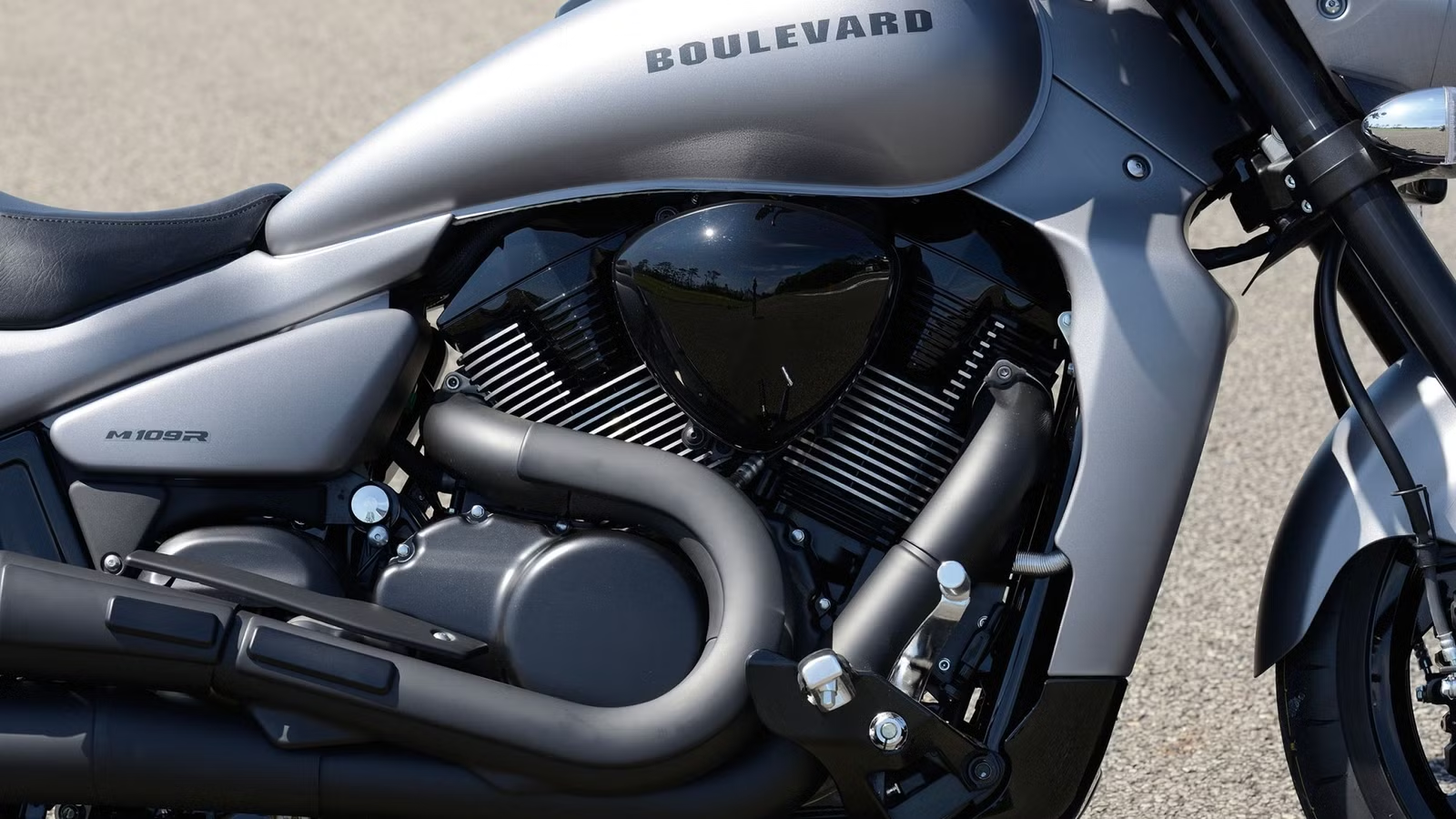
This cruiser bike is even more impressive when we factor in its age. Suzuki launched the Boulevard M109R in 2006, and it has stayed virtually unchanged to date. Despite its age, it still packs serious muscle, thanks to the M109R being overengineered for its time. Powering this Suzuki cruiser bike is a massive 1,783 cc V-twin engine.
This liquid-cooled mill produces 128 horsepower and 118 pound-feet of torque. Power goes to the rear wheel through a five-speed manual gearbox and a final shaft drive. Notable engine features include technology derived from the Gixxer sportbike, a relatively higher rev-band to 7,500 RPM, specially designed spark plugs with individual ignition maps, and a compact dry sump setup.
Sturdy Underpinnings Add To Its Larger-Than-Life Character

The torque-rich V-twin sits in a high-tensile steel double cradle frame. The heavy-duty chassis is suspended on chunky 46 mm inverted front forks with 5.1 inches of travel. The rear gets a preload-adjustable monoshock with 4.7 inches of travel. Despite weighing 764 pounds, the Boulevard M109R impresses with its notable rear suspension travel.
For reference, even lighter Harley Softails barely reach three inches of rear suspension travel. Braking duties come from dual 310 mm floating discs paired with radially mounted four-piston fixed calipers. The rear gets a 274 mm disc coupled to a two-piston floating caliper. Interestingly, the braking hardware is derived from the 2000s Suzuki Gixxer sportbike.
A 20-Year-Old Design And Size That Still Intimidates

The Suzuki Boulevard M109R design has been unchanged for over 20 years. This cruiser is huge, with a 67.3-inch wheelbase, making it longer than even the Triumph Rocket 3 Storm, which runs the world’s largest motorcycle production engine. Thanks to this, Suzuki’s classic styling, with its curves and muscular lines, gives this old design timeless appeal.
Its intimidating features include chunky front fork covers, a vast and exposed V-twin, and a distinctive headlight cowl. Despite this, the M109R remains quite accessible, with a seat height of 27.8 inches. The rider sits comfortably and in a relaxed position with forward-set footpegs and wide handlebars.
Source: Suzuki Cycles

Related posts
Latest Post



No Comments