
2027 KTM 990 RC R Review: A New Breed Has Arrived
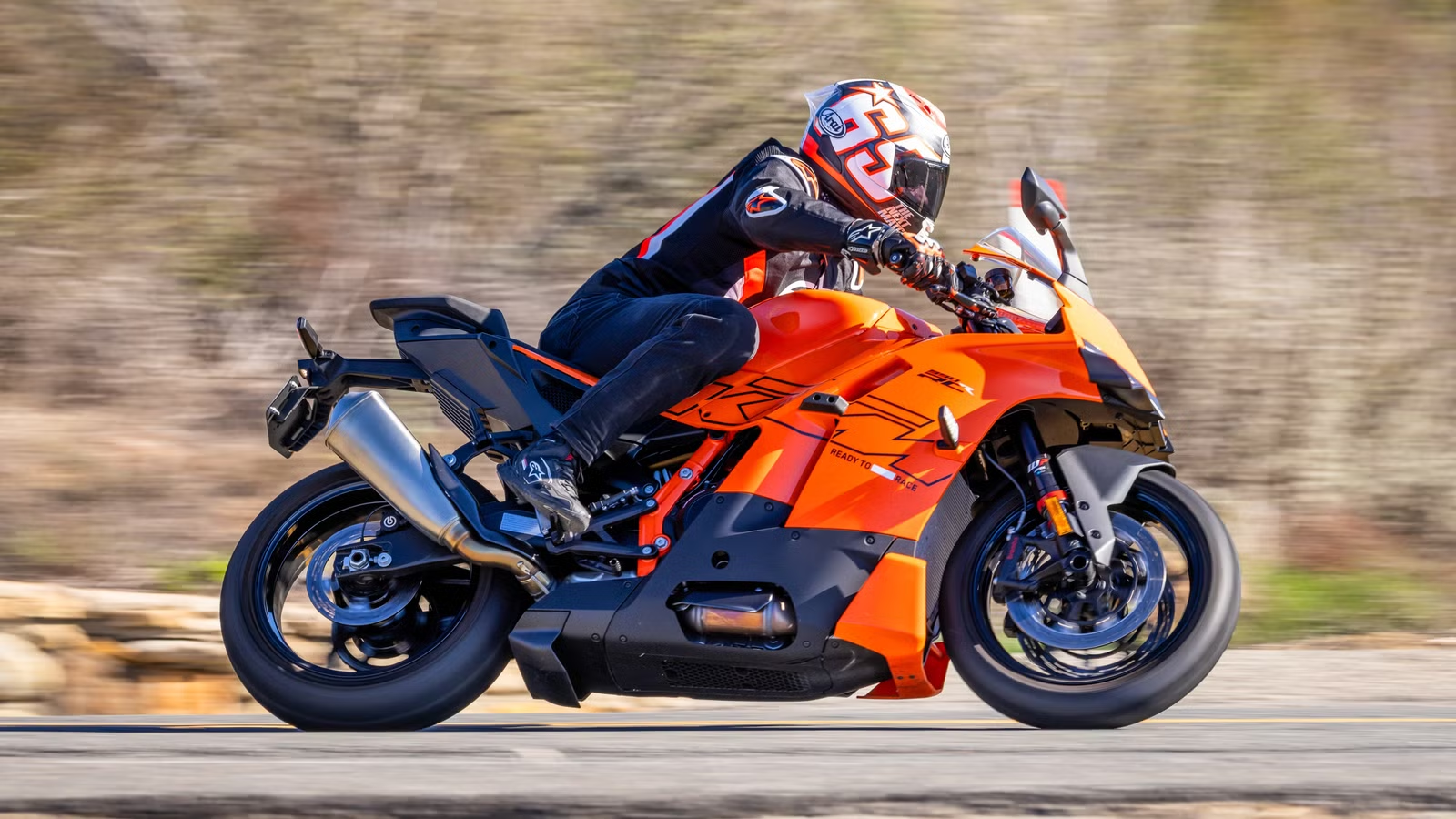
Where were you standing when the world changed? One day, we defined the supersport class by 600cc inline-four-powered shrieking meanies, and then, snap, things didn’t quite fit into that box anymore. Yamaha’s 890cc triple-cylinder YZF-R9 is touted as not being a replacement for the now-defunct street-legal YZF-R6, but functionally, it is. Ducati’s 890cc V2 engine propels the Panigale V2 platform into the fray, and, of course, the 2027 KTM 990 RC R saddles up alongside to join the fight.

Sure, a shift in class direction may not be as important as the internet coming into our homes, smartphones being integrated into our lives, or the miracles of modern medicine. But to all the rough-and-tumble, steely-eyed, performance-focused motorcyclists out there with piles of track-worn rubber stacked in the garage corner, change can quickly put a frog in one’s throat. Is our era gone? No, it’s adapting. After days spent between the Santa Monica Mountains close to home and the desert-baked asphalt of Chuckwalla Valley Raceway, that’s the only conclusion this scribe can draw. Supersport is alive and well, and the new breed has arrived.
Homecoming: From RC8 To RC R
The 990 RC R is KTM’s first full-size, street-legal sportbike since the RC8 V-twin rode off into the sunset, filling a hole in the lineup big enough to park a race transporter in. On that note, KTM staffers say they’re currently working on Supersport World Championship (WSSP) homologation. Built in Mattighofen, Austria, it asks $13,949 (plus $800 freight), comes in two colorways, Electronic Orange or Black Metallic, and is backed by KTM’s four-year Premium Manufacturer’s Warranty.

Yes, it wears MotoGP-inspired wings (a claimed 28.7 pounds of downforce at 149 mph, should you ever take to the Autobahn), but this is a street bike first, built for riders who want speed without the suffering.

Want more edge? The factory-built 990 RC R Track sheds roughly 30 pounds by deleting everything road-legal and adds shorter-travel suspension, direct brake lines, a track-optimized gearbox, and a claimed 133 horsepower. Both it and the street bike are eligible for KTM’s new 990 RC R Cup series in Europe.
Engine: Torque Before Tachometers

At its heart is the 947cc LC8c parallel-twin from the 990 Duke, treated to new mapping, an airbox that breathes through the subframe, and a fresh stainless-steel exhaust. The new tune also lets the throttle open to a full 100 percent, and the whole engine weighs a claimed 126 pounds. The magic is in the crank: a 285-degree crankpin offset gives it the firing interval of KTM’s own 75-degree V-twins, along with their characteristic, throaty exhaust bark, no less. It’s an oh-so-on-brand character trait. KTM claims 128 horsepower at 9,500 rpm and 76 lb-ft of torque at 6,750 rpm. Never mind the peak hp figure: that’s more torque and found earlier than any 600cc I4 screamer could manage.
The result is a hard-hitting bottom end and a midrange wave that catapults you off every apex. There’s a smirking surliness here, a naughty punch off the initial crack of the throttle that’s enough to smear the Michelin Power Cup 2 rubber when traction control is set to lower settings. It’s a stark contrast to the high-strung 600cc inline-fours of yore, which needed to bang off the rev limiter for any sort of adrenaline rush. The KTM serves up its wallop right out of the gate, but doesn’t continue throwing eye-widening haymakers like modern liter-class sportbikes. This is power we can use.

In the canyons, a few throttle blips between apexes are enough to keep things not just interesting, but damn fun, and there’s no need to bury the tach in the red to get a reaction. Revs build controllably, even if that initial jab keeps you on your toes through Chuckwalla’s fast, flowing layout. The torquey character carries into the top end, though it tapers at the bitter end of the rev range, a trait we’ve seen in plenty of parallel-twins. Chuck’s shorter straights hide it, but on a longer straight, where both could fully stretch their legs, an inline-four might pick its pocket up high. Hankering for more? KTM PowerParts offers Akrapovič titanium exhaust hardware that adds some oomph.
Rowing through the six-speed gearbox is made easy by the bidirectional quickshifter, which is buttery smooth when cracking the whip, as it prefers. All that V-twin-style torque does come at a cost: upshifts can land a touch rough at low rpm, and rapid-fire downshifts can make the rear end squirm if you get overambitious and spike the revs. Luckily, we’ve got a slipper clutch to help mitigate the latter issue.
Throttle mapping is well sorted across the board, with Sport my favorite, no matter the scenery. The optional Track mode’s throttle setting is a shade too aggressive for my tastes (also, on-brand for KTM), notably on circuit, where softer initial inputs make a difference at high lean angles.

There are few things to lament about the powerplant, though the bodywork does exhaust the engine’s heat directly onto your legs. Since the 990 Duke and 990 Duke R don’t roast chestnuts (a seasonal joke, you see), the culprit is the enclosed bodywork. Alas, keep your head in the wind, and it’ll be just fine.
Ergonomics: No Wrists Were Harmed In The Making Of This Review

Past supersports were race replicas through and through, and languishing sales might say that was to a fault. Then again, with ever-increasing prices and operating costs (consumables, insurance, registration), we can hardly pin all the blame on aggressive riding positions. The 990 RC R abandons the achy-wrist premise for a comfort-minded approach that runs nearly in lockstep with its competition from Bologna.
Sat behind the riser-style clip-ons and parked on the 33.2-inch seat, the KTM is positively spacious. That setup might earn side-eye from purists, but it earns quick approval on the commute to the canyons. Interestingly, Yamaha’s YZF-R9 sticks with true clip-ons, and for road riding, the KTM comes out far better for avoiding that choice. Legroom is ample, and the ol’ knees weren’t feeling pangs after a lengthy freeway stint. Flip the forged footpegs from Street to Track, and they move about an inch back and 0.7 inch up for added clearance.

And on the racetrack? Lifted clip-ons are gaining ground in MotoGP, but let’s not oversell it: ergonomics are highly preferential. Still, for me, they get on just fine around Chuckwalla, and the sculpted 4.15-gallon fuel tank, with six dedicated contact zones, makes a wonderful anchor, whether you’re scrubbing knee pucks or setting up for a braking zone.
It defies conventional logic. At 5-foot-10, I usually fold onto sport machines like a lawn chair, yet this is one of the few that comfortably fits my frame. You’d assume that makes it great for bigger folks. True, but not the whole story: my shorter-statured colleagues offered the same praise once they negotiated the seat height. Somehow, this definitely full-sized sportbike is a one-size-fits-all affair.
Tech: Screen Time, Well Spent

Faced with all 8.8 inches of the touchscreen TFT, some riders may feel a bit ill-equipped (heh). Fret not. KTM is becoming an industry leader in intuitive interfaces, and the switchcube’s five-way joystick makes navigating simple. The touchscreen is intriguing at a stop, but reaching under the windscreen on the move is inadvisable, one of the few manufacturer safety warnings we actually agree with. The real star of the dash show is standard offline navigation: no phone pairing, no data usage, and a welcome demise for brand-specific navigation apps that almost never work as advertised. Here’s hoping the rest of the industry takes notes.
Out on track, the electronics show their personality. Traction and wheelie control were clearly programmed by KTM staffers who believe in a longer leash at lower settings, yet high lean angles, especially in Chuckwalla’s banked bowl, still trigger the IMU in more sensible modes like Sport. That’s where adjustability earns its keep, and where KTM’s pricing structure comes into play.

KTM does routinely earn a rebuke for charging extra for core electronic upgrades, something its direct competition doesn’t engage in… yet. Standard fare covers Rain, Street, Sport, and Custom ride modes, plus lean-sensitive traction control and ABS. The fine-tuning (Track mode, adjustable wheelie control and traction slip, launch control, and a lap timer) lives in the Track Pack, but the $899 Tech Pack is the more cost-effective route, adding cruise control, the Quickshifter+, and Motor Slip Regulation on top. Every RC R ships in Demo Mode, unlocking the full buffet for the first 930 miles, so you can taste before you buy. Our take: just get it.
Okay, fine. ABS modes follow the same leash-length logic. Default Street ABS handles a calm warmup lap but is best paired with the mean streets and their errant debris. Sport ABS intervenes later, and Supermoto+ limits rear slides to 8 degrees. It’d be fine on track, too. Full Supermoto ABS disables rear nannying entirely, letting you slide to your heart’s content and trail brake as deep as you dare. Lean sensitivity is gone there, so it’s essentially basic front-only ABS. Have at it, ladies and gentlemen.

Bonus points for whimsy: flip through the wheelie control settings fast enough and the little wheeling-motorcycle icon animates like a flip book. I may have done it more times than strictly necessary.
Chassis: The Thinking Rider’s Supersport

The chassis, like most of this new-age supersport, derives from the 990 Duke launched in 2024, but key changes push it in a far sportier direction. The chromoly steel trellis frame is shared, yet a 33mm fork offset and a slightly longer 58.3-inch wheelbase lend the RC R greater stability than its nudist sibling. Its die-cast aluminum subframe, with integrated air intakes, is unique, too.
That’s just scratching the surface. The model-specific swingarm is deliberately more flexible to offset the stiff frame, as engineers hunted for a planted feel during hard acceleration, plus better edge grip and feedback on the tire’s shoulder. It also carries a progressive shock linkage, the first for KTM’s LC8c family, allowing softer initial rates that smooth out sharp hits while preserving stability deeper in the stroke.
Street or track, the KTM telegraphs when it’s hooked up and begging for gas just as clearly as when traction is iffy, which told me to ease off over some of Chuckwalla’s questionable asphalt. That Braille-like conversation holds true even at road pace, precisely because the RC R isn’t uncompromising: it won’t rattle your teeth or make your coccyx tremble at every unsavory crack in the road. Some lament 600cc supersports going the way of the dodo, but comfort was an afterthought to their racetrack mission.

Feeding the RC R into corners isn’t best done with a feverish snap, and the geometry hints at why: compared to the svelte, now-departed street YZF-R6, the KTM is four inches longer axle to axle. This is the thinking rider’s sport machine, rewarding planned lines with that treasured on-the-rails sensation on the tire’s edge. Front-end feel is superb, and the rear doubles down on communication. Through Chuckwalla’s trio of lengthy double-apex corners, focus and patience favor this machine’s inherent stability. It’s still agile enough to rescue a fluffed line.
Credit goes to the 48mm WP APEX Open Cartridge fork, with handy-dandy tool-less clickers (30 clicks each of compression and rebound) and preload adjustment. The fully adjustable WP APEX shock features a nifty Allen-key preload adjuster, so there’s no wrestling a spanner on a lock-collar setup, or going full Neanderthal with a flathead screwdriver and a hammer (we’ve all been there). A standard set of hand tools takes you on your setup journey. Its wide damping range did heavy lifting on the track, and backing those settings off a few clicks had it doing the Lord’s work on Southern California’s rough-and-tumble streets.

Stopping comes courtesy of Brembo HyPure four-piston radial calipers clamping dual 320mm floating discs. All that modern superbike-level stopping power is managed via a Brembo MCS master cylinder with three-stage ratio adjustment and an adjustable lever. The stopping power is immense, making it a one-finger affair in most road situations, with two digits when you need to scrub speed off on the circuit.
The Kids Are Alright

The 2027 KTM 990 RC R doesn’t try to be a 600, and it’s better for it, built for the world we actually ride in: a torque-rich, communicative, genuinely comfortable sportbike that can carve canyons Saturday, drag a knee Sunday, and still commute to work on Monday. All without a chiropractor’s appointment Tuesday. The top end tapers, the quickshifter gets grumpy at low rpm, and the best electronics cost extra. None of that dims the grin because it’s a machine that delivers in all situations, appealing to those moving up the sporting ranks or maybe stepping down into something that makes a little more sense.
Motorcycles are supposed to make us feel something. Every time the twin barked out of a corner and the chassis whispered there was grip to spare, it reminded me of why I got into motorcycles in the first place. For those of us with that pile of worn rubber in the garage corner, that’s no small thing. Supersport didn’t die. It adapted, evolved, and found a new voice. The kids, as they say, are going to be alright.
Gear Check:
Street:

Helmet: Arai Corsair-X
Gloves: Alpinestars SP X-7
Jacket: Alpinestars T-GP Air
Pants: Alpinestars Cooper V3
Boots: Alpinestars Superfaster
Track:

Helmet: Arai Corsair-X
Gloves: Alpinestars GP Pro V4
Suit: Alpinestars GP-Tech V5
Airbag: Alpinestars Tech-Air 7X
Boots: Alpinestars Supertech R
2027 KTM 990 RC R Review Photo Gallery:
2027 KTM 990 RC R Specifications:
Engine:
|
Type |
Four-stroke parallel twin (LC8c) |
|
Displacement |
947cc |
|
Bore x stroke |
92.5mm x 70.4mm |
|
Maximum horsepower |
128.2 horsepower at 9,500 rpm, claimed |
|
Maximum torque |
76.0 lb-ft at 6,750 rpm, claimed |
|
Compression ratio |
13.5:1 |
|
Valvetrain |
DOHC; 4 valves per cylinder (8 valves total) |
|
Fueling |
Bosch EMS w/ ride-by-wire; 46mm Dellorto throttle bodies |
|
Exhaust |
Stainless-steel primary and secondary silencer w/ centrally mounted middle damper and short muffler; three lambda sensors; 8.6 kg (19.0 pounds). |
|
Cooling |
Liquid, w/ water/oil heat exchanger |
|
Transmission |
6-speed; bidirectional Quickshifter+ available via Tech Pack |
|
Clutch |
Wet multi-disc w/ anti-hopping function (third-party listing). Cable actuation. |
|
Final drive |
520 X-Ring chain. |
Chassis:
|
Frame |
Chromium-molybdenum steel trellis, powder coated, engine as stressed element; pressure die-cast aluminum subframe w/ integrated air intakes (400 g lighter than 990 Duke subframe); model-specific aluminum die-cast swingarm w/ shock linkage |
|
Front suspension; travel |
Fully adjustable (compression and rebound, 30 clicks each; spring preload ±3mm) WP APEX 48mm Open Cartridge USD fork; 5.79 inches (147mm) |
|
Rear suspension; travel |
Spring-preload- (10 turns), rebound- (30 clicks), low-speed-compression- (30 clicks) and high-speed-compression- (3 turns) adjustable WP APEX linear-spring shock w/ linkage; 5.28 inches (134mm). |
|
Wheels |
Cast aluminum, black |
|
Front wheel |
17 x 3.5 |
|
Rear wheel |
17 x 5.5 |
|
Tires |
Michelin Power Cup 2, radial |
|
Front tire |
120/70-R17 |
|
Rear tire |
180/55-R17 |
|
Front brake |
Dual 320mm floating discs w/ Brembo HyPure radially mounted 4-piston calipers; Brembo PR16/19-21 radial master cylinder w/ three-stage ratio adjustment |
|
Rear brake |
240mm Galfer disc w/ 1-piston caliper |
|
ABS |
Standard; cornering ABS via 6D IMU (Street ABS default). Sport, Supermoto+ and Supermoto ABS modes available w/ optional Track Mode |
|
Electronic rider aids |
Cornering Motorcycle Traction Control (MTC); 6D IMU; TPMS; Rain, Street, Sport and Custom ride modes standard; 8.8-inch touchscreen TFT w/ offline map navigation and KTMconnect. Optional Track Pack: Track mode, 2 additional Custom modes, Anti-Wheelie Control (5 levels plus off), Launch Control, lap timer, telemetry screen, adjustable throttle response, MTC slip adjuster. Optional Tech Pack ($899): Track Pack contents plus cruise control, Quickshifter+, Motor Slip Regulation (MSR) and adaptive brake light (not available in U.S.). Demo Mode unlocks all features for the first 1,500 km (approximately 930 miles) |
Dimensions & Capacities:
|
Wheelbase |
58.3 inches (1,481mm) |
|
Rake |
24.2 degrees |
|
Trail |
3.9 inches (98.5mm) |
|
Seat height |
33.2 inches (845mm) |
|
Ground clearance |
6.4 inches (163mm) |
|
Fuel capacity |
4.15 gallons (15.7 liters) |
|
Curb weight |
430 pounds (195 kg, fully fueled); 405.6 pounds (184 kg) without fuel |
Price & Warranty:
|
Website |
ktm.com |
|
Price |
$13,949 MSRP; $14,848 As Tested |
|
Warranty |
Up to 4 years (KTM Premium Manufacturer’s Warranty) |
|
Service interval |
Oil every 9,300 miles; valve service every 18,600 miles. |
|
Color |
Electronic Orange, Black Metallic |

Related posts

Latest Post



No Comments