
This New York To LA Drive In A 43 HP 1992 Geo Metro Nearly Broke The Driver And The Car
The outright Cannonball Run record stands at 25 hours and 39 minutes, an average of 113 mph. Runs at that level rely on heavily modified cars, police-detection gear, and sometimes spotters in aircraft overhead.

One recent coast-to-coast run went the opposite way, with a cheap convertible sports car, no support crew, and a driver who paid for it with very little sleep and one lost shoe.
A Tiny 875cc Imp Set The Bar Back In 1964
Long before the Cannonball had a name, a Sunbeam Imp crossed America in 48 hours, 9 minutes, and 54 seconds. The tiny rear-engined sedan covered 3,011 miles between August 12 and 14, 1964, as the test car for American Rodding magazine.

That beat the 53.5-hour mark Erwin “Cannon Ball” Baker set in 1933, with help from the new Interstates. Heat reportedly reached 110°F, yet the car still averaged more than 60 mph and 35 mpg.
A standard Imp made just 39 hp from its 875cc engine. Both runs later helped inspire the Cannonball, first staged in the 1970s.
No Crew, No Spotters, Just A 43 HP Geo Metro

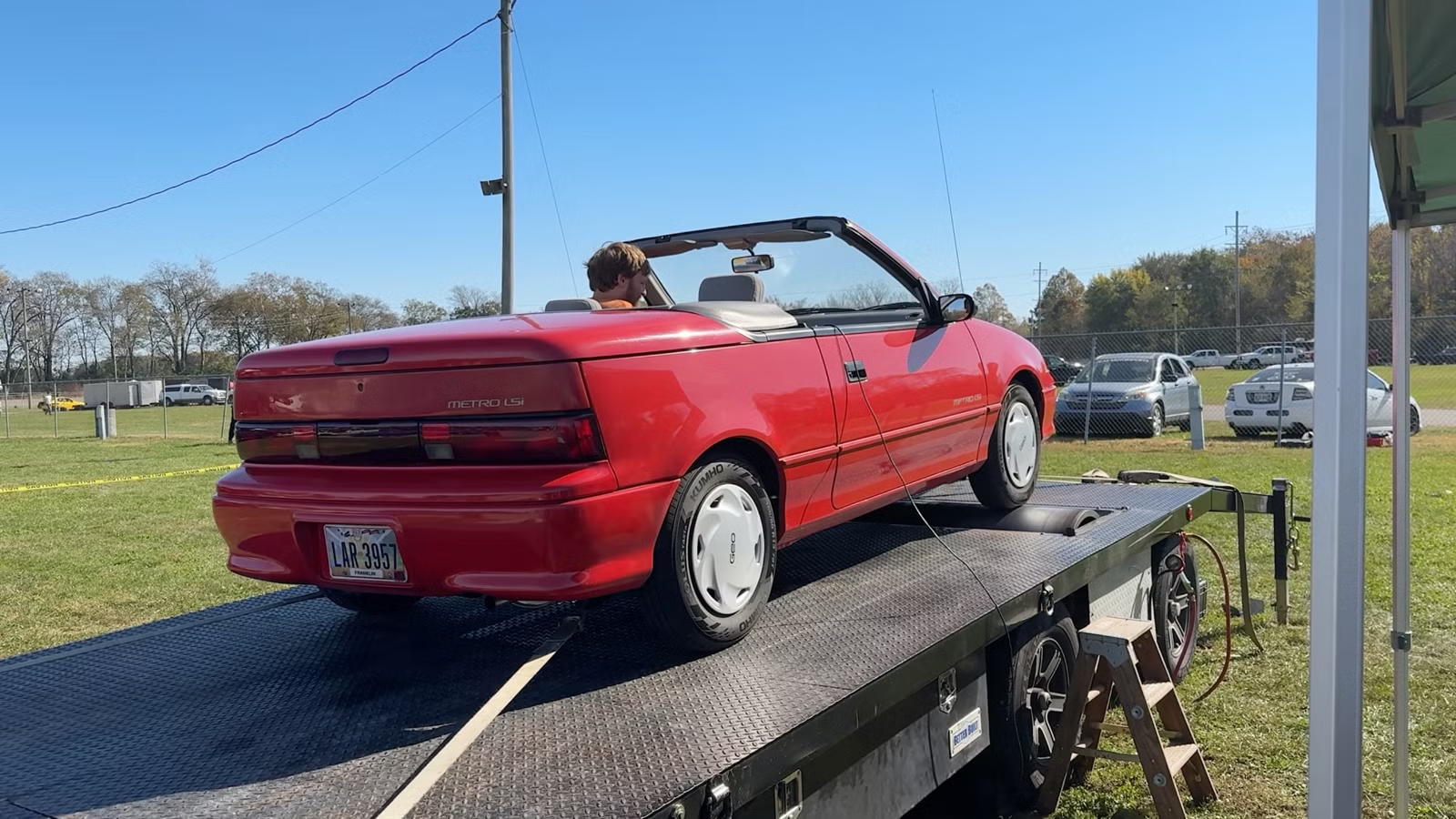
Mitchell Kohrmann’s answer to modern Cannonball budgets was a 1992 Geo Metro LSi convertible and a plan he called an “everyman’s Cannonball.” He brought no extra fuel tanks, no spotters, and no crew.
The 1.0-liter three-cylinder was rated at 55 hp when new, but it made only 43 hp at the wheels on the dyno. Kohrmann estimated that would fall to about 26 hp at Rocky Mountain altitude.

The 1,753-lb curb weight also grew to roughly 2,300 lbs with him and his luggage aboard. Tires that looked new turned out to be decades old, forcing a last-minute hunt 155/80 R13 passenger tires in New York. A tricky size, but he did find a replacement set of Kumho tires for $80 each.
Reaching the Red Ball Garage was no easier, since the 6.8-mile drive into Manhattan took about two hours.
The Rockies And A Dying Alternator Nearly Ended It

The AC’s evaporator froze over in Pennsylvania, so Kohrmann kept cycling it off. A bigger failure came at night in Iowa, when the alternator’s charge wire came loose and left him with a dead battery.
He bump-started the car by running alongside it, losing a shoe in the process. A previous installer’s mistake had also snapped a mounting ear, leaving the alternator hanging on by one bolt.
The climb into the Rockies left the Metro with an estimated 15 to 20 hp at around 8,500 feet. A highway closure then pushed his ETA from 12.5 hours to nearly 16, and the holdup turned out to be a driver with a flat tire.
Foot flat in third gear, the Metro still held 45 to 50 mph near the 11,158-foot Eisenhower Tunnel, the highest point on the Interstate system. It later hit 101.4 mph on a steep Utah downhill in a car with a neck-snapping 85-mph speedometer.
Kohrmann finished the 2,838 miles in 49 hours, 11 minutes, and 18 seconds, averaging about 58 mph. That left him about an hour behind the Imp’s 62-year-old time.

Related posts

Latest Post


No Comments