
Mopar’s 1,000-HP Crate Hemi Left The Hellcat’s Supercharger And Iron Block Behind
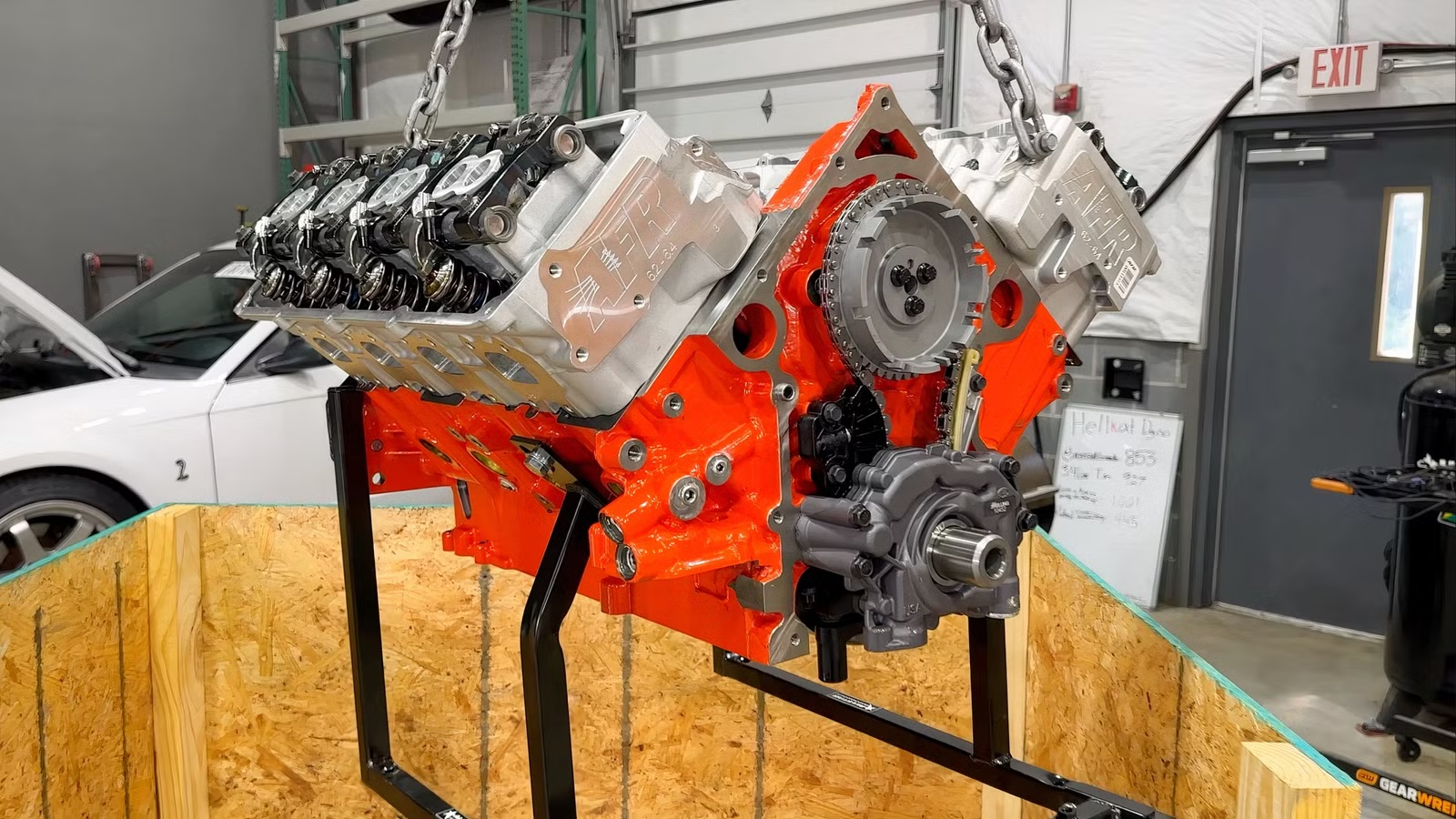
Many enthusiasts will tell tales of crate engines with incredible amounts of power. Typically, these are from that golden age of the American automobile that lasted up until the early-mid ’70s. But, there have been plenty of great modern crate motors. More modern crate motors have gained a lot of popularity among tuners, thanks to how easily they can be used as engine swaps in classic cars. That includes the engine we’re going to talk about here. This Mopar-made crate motor is an absolute monster, intended to be the final send-off of a legendary engine family. But, since then, things have changed a bit…
Some Modern V8s Have Insane Amounts Of Horsepower

The big-block powerhouses of the ’60s and ’70s had impressive horsepower for their day. But the more modern V8s you see in today’s Muscle Cars and Supercars have the kind of power that even the maddest hot-rodders back then couldn’t imagine. It’s perfectly normal for top-end examples of American muscle to have 700 horsepower or more.
Some Of The Best High-Horsepower V8s Have Come From Mopar
Out of those super-powerful modern V8s, some of the best have been made by Mopar. Everyone will point to the awesome 6.2-liter supercharged Hellcat V8, with its 700+ horsepower and old-school muscle car soundtrack. While many people will consider the Hellcat as the pinnacle of modern Mopar power, there was actually one engine that outclassed it. It’s a massive, supercharged performance monster, and it proved to the world that the demand for high-output V8s was far from over.

The Hellephant Is A Limited-Run Halo Engine That Was Supposed To Be A Farewell To The Hemi
|
Type |
Displacement |
Power |
Torque |
Number produced |
|
Supercharged V8 |
7 liters |
1,000 hp |
950 lb-ft |
100 |
As far as modern V8s go, the Hellephant has to be up there among the craziest. This 7-liter supercharged behemoth is rated at 1,000 horsepower and 950 lb-ft of torque running on gasoline. If it’s running E85 or a crazier tune, that number can reach over 1,100 horsepower. That gives a Hellephant-equipped car enough power to potentially outrun the most powerful supercars, and even some hypercars. It also makes it the most powerful Hemi family engine ever—even more powerful than the Hellcat variant that powered the Dodge Demon 170. That’s a fitting title, considering it was supposed to be the final Hemi V8.
It’s tempting to think of the Hellephant as just being a larger version of the Hellcat engine. It is a Hemi engine, after all, and it’s supercharged just like the Hellcat is. That’s actually very far from the truth. It has a completely different engine block to the Hellcat – the Hellcat’s is iron, while the Hellephant’s is all-aluminum. That all-aluminum block is based off the one found in the Dodge Challenger Drag Pak, a purpose-built racer designed to compete in NHRA Stock and Super Stock events. Its supercharger is also larger and more powerful than the Hellcat’s. It’s 3 liters in size as opposed to the 2.4 and 2.7 liter units in the Hellcat, and has more boost at 15 psi.
Only 100 Hellephant engines were ever produced. They were also never fitted into a production model. They were only ever sold as crate motors, designed to be dropped into whatever crazy project car you’re working on.
It Was Designed To Be Easily Swapped Into Older Cars
With that project car intention, it’s not surprising that Mopar tried to make the Hellephant as easy as possible to swap into an old muscle car. For an extra $2,265 on top of the $29,995 engine assembly price, it came with a “plug-and-play” kit that contained all the modern electronic components the engine needs. While you still need proper equipment and know-how to swap a Hellephant into a pre-1976 muscle car, the plug-and-play kit having everything you need to get it to work in your build definitely makes things a lot more straightforward.
Its Entire Allocation Sold Out Within 48 Hours
Those 100 Hellephant units shifted very quickly once they came onto the market. Once pre-orders started in 2019, the entire allocation sold out within 48 hours. For such an extreme crate engine with an overall price of over $30,000, that’s a jaw-dropping statistic. Enthusiasts really were willing to pay a premium to get a limited-run engine that was being pitched as the last Hemi V8.
The Hemi’s Return (And The Hellephant’s Success) Has Proved That The Clock Still Hasn’t Run Out On V8s

The Hellephant may have supposed to have been a last hurrah for the Mopar V8. But, recent events have told a different story. Not only has Stellantis decided to not permanently shelve the V8, it seems like demand for it is bigger than ever. Production for the Hemi was recently restarted at Stellantis’s plant in Dundee, Michigan. Why? To fix a shortfall caused by demand for Hemi-powered models – Stellantis forecasted in 2025 that it needed to build 100,000 Hemi units in 2026 to solve that. Interestingly, this mainly isn’t about muscle cars. The 100,000 engines were mainly intended to power V8-engined Ram trucks, like the incredibly popular Rumble Bee.
This is only great news for the V8 lovers among us. The attempt to pivot away from V8s towards the Hurricane inline-6 and fully-electric models like the Dodge Charger Daytona has spectacularly failed. Customers really want old-school V8s, and Stellantis has no choice but to offer them. The phenomenal speed at which the Hellephant allocations got snapped up was a sign of things to come, rather than a bunch of niche enthusiasts going crazy over a limited-run crate engine.
Source: Mopar, Stellantis

Related posts





Latest Post


No Comments