
The Compromised American Turbo Roadster Nobody Took Seriously
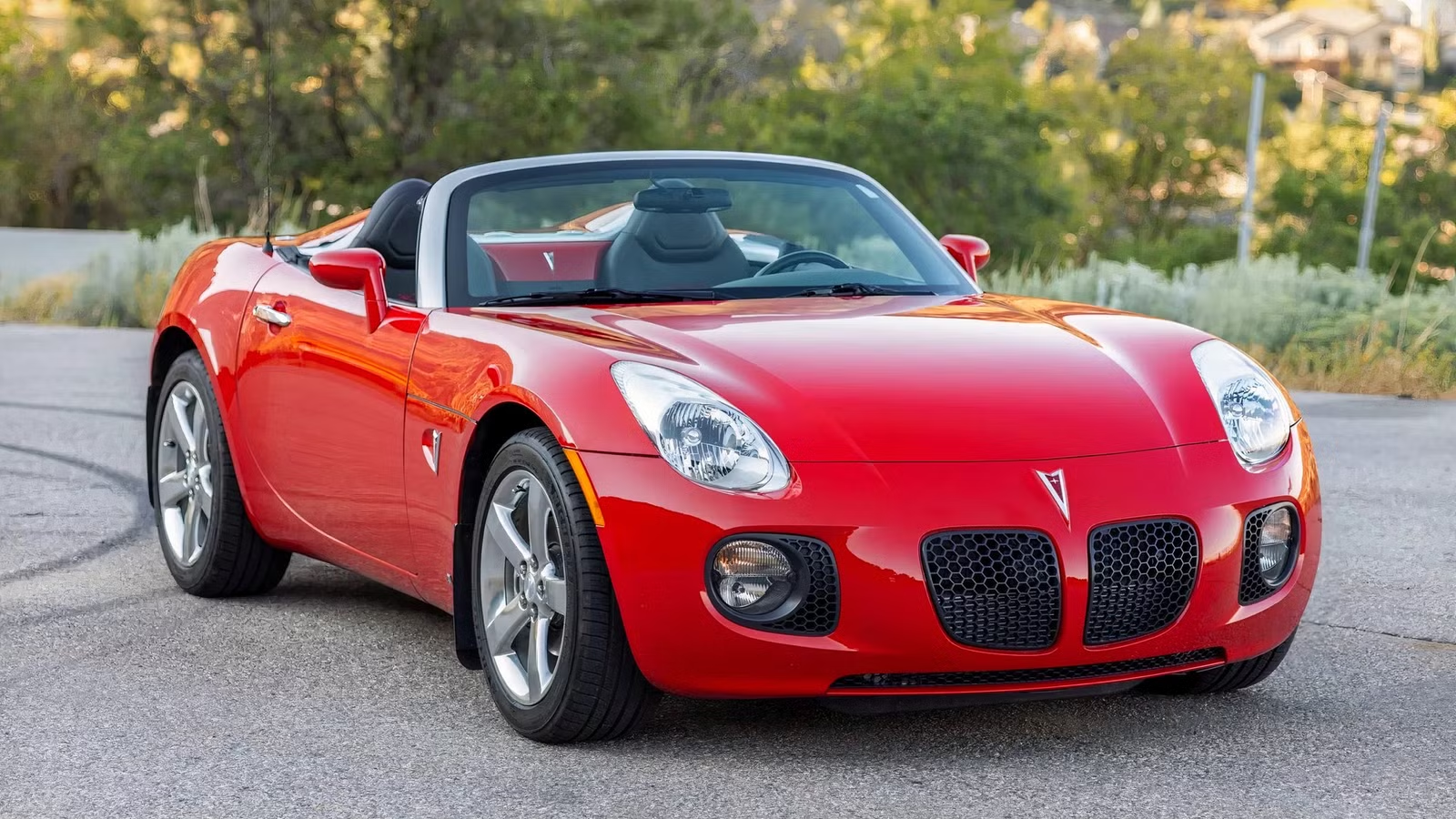
You could forgive a sports car for cheap plastic until that plastic started competing with the driving experience for your attention. That was the problem facing Pontiac’s turbocharged roadster: enough performance to make established competitors uncomfortable, wrapped in a cabin that made dismissing the whole package remarkably easy. The engine deserved a better supporting cast, and your right elbow deserved a softer landing.

Today, that disconnect makes the Solstice GXP interesting. You can buy serious turbocharged performance without paying for a prestigious badge, provided you understand why the discount exists. This Pontiac Solstice deserves consideration, but rose-colored glasses should stay out of your inspection kit.
GM Built A Serious Roadster Just Before Its World Fell Apart
The Kappa Platform Gave Pontiac More Than A Showroom Ornament
GM’s compact roadster project offered something increasingly unusual: a small, purpose-built RWD platform created around driving enjoyment. The Kappa architecture combined a short wheelbase, independent suspension, and seating that put you close to the rear wheels.

The original roadster reached buyers for the 2006 model year, following the attention-grabbing 2002 concept. Its proportions delivered showroom drama, although the base engine left room for something stronger. You could admire the bodywork without immediately wondering whether your license would survive the weekend.
The GXP Arrived In Time To Impress, But Not To Build A Lasting Legacy

The Solstice GXP arrived for 2007 with the performance upgrade the shape invited. Its timing gave Pontiac an appealing enthusiast flagship just as GM approached the financial crisis that would help determine the brand’s fate.
Production ended in 2009, with a handful of cars carrying 2010 model-year identities. Pontiac’s 2010 cancellation then closed the door on further development. The GXP had received serious coverage and favorable reviews; its problem was a short runway, unresolved compromises, and a parent company with considerably larger emergencies.
The Turbocharged GXP Had The Performance Its Styling Promised
The LNF Delivered 260 Horsepower Without Needing Six Cylinders

The GXP’s LNF engine was a direct-injection, turbocharged 2.0-liter four-cylinder producing 260 horsepower and 260 pound-feet of torque. That torque transformed the car’s usefulness, giving you substantial midrange acceleration without constantly chasing the upper reaches of the tachometer.
MotorWeek recorded 0–60 mph in 5.8 seconds and a 14.4-second quarter-mile at 97 mph. Those were credible sports-car numbers, supported by a choice of five-speed manual or five-speed automatic transmissions. The manual added involvement, although its operation lacked the polish that made some Japanese alternatives so satisfying.
Against a contemporary Miata, the Pontiac’s attraction was accessible shove. Against an S2000, it offered a different rhythm: boost and midrange muscle instead of the Honda’s invitation to keep revving. Neither experience becomes better simply because its owner argues more loudly.
The Chassis Offered More Than Straight-Line Entertainment

The GXP backed its engine with Bilstein dampers, sport-tuned suspension, a limited-slip differential, and standard stability control. MotorWeek praised its confidence through corners and limited body roll, while noting its willingness to slide with stability assistance disabled.
However, the handling verdict was never unanimous. Other assessments criticized the steering, communication, and throttle response, and adding power did not automatically make the Pontiac more precise than its rivals. You should expect a capable, entertaining chassis rather than assume you have discovered a forgotten substitute for Porsche development work.
That distinction strengthens the case. The GXP could deliver an enjoyable road drive without winning every steering-feel argument, and a track outing still required attention to tires, brakes, fluids, and the condition of an aging car.
The Saturn Sky Red Line Shared The Same Serious Hardware
Different Bodywork Wrapped Around The Same Turbocharged Formula

The Saturn Sky Red Line offered the same basic mechanical proposition beneath sharper, more angular styling. Its turbocharged 2.0-liter engine also produced 260 horsepower and 260 pound-feet of torque, and it was supported by the shared Kappa platform.
That matters because Pontiac’s performance credentials were part of a broader engineering program. GM had developed hardware capable of supporting two convincing turbocharged roadsters, even if neither brand survived long enough to refine the formula through another generation.
Your preference may come down to appearance and the individual example. The Sky’s exterior projects a different personality, but choosing Saturn does not magically remove the underlying platform’s packaging and ownership compromises.
Today’s Used Alternatives Expose What The Pontiac Does Best

For U.S. buyers, the NC-generation Mazda MX-5 Miata covers model years 2006–2015. A late manual-transmission example produces 167 horsepower and 140 lb-ft of torque, leaving a substantial output gap against the Pontiac.
The Mazda answers with less weight, naturally aspirated response, and controls that encourage you to enjoy momentum. You work harder for acceleration, but that effort can become part of the entertainment rather than a deficiency.
Prices overlap enough to make this a real decision. An 11,000-mile 2007 Miata Sport five-speed brought $16,200 on Bring a Trailer in July 2026, while a 2007 retractable-hardtop six-speed sold for $16,500 that August, before buyer fees.
A Later 981 Boxster Tests How Much Refinement Is Worth To You

The 981 Boxster belongs in this discussion as a 2026 used-market cross-shop, not a contemporary showroom rival. U.S. examples arrived for the 2013 model year, after Solstice production had ended.
The base Porsche’s 2.7-liter flat-six produces 265 horsepower, superficially close to the Pontiac’s output. Its mid-engine layout, naturally aspirated delivery, cabin execution, and power-operated roof create a substantially different ownership experience.
The purchase prices can be substantially different, too. A 16,000-mile 2013 base Boxster six-speed sold for $38,500 on Bring a Trailer in April 2026, before fees. That low-mileage example does not define the entire market, but it punctures the assumption that every attractive 981 is a $20,000 alternative.
The Right GXP Is A Bargain Only If Its Compromises Fit Your Life
The Cabin And Convertible Top Deserve As Much Attention As The Turbo


The hard plastics, awkwardly positioned controls, and inconvenient storage remain part of the purchase. They are easier to forgive during a Sunday drive than during a wet commute, when your interaction with the car involves considerably more than the accelerator.
The roof deserves particular attention. GM issued service information addressing rear-window water leaks, along with a separate bulletin covering abnormal fabric wear on certain early-build 2007 cars. These are documented concerns, although they do not mean every surviving roof is defective.
Have the seller demonstrate the complete opening and closing procedure. Inspect fabric contact points, rear-window sealing, weatherstrips, latches, and carpets for moisture, then arrange a water test. Pontiac’s owner’s guide also warns that objects left in the roof-storage area can damage the top or rear glass.
Buy On Condition, Verify Parts, And Leave Room In The Budget
A $15,000–$20,000 budget gives you meaningful shopping room, rather than representing a mandatory entry fee. A 32,000-mile, original-owner 2007 GXP automatic sold for $14,850 on Bring a Trailer in September 2026, before fees. Keep roadster comparisons separate from scarce GXP coupes, whose prices can distort the picture.
Before buying, obtain an independent inspection, investigate the tuning history, check the cooling and turbo operation, and verify recall completion by VIN. Price out tires, fluids, roof work, and overdue maintenance before deciding how much you can spend on the car itself.
The right GXP gives you a lively turbocharged roadster while leaving money for its next chapter. Buy a sound example whose compromises fit your routine, and the cheap plastic becomes something you accept with your eyes open, while the engine supplies a much better reason to remember Pontiac.
Sources: Pontiac, MotorWeek, Grassroots Motorsports, Mazda, Porsche, Bring a Trailer, KBB

Related posts



Latest Post


No Comments