
Honda’s New ADV Has An Ace Up Its Sleeve To Match Up With BMW And KTM
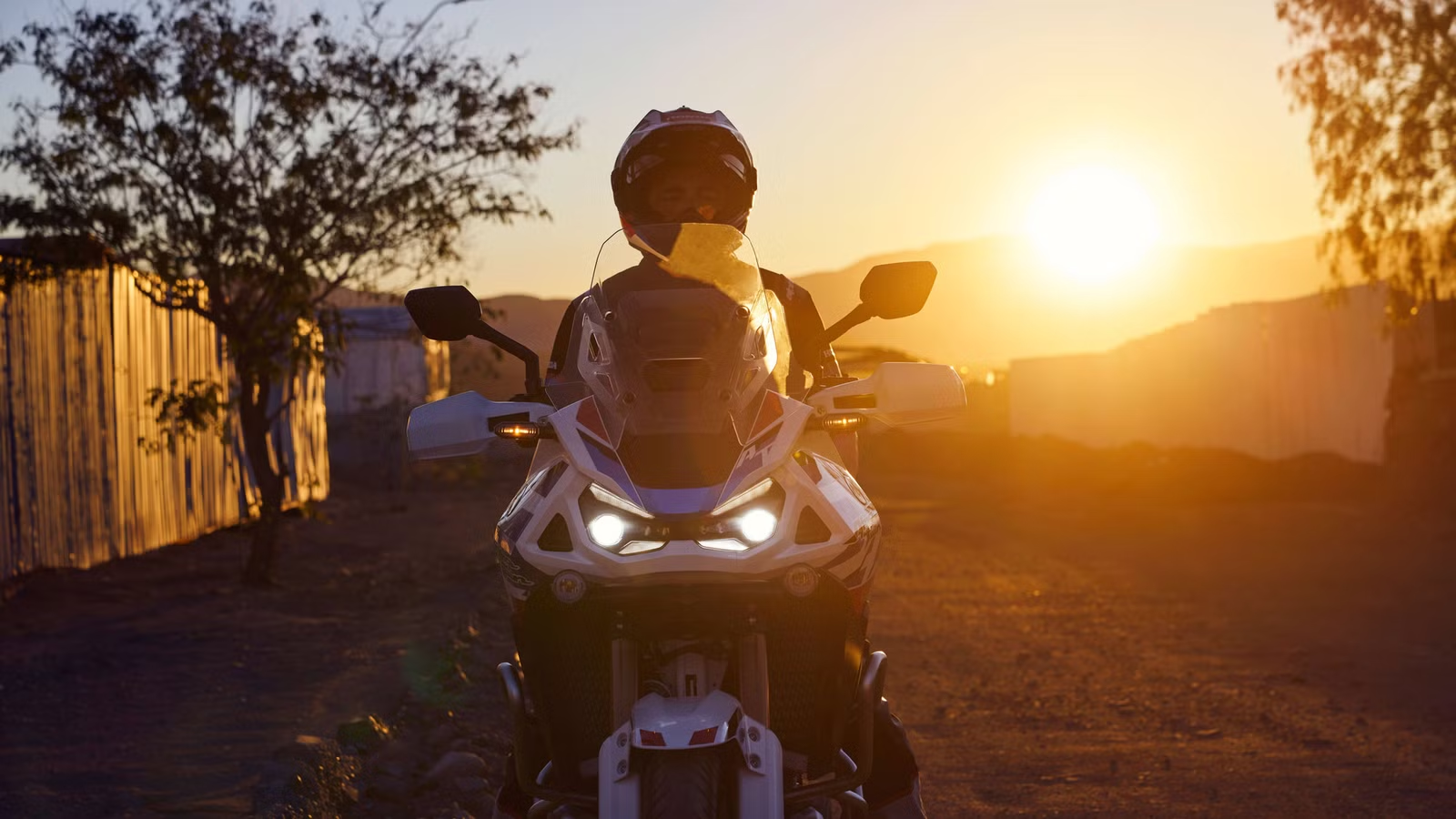
Somewhere along the way, flagship ADVs stopped being big-tank motorcycles and turned into rolling tech showcases. Today’s range-toppers will adjust their own suspension, shift their own gears, and hold a safe gap in highway traffic. Europe has led the charge, with BMW, Ducati, and KTM turning the class into a full-blown electronics arms race. Honda, true to form, hasn’t been in any rush. Big Red prefers to wait until it develops technology that truly works for everyday riders, then make it accessible and easy to live with. That approach has produced some of motorcycling’s smartest ideas, and for 2027, it’s bringing a new one to the flagship ADV fight.
Honda Has Redefined Usable Motorcycle Tech For Years

Honda has never been shy about bringing big ideas to two wheels. It outfit the Gold Wing with the world’s first production motorcycle airbag in 2006, then gave the VFR1200F the first Dual-Clutch Transmission (DCT) on a motorcycle. What seemed preposterous to motorcycling’s traditionalists has stuck, with American Honda saying most Gold Wing buyers now choose the DCT over the manual. Then there’s the deceptively simple E-Clutch, which might be the best Honda idea of the lot. Introduced on the 2024 CB650R and CBR650R, it handles the clutch work in stop-and-go traffic and takes stalling off the table, yet leaves the lever in place for when you want to feel involved. Best of all, you don’t need flagship money to get it.
But It Lacks In One Area

Yet for a brand so good at solving everyday riding problems, Honda has been surprisingly late to the radar party. While Big Red was reinventing the clutch, Europe was teaching motorcycles to read traffic. Ducati fired the first shot with the Multistrada V4 platform, the first production motorcycle with front and rear radar. KTM soon made radar cruise standard on the 1290 Super Adventure S, and BMW brought its system to the R 1250 RT before offering it on the R 1300 GS through its Riding Assistant package.
That technology has only grown sharper since. The KTM 1390 Super Adventure S EVO can now bring itself to a stop in traffic and restart on its own. Radar even spread to other Japanese manufacturers, with Kawasaki and Yamaha adding it to the Ninja H2 SX SE and Tracer 9 GT+. Patent drawings of a radar-equipped Africa Twin surfaced back in 2021, but it took Honda another five years to deliver. Now, the wait is finally over.

Honda Finally Answers Back With Honda SENSING RIDE

At EICMA 2026, Big Red pulled the covers off Honda SENSING RIDE, its first advanced rider-assistance system for motorcycles, which debuts as an option on the 2027 Africa Twin Adventure Sports DCT. Honda didn’t start from scratch here. The system draws on the technology and know-how behind Honda SENSING, the driver-assistance suite found in its automotive catalog, while evolving functions developed specifically for motorcycles.
At its core is a millimeter-wave radar unit at each end of the bike, giving the system a read on the traffic ahead of, behind, and in the blind spots of the rider. The hardware barely registers on the scales, either, adding just 2.2 pounds over the standard Adventure Sports DCT. Honda has also confirmed that more models will follow, so Honda SENSING RIDE won’t remain an Africa Twin exclusive for long.
What Honda SENSING RIDE Can Actually Do
So, what does all that radar hardware actually do for you? Quite a lot, as it turns out. Honda SENSING RIDE packs 10 functions, and between them, they take on much of the mental load that comes with heavy traffic and long days in the saddle. Here’s how each one helps:
- Adaptive Cruise Control: No more constantly resetting cruise behind slower traffic. Pick your speed and following gap, and the bike manages the throttle and brakes to hold them.
- Stop & Go: Interstate gridlock is where this earns its keep, with cruise staying active as traffic slows the bike to a halt.
- Group Ride Assist: Regular adaptive cruise and group rides rarely get along. This keeps your spacing consistent, even in a staggered formation.
- Distance Assist: You’re still in charge of the throttle, but the bike steps in if you start closing up on the vehicle ahead.
- Emergency Brake Assist: If a crash looks likely, and you’ve started braking, the system adds extra braking help.
- Forward Collision Warning: If your attention drifts at the wrong moment, an alert on the display calls you back to the road ahead.
- Brake Pulse: This backs up Forward Collision Warning with a second alert, so the warning is harder to miss.
- Blind Spot Information: That quick shoulder check gets some backup, with a mirror indicator lighting up or flashing when a vehicle slips into your blind spot.
- Rear Distance Information: Think of it as a tailgater alert, with the display flagging anything approaching from behind.
- Rear Collision Warning: If a driver behind you looks set to hit you, the turn signals flash rapidly to grab their attention.
The Radar Setup Works In Tandem With The DCT

There’s one catch if you’ve got your heart set on a clutch lever, because SENSING RIDE is reserved for the DCT model. There’s sound engineering behind that decision. Stop & Go has to bring the bike to a complete halt without any risk of stalling, and that calls for a clutchless setup. You’ll still need to give input to pull away again, though. Luckily for Honda, it already had the perfect partner on the shelf, with a dual-clutch gearbox it has been refining since 2010.
How Honda’s Radar Squares Up With BMW And KTM Systems

Honda is walking into this fight with some catching up to do. BMW and KTM have both had years to refine their radar systems, so SENSING RIDE has to do more than tick the basic boxes. On paper, it does just that, with cruise that works down to a stop in traffic, a dedicated group-riding function, and braking assistance.
KTM’s 1390 Super Adventure S EVO is the closest match, with Stop & Go, brake assistance, and a group-riding mode running through a fifth-generation Bosch front radar, though its official features don’t include blind-spot alerts. BMW’s R 1300 GS takes a different route, offering Active Cruise Control, Front Collision Warning, Lane Change Warning, and Rear-end Collision Warning through its radar options, but BMW doesn’t list a Stop & Go function. Honda, meanwhile, pairs Stop & Go with rear-radar functions like Blind Spot Information on one bike, and that’s the real appeal of SENSING RIDE.
Arrival: We’ll Have To Wait In The States

If you’re a US rider eyeing all this tech, you’ll need a little patience. So far, Honda has announced the new Africa Twin range only for Europe, with the Adventure Sports expected in the UK in 2027. American Honda hasn’t confirmed its plans yet, but there’s good reason to stay hopeful. The current Africa Twin Adventure Sports is already sold here, and if that model history represents anything, then we may see if arrive Stateside.
Pricing is unknown at this time, and it could decide how much of a threat Honda SENSING RIDE is. For context, the current Adventure Sports ES DCT starts at $18,599, compared with $20,395 for a base R 1300 GS and $22,699 for the 1390 Super Adventure S EVO, though the BMW’s radar tech costs extra. If Big Red can keep the radar model close to that, BMW, Ducati and KTM will have worthy competition.
Source: Honda Powersports

Related posts


Latest Post


No Comments