
The World’s Fastest Sedan In The ’80s Came From Australia
Performance Cars When people think about the golden era of performance cars, the usual suspects come to mind: thundering Detroit V8s, exotic Italian supercars, and razor-sharp Japanese sports coupes. Each region had its own recipe for speed — raw power, exotic engineering, or high-revving precision. What almost nobody expected was for a small Australian automaker to quietly build the quickest four-door sedan on the planet. It wore a familiar family badge, looked like something you’d park outside a grocery store, and hid full-blown racing hardware beneath its sheetmetal. Decades later, enthusiasts still debate how one car — born for the track — outran rivals from Stuttgart and Tokyo while leaving room for four adults and their luggage.
The Holden Commodore SS Group A SV Was A Racing Car In Disguise

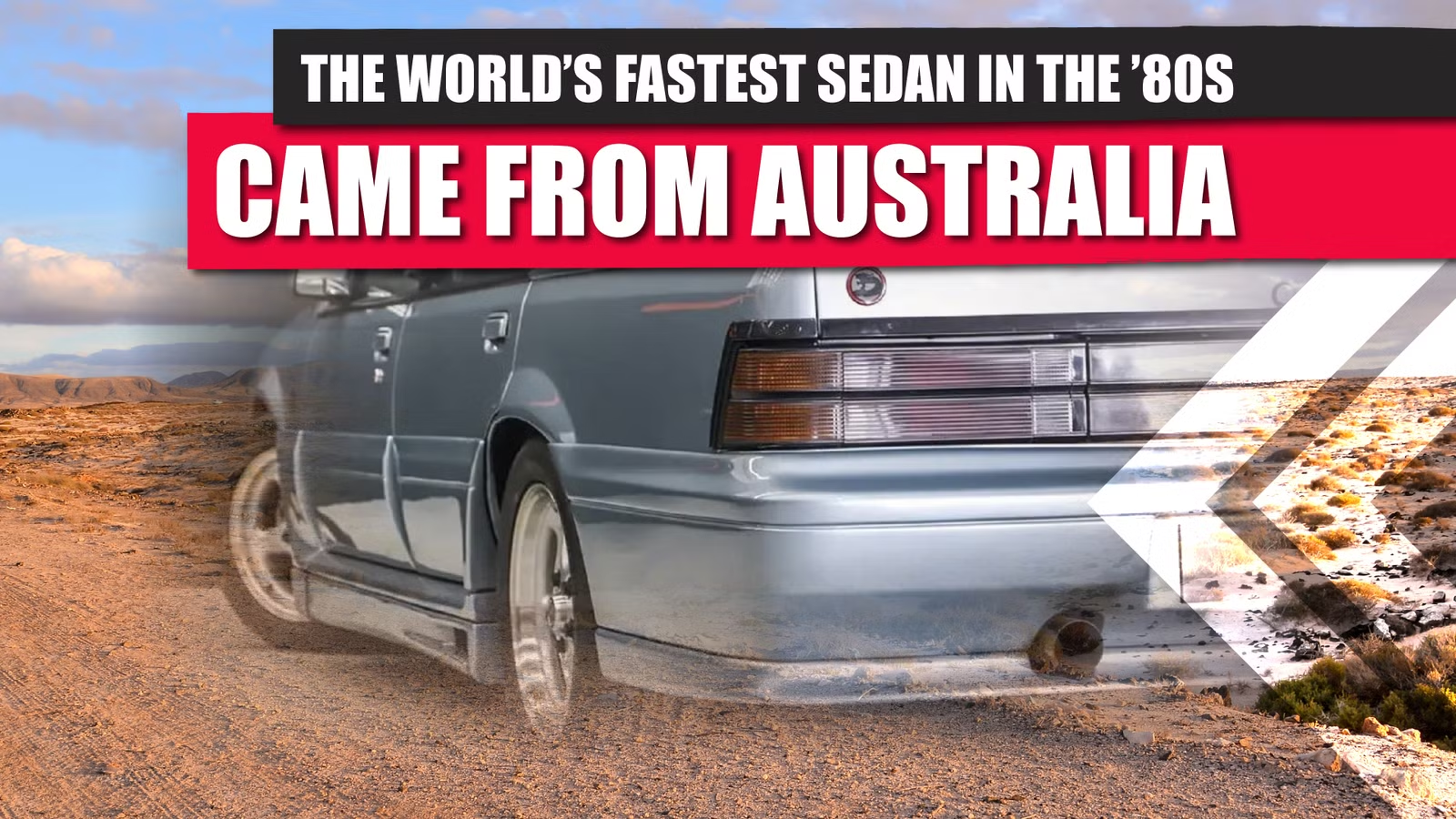
The Holden Commodore SS Group A SV debuted in early 1986 as a homologation special. Holden, Australia’s General Motors division needed a road-legal model to satisfy Group A racing regulations. The SV (Special Vehicles) package included everything required for a full race campaign. Beneath the family sedan exterior lay upgraded suspension, beefed-up brakes, and a tuned V8. Buyers received a street car that could roll straight into a pit lane without embarrassing its racing cousins.
Holden required at least 500 units to qualify for competition. Engineers at Tom Walkinshaw’s TWR workshop collaborated closely with the factory race teams. They fitted a larger rear wing, flared fenders, and a deep front air dam. Each body panel received hand-finished paint and special decals. The extensive use of plastic body panels added over the standard shell earned the car two memorable nicknames among fans: the Plastic Pig and the Batmobile. Engines underwent a blueprinting process to maximize reliability at high revs. Only 500 silver-and-red examples were produced, making the SS Group A SV an instant collector’s piece.

On the track, it proved its worth immediately. Drivers praised its raw torque and crisp gearbox. At Bathurst and Sandown, it went wheel-to-wheel with BMW M3s and Nissan Skylines. The SS Group A SV crushed lap records, setting a new benchmark for four-door speed in 1986. Its success cemented Holden’s racing pedigree and gave customers a car they could drive to the circuit, race all weekend, then commute home on Monday.

On the street, the SV felt surprisingly civil. Power delivery was smooth at low rpm, and the suspension — though firm — absorbed most road imperfections without jarring the cabin. Inside, Recaro-style seats held occupants securely through corners. The gauge cluster gave clear readouts for engine speed, oil temperature, and boost where fitted. It blended performance and everyday usability in a way few sedans dared attempt at the time.
For buyers, the appeal lay in its dual personality. It looked like an ordinary family car but carried full-blown race hardware underneath. Under a gentle right foot it behaved like a mild-mannered cruiser; under hard throttle it launched like a drag car. Holden had pulled off the rare trick of building a road car as quick as many pure sports cars, all hidden beneath the disguise of a sedan.
High-Revving Bored V8 And A Manual Gearbox

At its heart sat a 5.0-liter V8 bored out to 5,320 cc. Engineers fitted high-flow cylinder heads, stiffer valve springs, and a more aggressive camshaft. The factory quoted output at approximately 274 hp at 5,200 rpm and 305 lb-ft of torque at 3,600 rpm. Those figures translated into a 0–60 mph time of around 6 seconds — a remarkable number for a four-door sedan in 1986. The strong low-end torque made dragstrip launches particularly brutal.
Power was routed through a close-ratio five-speed manual gearbox. Shifts were short-throw, with a tall fifth gear for relaxed highway cruising. A heavy-duty limited-slip differential directed torque where it was needed most. Engineers also strengthened the driveshafts and rear axle to withstand repeated race starts.
State-of-the-art for its era, the SV used adjustable Koni dampers with uprated springs. The front anti-roll bar was thicker than standard, and all bushings used harder compounds. At the rear, revised trailing-arm geometry improved traction under hard acceleration. Steering was power-assisted yet retained genuine road feel. Brembo four-piston calipers clamped 280 mm vented rotors up front, with two-piston units at the rear — delivering fade-free, confident stopping power even after sustained hard laps.
Weird But Functional Aero

Subtle at first glance, the SV’s aero kit worked hard at speed. A deep front spoiler reduced lift, side skirts smoothed airflow along the body, and a tall rear wing generated meaningful downforce. Holden engineers dialed in the ride height to balance grip with adequate ground clearance. Wider steel wheels wrapped in Pirelli 235/60 R15 tires provided a larger contact patch than the standard Commodore could offer.
Inside, the SV differed little from lesser Commodores at first glance. The seats featured suede inserts and extra bolstering to keep occupants in place. Walnut veneer trim added a touch of unexpected luxury. Holden fitted a four-gauge cluster to monitor engine health. Air conditioning and power windows were standard equipment. The floor-mounted gear lever sat on a sculpted console, and the leather-wrapped steering wheel felt chunky and reassuring in hand.
From The Race Track To The Street

Production ran from January to June 1986, ending once the 500-unit homologation requirement was fulfilled. Each car carried a numbered plaque on the dashboard. The SV commanded a significant premium — roughly A$47,000 at the time, more than double the price of a standard Commodore. Despite the cost, every example sold quickly. Many buyers went straight into race teams or organized spirited road events.
Racing Pedigree
On track, the SS Group A SV rewrote local racing history. In its debut season, it claimed outright victory at the 1986 Australian Touring Car Championship round at Oran Park. Later that year at Bathurst, SV entries ran at the front, challenging the dominant BMW and Nissan squads. By 1987, Brock and co-drivers had taken pole position at the Bathurst 1000, and successive wins in national series rounds and Bathurst support events cemented the SV’s reputation as a genuinely race-bred machine.
The victories kept coming. The SV scored multiple class wins at Sandown and Lakeside, regularly beating faster purpose-built machinery. Its strong low-end torque and well-sorted chassis balance proved particularly effective in mixed-surface endurance events. These results demonstrated how a production sedan, homologated purely to satisfy regulations, could outpace purpose-built racers — and do so with consistent reliability.
Rare And Expensive

Collectors today place enormous value on unrestored SVs. Well-preserved examples fetch six-figure sums at auction, and even cars requiring full restoration attract serious bidding. A fully restored SV in concours condition can exceed A$200,000. Parts are scarce; original aero components and correct wheels change hands quietly within dedicated collector circles.
Over the years, several replica builders have attempted to recreate the SV package on later Commodore generations. Few have captured the precise combination of performance and provenance. Holden’s subsequent Group A models — including the VL SS Group A and VN SS Group A — borrowed SV styling cues but lacked the hand-built Walkinshaw pedigree. True SV enthusiasts continue to seek out the 1986 originals.
Today the SV appears regularly at vintage racing events across Australia and internationally. Bathurst Historic meetings feature these sedans year after year, where they still post impressive lap times. Owners report the car remains surprisingly drivable after all these decades. The combination of raw V8 character and road-car civility has proven remarkably enduring.
More Hot Holden Models

Holden’s history is filled with performance sedans beyond the SV. In 1979, the LX Torana A9X ran V8s in short-nose trim. Its six-cylinder sibling, the SL/R 5000, blended muscle with light weight. Both set local racing records. The Monaro coupe line offered V8 power in a sportier body. The GTS-E of 1983 added handling upgrades and luxury refinements.
In 1987, Holden introduced the VL SS Group A, powered by a turbocharged Nissan RB30 engine in right-hand-drive configuration. Fans debated whether it could match the SV’s pace. The VL road cars leaned more heavily on electronics and forced induction but lacked the Walkinshaw mystique. The 1988 VN SS Group A Evolution updated the aero and suspension further, though only 502 were built — and they sold quickly to loyal Holden enthusiasts.
Moving into the 1990s and 2000s, Commodore generations VT, VX, and VY carried SS badging. They grew larger and heavier but gained modern electronics and improved safety equipment. The LS1-powered Monaro coupe that arrived in 2001 revived showroom excitement, and the V8-powered sedan kept the performance spirit alive through the brand’s final years.

Related posts

Latest Post


No Comments