
The Oldsmobile 4-4-2 Name That Ended Up On A Front-Drive Four-Cylinder Calais
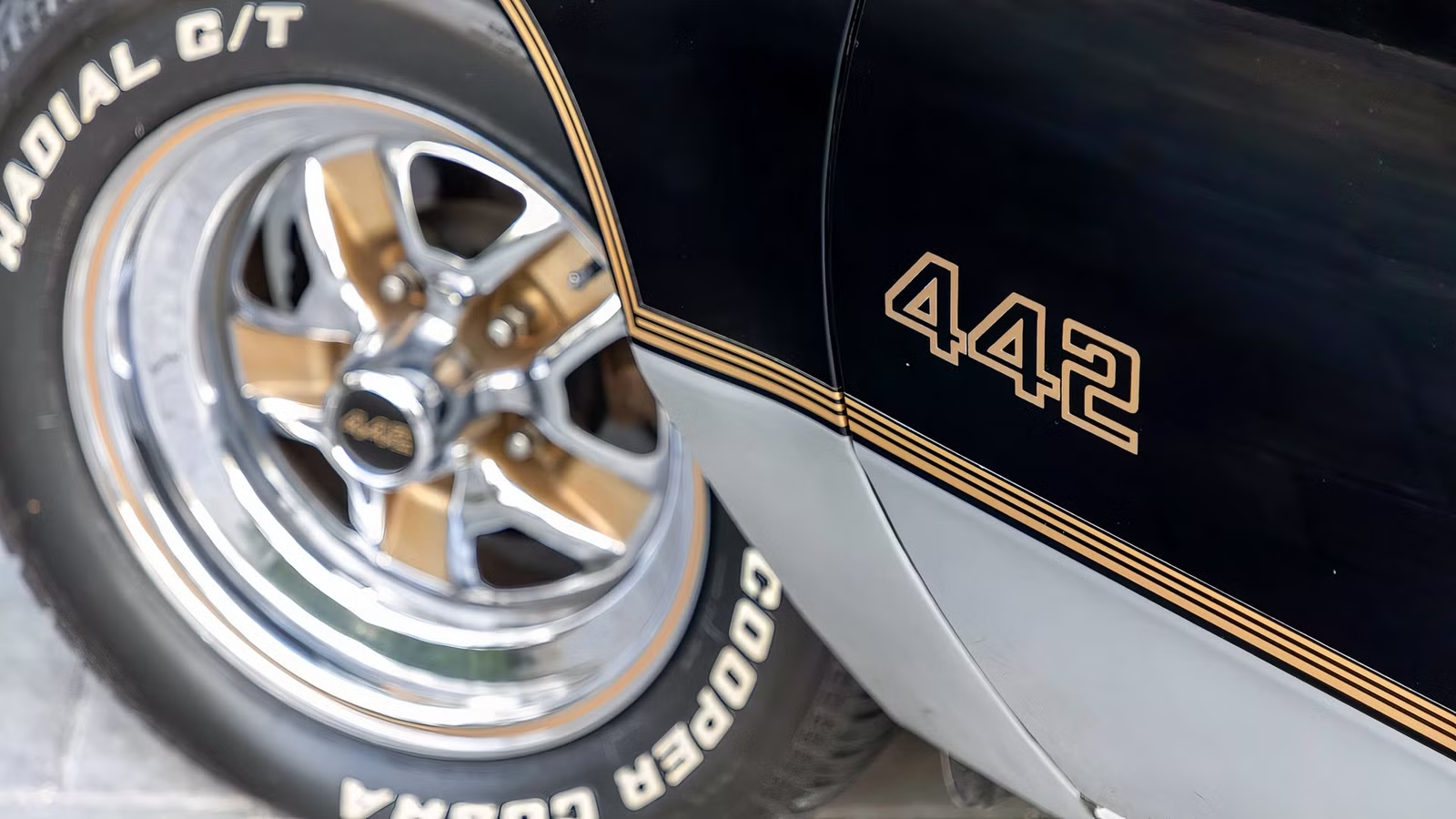
General Motors’ Oldsmobile’s final rear-drive 4-4-2 had a factory option that reportedly appeared on only 201 cars. The 1987 Astro Roof electric sunroof was far less common than the V8 under the hood, and it gives collectors one more detail to look for. By 1990, the 4-4-2 name had moved to a front-drive Cutlass Calais with a four-cylinder engine, and its familiar numbers meant something entirely different.
The Last Rear-Drive Version Had A Surprisingly Rare Factory Option

Of the 4,208 Oldsmobile 4-4-2s built for 1987, only 201 reportedly left the factory with the Astro Roof electric sunroof. That figure has not been independently confirmed, so it is best treated as a reported production count rather than a definitive factory record. Even with that caveat, it points to an unusual detail on the final year of the rear-drive car.
The sunroof did not make the car quicker, of course. Its appeal is that it sets it apart from the rest of an already limited production run. Collectors often look beyond engine output when identifying an unusual car, and a rarely ordered factory option can be worth investigating.
The Details Collectors Look For Were Not Always Under The Hood

The 1985–87 cars also came with factory rear air shocks. They were easy to overlook because the system’s inflation valve was tucked behind the rear license-plate area. Unlike a visible spoiler, the hardware could go unnoticed until someone looked underneath or checked the car’s equipment.

That makes the Astro Roof a useful hook, but not the only detail that separates these cars. Their appeal now rests partly on options and equipment that do not announce themselves at a glance. To understand what those details were attached to, though, it helps to go back to Oldsmobile’s original formula.
The 1985–87 Oldsmobile 4-4-2 Still Had A Rear-Drive V8

The 4-4-2 returned for 1985 as a performance package on Oldsmobile’s rear-drive G-body Cutlass Salon. It remained at the Salon for 1986, then moved to the Cutlass Supreme for 1987. The package was intended to carry the performance role previously held by the Hurst/Olds, and it retained a V8 rather than chasing the smaller engines that would later wear the badge.
That engine was Oldsmobile’s 307-cu-in V8, rated at either 170 or 180 hp. Hooniverse gives the lower figure, while MotoGallery lists 180 hp. Both sources put torque at 255 lb-ft. The disagreement is worth preserving; neither number should be treated as settled without a stronger factory record.
The Meaning Of 4-4-2 Had Already Changed Once

The original 1960s name described a four-barrel carburetor, four-speed manual transmission, and dual exhaust. By the 1980s, the formula had changed to a four-speed automatic, four-barrel carburetor, and dual exhaust. It was still a rear-drive V8 package, but the second number no longer referred to a manual gearbox.
Production totaled 3,000 in 1985, 4,273 in 1986, and 4,208 in 1987. Seven sources in the research agree on the combined figure of 11,481 cars. The run ended after 1987, but Oldsmobile was not finished with the 4-4-2 name. Its next use would discard the V8 and rear-wheel drive that had defined this version.
The 4-4-2 Badge Moved To A Front-Drive Four-Cylinder Calais

For 1990, Oldsmobile brought the name back to the N-body Cutlass Calais, now called the Quad 442. The change was more than a new platform. The car was front-wheel drive, and its engine was the Quad 4, a high-output four-cylinder designed for a different kind of performance buyer.
The name was reinterpreted to describe four cylinders, four valves per cylinder, and two camshafts. That was a long way from the original four-barrel, four-speed, dual-exhaust combination. Oldsmobile was aiming at sport compacts from overseas, including cars such as the BMW 3 Series and Honda Prelude. The Quad 442 was not a traditional muscle car, but it was not intended to be one.
The Production Numbers Tell A Different Story
The reported production total for the 1990–91 Oldsmobile Cutlass Calais Quad 442 is 3,993 cars. That figure breaks down to 2,629 in 1990 and 1,364 in 1991. The total comes from a narrower source base than the G-body figures, so it should be attributed rather than presented as an independently verified factory count.
The sharp drop in the second year makes the later cars particularly interesting to collectors, although the numbers alone do not explain why sales fell. What matters to this story is how far the badge has traveled: from a rear-drive V8 to a front-drive four-cylinder. The W-41 version gave that new formula its strongest performance credentials.
The W-41 Made The Final Quad 442 More Than A Badge Exercise

The 1991 Cutlass Calais Quad 442 W-41 was the most serious version of the front-drive car. Its high-output Quad 4 produced 190 horsepower and was paired with a five-speed manual transmission. The package was developed with showroom-stock racing in mind, giving the Calais a competition connection that went beyond its unusual name.
The W-41 was also quick by the standards of its class. Its 0–60-mph time is about seven seconds. That was a different kind of performance from the torque-heavy G-body V8, but it showed what Oldsmobile could do with the Quad 4 when the car received the right equipment.
The Final 4-4-2 Is Now A Collector’s Choice

A1987 Cutlass Supreme 4-4-2 sold for $24,250 at Classic.com while the 1991 Cutlass Calais W-41 is harder to benchmark. One example, with 148,000 miles, sold for $2,900 at Hemmings Auctions. That older result is useful context, not a current valuation. The G-body offers a rear-drive V8, factory air shocks, and the reported Astro Roof rarity. The Calais counters with a high-output four-cylinder and the W-41’s racing connection. The badge stayed familiar. The cars did not.
Source: Classic, Mecum

Related posts
Latest Post


No Comments