
The Dual-Sport Motorcycle That Makes More Sense At 40 Than It Did At 25
There is a running joke in biology that aging is just childhood running in reverse. First goes your hair, then your patience, and eventually the raw muscle mass needed to muscle a powerful motorcycle out of a muddy rut. It is not an aesthetic choice, either. Free time shrinks, gym sessions get replaced by grocery runs, and maintaining the physical strength required to wrestle an aggressive machine turns from an enjoyable workout into joint punishment.

Eventually, ego surrenders to self-preservation: you simply lack the physical bandwidth to wrestle an overpowered motorcycle anymore. That’s when you realize a small-capacity machine might make more sense for you than something physical. Here’s a dual-sport that we’d recommend for the same.
The Mental Math Of Off-Roading: Why Injuries Cost More At 40
In your twenties, crashing is a funny pub story told over a bruised shin. At forty, an emergency room visit is a logistical catastrophe. Ligaments take months to mend, sick leave is finite, and workplace projects stall without you. If you have a household to run, daily life grinds to a halt while you apply ice packs. The risk-to-reward ratio of piloting an intimidating, high-speed motorcycle completely collapses. A small, light dual-sport motorcycle recalibrates that reality: when you misjudge a trail turn at 20 MPH instead of 60, you pick it up single-handedly, dust yourself off, and ride home.
Mental Peace Is Also Necessary


Beyond physical aches, an older rider simply has no patience for bike trouble. Spending a weekend morning tracking down wiring bugs, fixing oil leaks, or checking valve clearances every few rides is not fun. The ideal bike cannot be an ongoing project. It needs to be basically unbreakable, asking for nothing more than fresh oil, a clean filter, and basic chain maintenance. If all those points add up and match your POV, Honda’s popular CRF is the obvious choice
The Honda CRF300L Delivers Stress-Free Trail Access

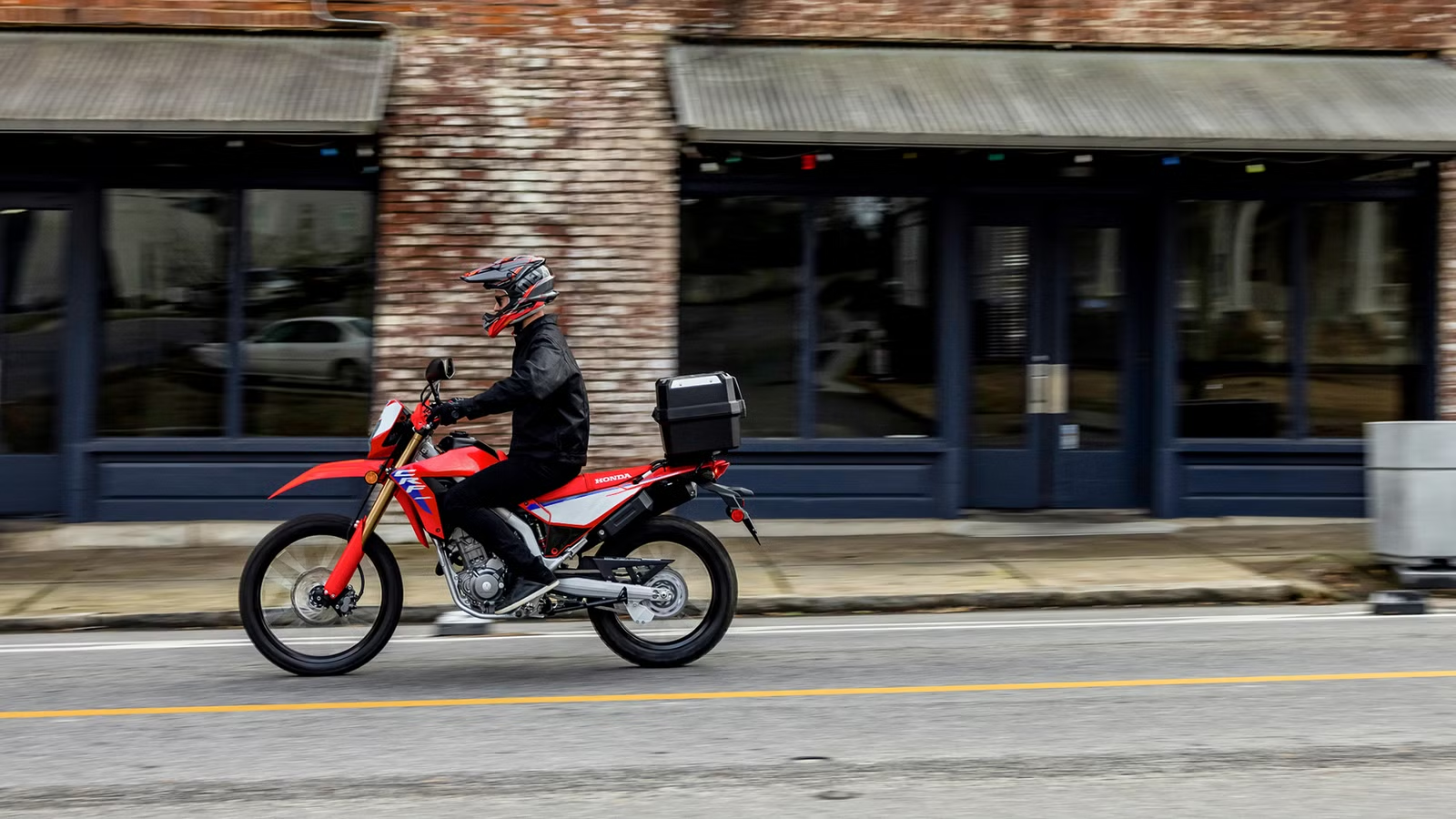
The $5,749 Honda CRF300L is built with that exact mindset, and what makes it the perfect first bike for new riders also works when you’re getting on in years. In your twenties, you would probably skip it because the engine looks modest on paper and the stock suspension is soft. But with more years and real-life responsibilities under your belt, those traits make complete sense. The light clutch pull, push-button start, upright seating, and low curb weight take the stress out of tough trails, while sixth gear lets you cruise home on the highway without drama. It skips the racing hype to deliver pure, hassle-free riding.
A Forgiving 27-HP Liquid-Cooled Thumper That Won’t Wear You Out
The CRF300L’s liquid-cooled 286 cc thumper has a DOHC head, four valves, a slightly short-stroke design, and a compression ratio of 10.7:1. It puts out 27 horsepower at 8,500 RPM and 19.6 pound-feet at 6,500 RPM with the help of PGM-FI fuel injection. This is run through a six-speed manual transmission with an assist and slipper clutch. This is a really easygoing engine that focuses on low- and midrange torque. It is capable of highway running, but it does not pretend to compete for the performance crown. The flip side is that it nails comfort, capability, and everyday usability.
The Lightweight Construction Takes The Physical Work Out

The CRF300L uses a steel semi-double-cradle frame with an aluminum swingarm. This is paired with suspension from Showa: a 43 mm inverted front fork and a Pro-Link monoshock with adjustable preload. Both ends offer 10.2 inches of travel. These are mated with a 256 mm front disc and a two-piston floating caliper, and at the rear, a 220 mm disc with a single-piston caliper. A 21-inch front and 18-inch rear spoke wheel setup requires tires with tubes.
All of it is simple, and so are the dimensions. The 34.7 inches of seat height and a curb weight of 311 pounds wet are key figures, in addition to the wheelbase of 57.2 inches. It also offers a ground clearance of 11.2 inches and a fuel capacity of 2.1 gallons. If the seat is too high, you can opt for the CRF300LS (32.7-inch seat height), which is built for both dirt and daily life at the same price. It reduces suspension travel to 9.3 inches at the front and 9.0 inches at the rear.
Uncomplicated Cockpit Hardware Means Zero Electronic Gremlins

The CRF300L blends simplicity, durability, and versatility perfectly with its feature set. Its instrument cluster is an LCD, but it displays quite a lot of information succinctly. That includes speed, revs, fuel level, a clock, the gear selected, the odometer, two trip meters, and even average speed. The handlebar has a crossbrace, which you will appreciate if and when you drop the bike. It also offers tie-down hooks in case you want to strap luggage onto the back. On the options list, there are more useful things like a USB charging port, a skid plate, and handguards.
The Kawasaki KLX300 Is Its Only Serious Threat

As a 40-year-old, your preferences are locked in, and there are a lot of choices that you can make. There is the tiny Yamaha TW200 or the large Suzuki DR650S, neither of which will ever break, but you will have to learn how to take care of a carburetor. At the same time, the KTM 390 Enduro R offers the most features in its class and the most performance, but being a KTM, you know it is going to need a lot of attention in exchange for the extra performance.
Therefore, the only real competition for the CRF300L is the $5,999 Kawasaki KLX300, which balances reliability, simplicity, and off-road performance. The extra money goes into its better stock KYB suspension that offers adjustable compression damping on the front and adjustable compression as well as rebound damping at the rear. It also has a perimeter frame and makes slightly more power and a little less torque than the Honda. Where it falls short is in its older, more minimalist LCD instrument cluster, and the ABS is front-wheel only.
Source: Honda PowerSports

Related posts



Latest Post



No Comments