
The 10-Second Hemi Monster Dodge Sold “As Is” With No Warranty
By 1968, Mopar had everything it needed to build the drag car of every street racer’s dreams: one of Detroit’s lightest compact platforms and the 426 Hemi. Dodge refused to put that combination in ordinary dealership showrooms. But when it did finally assemble it, complete with a bold disclaimer, the car changed drag racing forever.
Dodge Blocked The Ultimate Power-To-Weight Ratio Car

You likely know the story of the big Mopar muscle cars. You might not know that by the 1960 model year, Mopar was already building lightweight, inexpensive cars. Chrysler was leading the charge with its A-body compact unibody platform, shared by cars including the Dodge Dart and Plymouth Valiant/Barracuda. Using the body itself as structure instead of a separate frame helped save weight, while longitudinal torsion bars handled front-suspension spring duty. By 1967, Dodge had turned the Dart into a serious performance compact with the GTS package’s improved handling and 383 cubic-inch big-block.
Even though the torsion-bar front end meant the Dart had no upright shock towers cutting down engine-bay space, the 383 was a tight fit. So Dodge gave up on installing its big brother: the 440 Magnum V8. But that wasn’t good enough for one Chicago-area dealer. Mr. Norm’s Grand Spaulding Dodge pushed through a 48-car special order, with Hurst-Campbell completing the 440-powered GSS Darts. With proof of a market, Dodge finally offered a factory M-code 440 Dart for 1969. Dodge was so close to dropping its 426 “Street Hemi,” the 425-hp street version of Chrysler’s NASCAR Hemi, into an A-body. The result would have been a power-to-weight ratio sure to make Mustang and Camaro drivers take notice. But that combo never hit dealership showrooms. It did, however, hit drag strips.
Detroit’s Factory Drag Racers Made Street Muscle Cars Look Tame


Over at Dodge’s racing department, power-to-weight ratio was king. And it had to be, to keep up with the rest of Detroit. Factory Super Stock specials were purpose-built drag cars assembled in small numbers to exploit NHRA’s weight-to-horsepower classes. Manufacturers stuffed in their nastiest legal engines, then deleted or lightened anything the rules allowed. Pontiac went as far as fielding 421-powered Super Duty Le Mans/Tempest midsize race cars. Ford had Dearborn Steel Tubing rebuild the midsize Fairlane around its 427 to create the Thunderbolt.
Meanwhile, Dodge’s quarter-mile weapons left performance on the table. The 1967 W023 Coronet Super Stock was a midsize B-body, a full class above the compact Dart. The W023 deleted the heater, radio, sound deadening, and front sway bar, downsized its front brakes, moved the battery rearward, and even replaced its front torsion bars with lighter Dart components. Dodge was already raiding the A-body parts bin to make its Hemi-powered B-body lighter. The obvious next step was to start with the A-body.
1968’s LO23 Super Stock Dart Gave Us A 426 Hemi A-Body

For 1968, Dodge built exactly that car: the LO23 Super Stock Dart. This code tells the story: L for Dart, O for Super Stock, and 23 for the two-door hardtop body. Chrysler’s Race Group designed a purpose-built A-body racer, got the concept cleared with NHRA, and handed development to engineer Bob Tarozzi. The limited run stopped at just 80 cars.

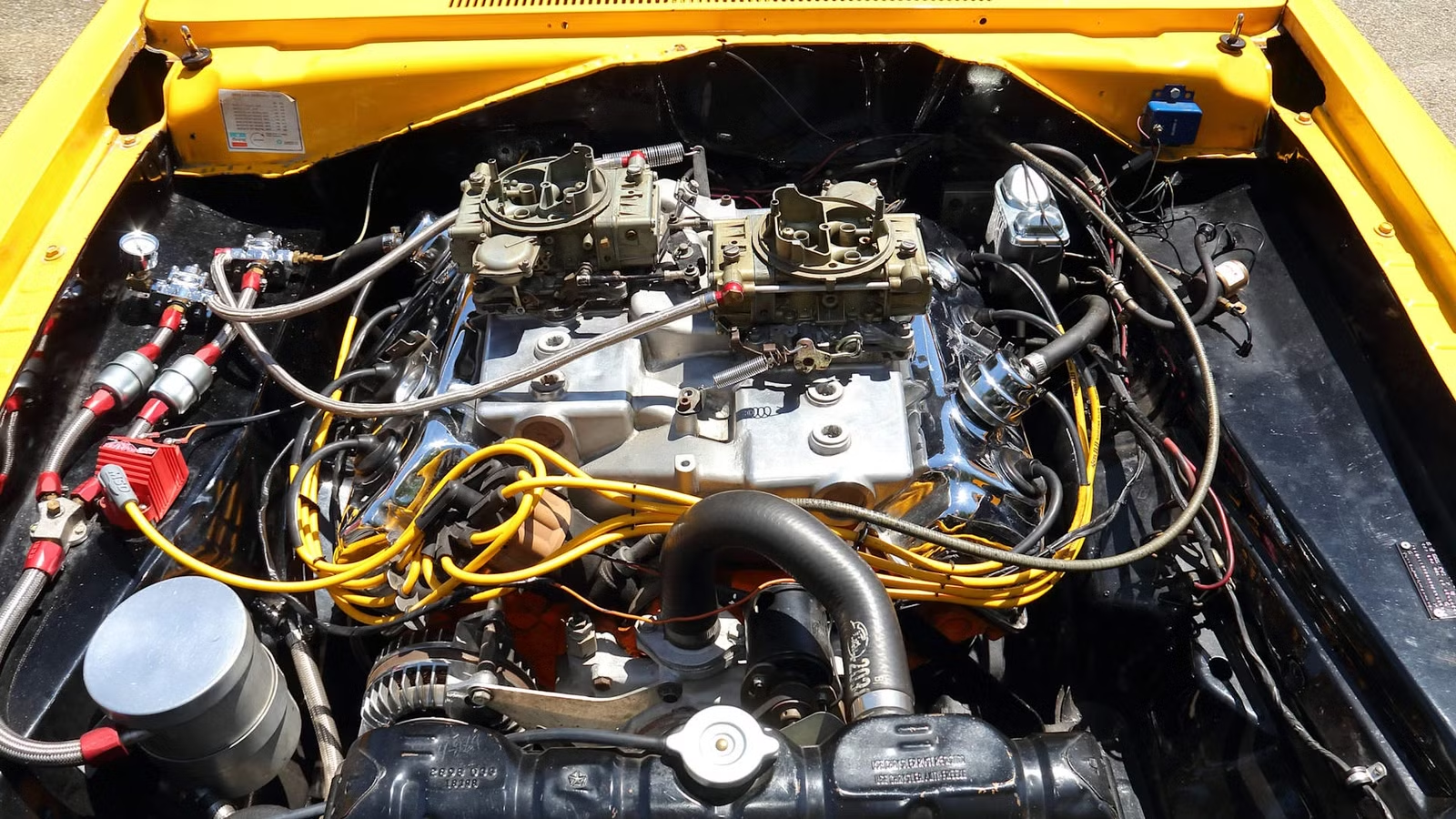
The engine made the regular 425-horsepower Street Hemi look civilized. This was a 12.5:1-compression 426 Race Hemi with cast-iron heads, an aluminum cross-ram intake, and twin 770-cfm Holley four-barrels. TorqueFlite cars got an 8¾-inch rear with 4.86 gears. Four-speed cars were upgraded to a Dana 60 with 4.88 gears. With fiberglass front panels, stripped equipment, special suspension, and its huge battery relocated to the trunk, Dodge lists the race-ready LO23 at an incredible 3,020 pounds.
Dodge Sold Its 426 Hemi Dart “As Is” With No Warranty

Hamtramck did not simply roll a completed Hemi Dart off the assembly line. The partial cars went to Hurst in Madison Heights for their transformation into racing machines. Hurst fitted fiberglass fenders and a hood, complete with its massive scoop. Then it added thin .080-inch Chemcor side glass, stripped doors, lightweight A100-style seats, enlarged rear wheel openings, and dedicated Super Stock springs. Clearance was so tight that workers took hammers to the passenger-side inner fenders, bending the metal enough that the right valve cover could be removed without pulling the entire engine.

Period Chrysler dealership material for the Hemi A-body program described the cars as intended for “supervised acceleration trials,” not ordinary highway use. Dodge added “SOLD ‘AS IS’ WITHOUT ANY WARRANTY WHATSOEVER.” Mopar would sell you the fastest Dart it knew how to build. But what happened next was your problem.
The Hemi Dart Was So Fast, NHRA Bumped It From Its Class

Timeslips prove the Hemi Dart was worth the effort. Dick Landy’s four-speed LO23 ran 10.46 seconds at 131.19 mph at Orange County International Raceway in October 1968. Landy’s car competed in both Super Stock and Modified Production.
The LO23s began life classified in SS/B and SS/BA. But they did so well that by 1970, NHRA moved them into the quicker SS/A and SS/AA classes. Even forced to skip a grade, the LO23 Darts weren’t about to let the other kids catch up. Ron Mancini won the 1970 Summernationals and U.S. Nationals, setting a 10.33-second national ET record at Indy.
The configuration never really died. NHRA still runs an SS/AH class specifically for 1968 Hemi-powered A-bodies. The LO23 wasn’t Mopar’s only Hemi A-body experiment. A 1967 Barracuda became Chrysler’s development mule. Plymouth also built its own run of 1968 BO29 Super Stock Hemi Barracudas. Hurst also turned a few earlier Barracudas into rear-engine “Hemi Under Glass” exhibition machines.
Sources: Dodge, NHRA, Hamtramck Registry, and Stock Mopar

Related posts



Latest Post


No Comments