
GM’s New Patent Shows How It Could Make Truck V8s Both More Powerful And More Efficient
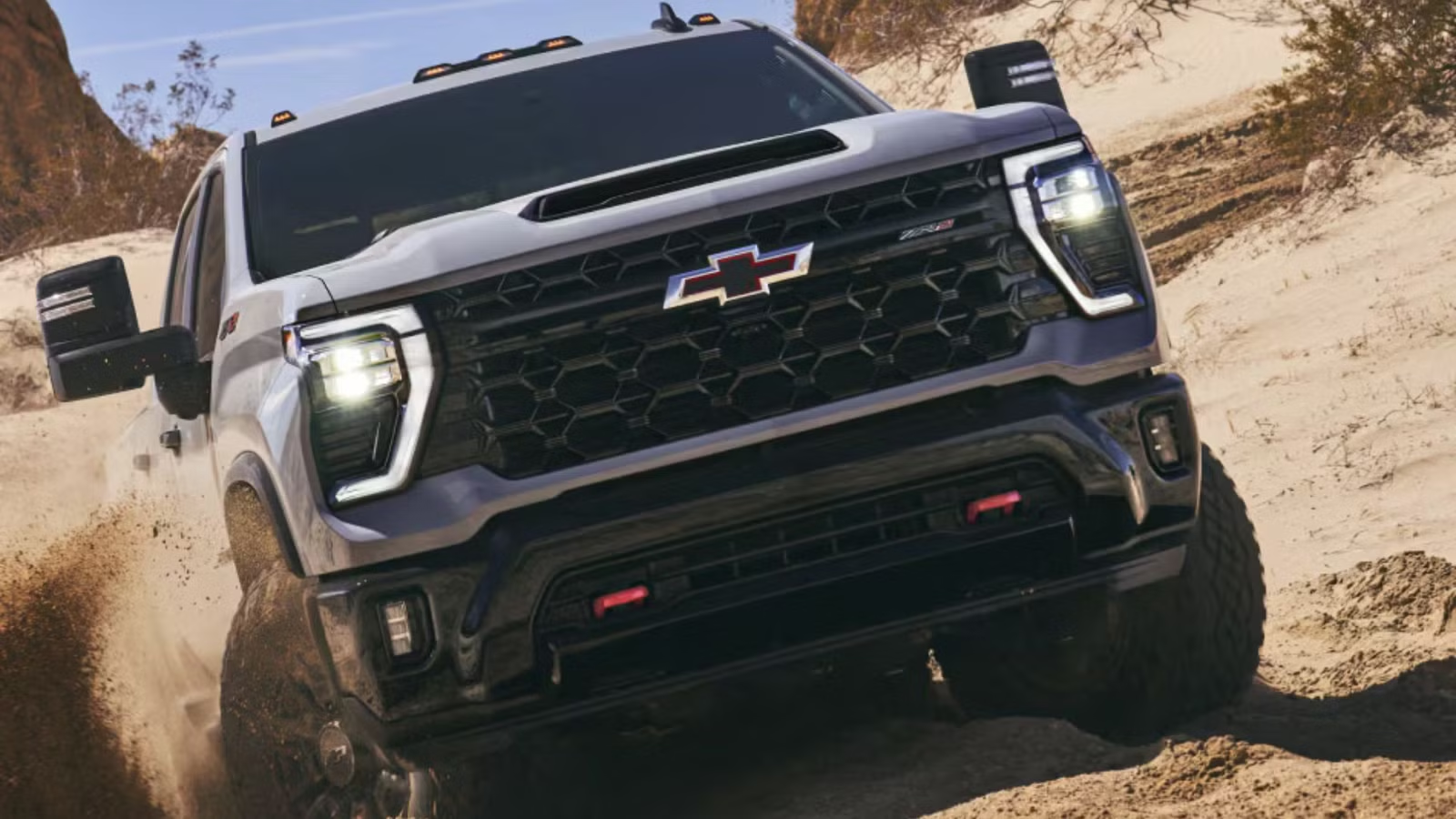
GM just filed a patent that tackles one of the oldest problems in truck engines: making more power without burning more gas to get it. The filing, published on the USPTO website this week, describes a mechanical system that stretches the engine’s expansion stroke well beyond its compression stroke, while also letting the compression ratio swing between 7:1 and 11:1 on the fly. GM hasn’t named a vehicle, but the layout suggests the technology could eventually suit pickups such as the Silverado and Sierra.
How The Three-Crank Mechanism Actually Works

GM says the mechanism can make the expansion stroke up to 1.4 times longer than compression. That lets combustion gases push the piston farther, extracting more energy from the fuel before it exits as exhaust heat.
Because nothing rotates in a simple, smooth arc anymore, the compression and expansion strokes no longer have to match. GM’s patent claims this setup can stretch the expansion stroke up to 1.4 times longer than the compression stroke. That means the piston keeps getting pushed down longer after combustion, pulling more work out of the same amount of fuel and burning less energy off as heat before it escapes out the exhaust valve.
Variable Compression Adds A Second Layer Of Control


The phasing device does double duty. By changing the angle between the crank and control shafts, it also raises or lowers how far the piston travels up the cylinder, which shifts the compression ratio anywhere between 7:1 and 11:1. Drop the ratio and the engine can lean harder on turbo boost for more power. Raise it and the engine runs more efficiently under light loads. An 11:1 ceiling isn’t remarkable. What’s unusual is pairing variable compression with an extended expansion stroke.
How GM’s Approach Compares To Nissan’s VC Turbo

Nissan already sells a variable-compression production engine, the VC Turbo, which swings between 8:1 and 14:1 in the QX50 and Altima using a multi-link system and a single electric actuator. It took Nissan roughly two decades and over 300 patents to get there, and it’s still a four-cylinder built for transverse mounting in crossovers.
GM’s patent covers only longitudinally mounted inline engines, the kind that would sit in a pickup rather than a crossover, and it explicitly adds the extended-expansion piece on top of variable compression. That makes the GM design mechanically busier than anything currently on sale, with three shafts working together instead of one actuator nudging a multi-link.
The Packaging Problem Is Real

None of this comes free. The engine sketched in the patent is wider than it is tall, which creates a serious packaging headache under a truck’s hood, especially with steering components and other hardware competing for space nearby. Building it would also mean sourcing and machining parts for three shafts instead of one, which raises cost and adds failure points that don’t exist in a conventional V8 or inline-six.
GM’s filing does note that it kept serviceability in mind, so a shop wouldn’t need to tear the whole engine down for routine work. Still, a patent is a legal filing meant to protect an idea, not a confirmation that GM is building this engine. Most patents never leave the drawing board. But this one goes deep enough on mechanical detail that it reads like GM sees real upside in solving the power-versus-economy trade-off for its truck lineup, even if a production date is nowhere in sight.

Related posts




Latest Post


No Comments