
The French-Swedish V6 That Gained An Undeservedly Bad Reputation
Like in many other industries, the automotive industry isn’t averse to doing a fair bit of collaboration. It’s commonplace for different manufacturers to team up to create a shared product. Sometimes that can be a shared platform. Other times it can be straightforward badge engineering. There are some examples, though, where important mechanical components have been developed through collaboration.
Some Odd Collaborations Have Appeared Between Automakers Over The Years

If you look at some of the collaborations that automakers have done over the years, there really are some you wouldn’t expect. Maserati has worked with both Citroën and Chrysler in the past. There was Alfa Romeo‘s collaboration with Nissan, which gave rise to one of the worst cars ever produced. There was also the odd badge-engineering arrangement that gave Japanese customers a Honda-badged version of the Land Rover Discovery. One of those odd collaborations, though, was actually quite successful on the quiet.
One Of Those Odd Collaborations Gave Birth To A Very Controversial Engine

Back in the 1960s, a partnership formed between Peugeot and Renault in France and Volvo in Sweden. These three popular European brands wanted to launch a joint venture to produce brand-new engines. That joint venture resulted in Compagnie Française de Mécanique (shortened to FM), and a new factory was built for it in Douvrin, France. The new engine that FM built was supposed to be a staple of the model lineups of all three brands, as well as having the potential to be purchased by others as an off-the-shelf engine. But, its reputation became more complicated than that.

The PRV Is A Franco-Swedish V6 That Stuck Around For 24 Years

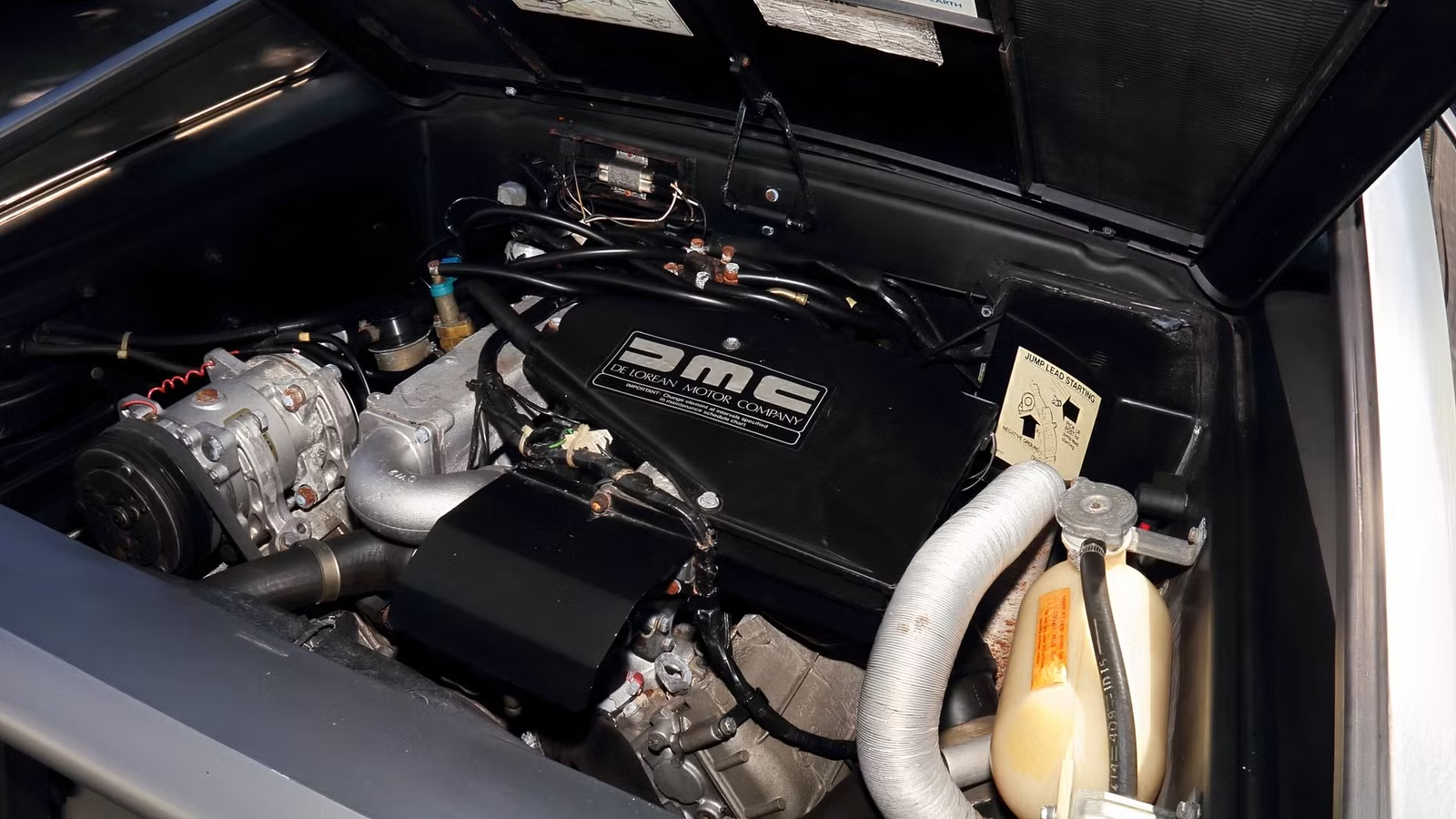
The engine that came out of FM’s Douvrin plant by 1974 was the PRV (an acronym of Peugeot Renault Volvo) V6. The first PRV variants were 2.7 liters in size, but the engine later expanded into a variety of smaller and larger sizes. The smallest 2.5-liter and the largest 3-liter versions of the engine also got turbocharged variants. These turbocharged PRVs ended up becoming real powerhouses, producing as much as 402 hp and 384 lb-ft of torque in the 3-liter versions.
The PRV lasted for a surprisingly long time. The final PRV engines were produced in 1998, 24 years after the original 2.7-liter engines started being made. That makes the PRV a constant presence during three major decades in the automotive industry (the ’70s, ’80s, and ’90s). The collaborative spirit survived beyond the PRV’s lifespan, too. The ES V6 that replaced it preserved the Peugeot and Renault part of the arrangement, with Volvo moving on in its own direction.
It Was Originally Supposed To Be A V8
The PRV’s V6 layout wasn’t actually the joint venture’s first choice. Originally, it was going to be a V8. But, the 1970s energy crisis and high taxation on engines over 2.8 liters in Europe put paid to those plans. The designers simply lopped two cylinders off the original V8, and took things from there in a V6 format. That explains why the PRV has a 90-degree cylinder bank configuration, rather than the typical 60 degrees you’d get in a V6—a 90-degree angle is the default for a V8.
It Appeared In A Huge Variety Of Vehicles

As well as its unusually long production run, the PRV appeared in an unusually wide variety of different vehicles. Of course, it appeared in many Peugeot, Renault and Volvo models, including the Volvo 780 coupe. There’s also the DeLorean DMC-12, the car that most American enthusiasts will most associate with that engine. But, it also appeared in sports cars made by Alpine and Venturi (the Alpine A610 and Venturi 400 both got the very powerful 3-liter turbocharged variants), the Talbot Tagora, the Citroën XM, the Lancia Thema, the 1990-1992 Dodge Monaco, The Eagle Premier, the UMM Alter II during the ’90s and even a couple of military vehicles made by Panhard. It seems like there was a period when it was almost impossible to escape this engine!
Why Does It Have Such A Bad Reputation?
From what we’ve already talked about, you’ll have gathered that the PRV was actually quite a successful engine. So why does it have such a bad reputation? There are a couple of good reasons why that is. One of those reasons is understandable. The other, though, stems from something that really isn’t the engine’s fault.
US-Spec Engines Were Severely Underpowered

The biggest reason why the PRV has such a bad reputation is that it’s perceived as being underpowered. That’s not actually strictly true. European-spec cars with PRV engines could actually be quite powerful. You only have to look at the aforementioned Alpine A610 or Venturi 400 to see that. The issues with the PRV being underpowered came entirely from US-spec cars that had them.
Like many other engines during the ’70s and ’80s, US-spec PRVs got strangled to appease American emissions regulations. US-spec versions of the 2.8-liter PRV used in the DeLorean DMC-12 only produced 130 hp and 153 lb-ft of torque. That’s a far cry from the 190+ hp the European-spec versions of this engine could produce. Since the primary experience many American enthusiasts have with the PRV is the strangled US-spec version from the DeLorean, the reputation has stuck.
Volvos Equipped With It Weren’t As Reliable As Ones With The 4-Cylinder Redblock Engine

Another less publicized but still important reason why the PRV has a bad reputation is how reliable it is compared to other engines. Specifically, that’s within the Volvo line-up. The PRV engines in more expensive Volvos ended up proving to be markedly less reliable than the 4-cylinder Redblock engines in more humble models. While the Redblock is absolutely bulletproof, the PRV often requires major work after 100,000 miles. That’s due to a weakness in the camshafts. It’s inherent in the PRV’s design, and there’s nothing that can really be done to fix it.
Sources: Alpine, Citroën, DeLorean, Dodge, Eagle, Panhard, Peugeot, Renault, UMM, Venturi, Volvo, Volvo Enthusiast’s Club

Related posts



Latest Post


No Comments