
5 Best Crate Engines For Classic Cars Ranked By Torque
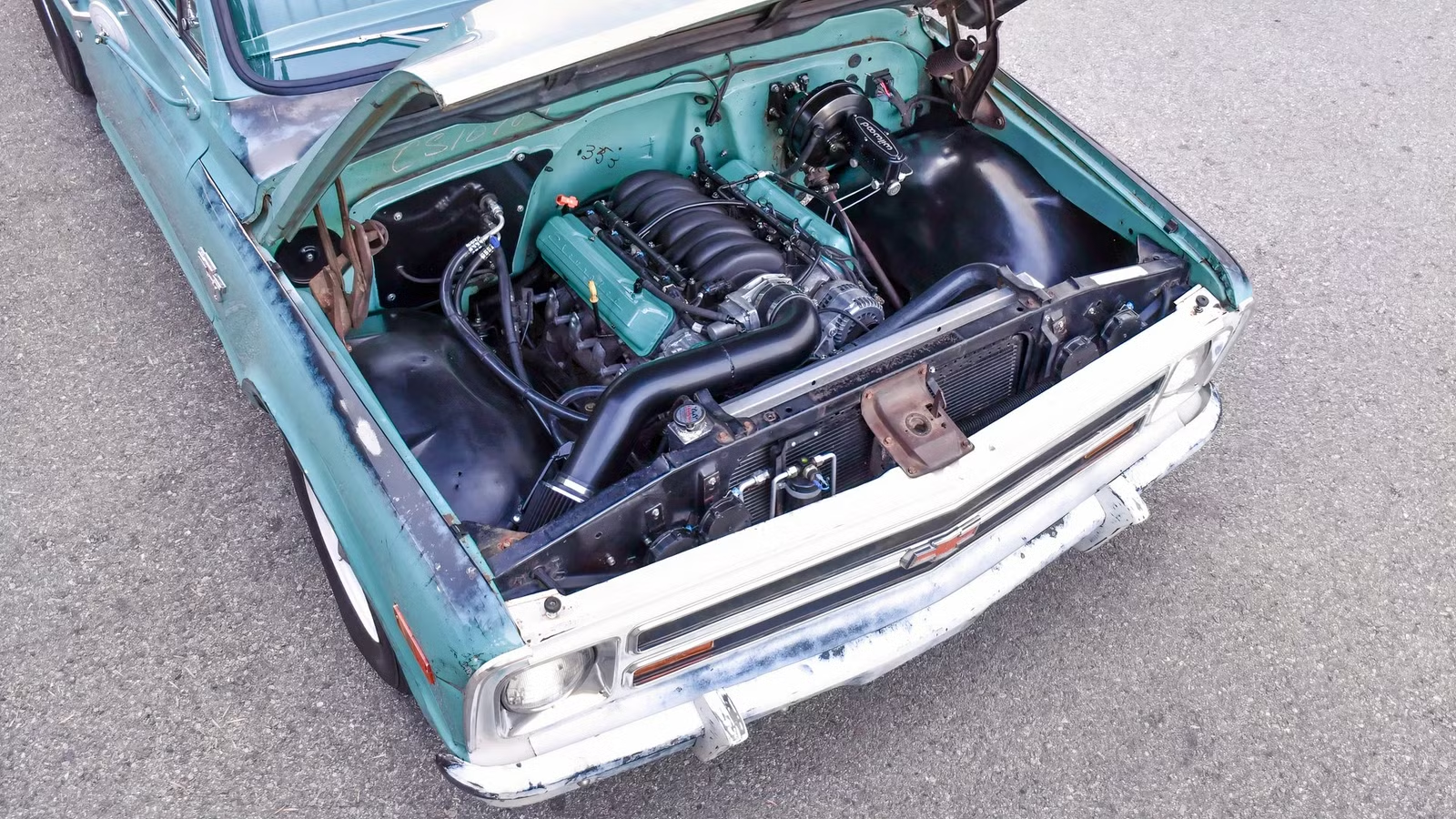
When 575 lb-ft earns last place, you’re looking at serious crate-engine muscle. The strongest of these five gasoline V8s is rated at 950 lb-ft. But that kind of torque can turn a classic-car dream into an expensive puzzle. The cost of an engine swap doesn’t stop at the crate; transmissions, cooling, and engine-bay clearance still have to work.

We’ve ranked these engines by manufacturer-published peak torque, not a shared dyno test, while weighing fitment and builder support. Fuel demands and competition-use restrictions could decide which one belongs in your classic.
5
Ford Performance Z460 Boss
Torque: 575 LB-FT
Imagine a classic Ford fighting for grip as the Z460 reaches its 575-lb-ft torque peak. At 4,700 rpm, that much twist puts the drivetrain to work. Ford packs 460 cubic inches into a 351-based Windsor small-block, not Ford’s 460 big-block. There’s 575 hp on tap, too.

Behind it are a Boss block, aluminum Z heads, a forged SCAT crankshaft, and forged Mahle pistons. For anyone retaining a Windsor-based engine, the layout is familiar, but chassis fit isn’t guaranteed. Its 10.0:1 compression requires premium unleaded.
Ford lists the engine at $13,250. Its output used an Edelbrock Super Victor intake, 850-cfm Holley carburetor, and long-tube headers; intake, carburetor, distributor, and flywheel cost extra.
Raised exhaust ports may need custom headers; the rear-sump pan, timing cover, or water pump could also need changes. And this is competition/off-highway equipment, not a guaranteed road-legal swap.
4
Chevrolet Performance ZZ572/620
Torque: 645 LB-FT

At 4,200 rpm, Chevrolet’s ZZ572/620 serves up 645 lb-ft—enough twisting force to put a classic’s tires, transmission, and rear axle on notice. No supercharger. Just 572 cubic inches breathing through an 850-cfm carburetor, with a hydraulic roller cam working the valves. That torque peak arrives 500 rpm below the Ford Z460’s, which can change how you choose gearing.
Despite the 620 badge, Chevrolet rates it at 621 hp. Its Deluxe package includes the intake, carburetor, distributor, and water pump. But the tall deck block may challenge hood and exhaust clearance, so budget for cooling and drivetrain upgrades rather than assuming it will drop straight in.
Chevrolet specifies at least 92 AKI premium fuel; the more extreme ZZ572/720R needs 110-octane racing gasoline. And Chevrolet designates this engine for competition use. An old registration alone doesn’t establish road-use approval.
3
BluePrint Engines 632 Pro Series
Torque: 775 LB-FT

BluePrint’s fuel-injected 632 Pro Series makes 775 lb-ft and 815 hp, with a forged crankshaft and pistons and a dyno sheet recording each engine’s test results.
The $19,999 PS6320CTF1 includes Holley Sniper 4500 injection, intake, and distributor; a flywheel or flexplate costs extra. But fitting it takes more than enthusiasm. Its iron block’s deck sits roughly 0.400 inch higher than the original Chevrolet big-block design, while the exhaust ports are raised 0.300 inch. Check header, steering, and shift-linkage clearance.
BluePrint recommends a 3,800–4,200-rpm stall converter and electric fans flowing at least 4,000 cfm for engines this large. Those recommendations matter before you choose an automatic transmission and cooling system. This package isn’t for pollution-controlled vehicles.
2
Chevrolet Performance ZZ632/1000
Torque: 876 LB-FT

Chevrolet Performance ZZ632/1000 Crate Engine
At 5,600 rpm, Chevrolet’s ZZ632/1000 delivers 876 lb-ft without a supercharger. Its 632 cubic inches also produce 1,004 hp, with more advertised peak torque than BluePrint’s equally sized 632. Every gear, axle shaft, and tire between engine and pavement must be chosen accordingly.
High-flow, symmetrical-port heads and fuel injection feed this enormous big block. The Deluxe engine includes its control system and harness, but needs constant 58-psi fuel pressure. Change the calibration and you risk engine damage and a voided warranty.
Its torque peak arrives 1,400 rpm later than the ZZ572/620’s, making gearing more important than the headline alone suggests. Raised exhaust ports may demand custom headers; the tall deck and supporting systems can require fabrication. Chevrolet designates this engine for competition use, so plan the entire car before ordering.
1
Mopar Hellephant A30 426 Hemi
Torque: 950 LB-FT

The Hellephant A30 wins this countdown with 950 lb-ft and 1,000 hp on premium gasoline. Its 3.0-liter twin-screw supercharger forces air into 426 cubic inches of Hemi, while a forged-steel crankshaft and forged-aluminum pistons work inside an aluminum block. A classic’s gearbox, driveshaft, and rear axle would all have to handle that output before the tires can put it down. A weak link could turn the first hard pull into an expensive repair.
Direct Connection lists $34,995 MSRP, plus $2,795 for the matching 77072500AE controller kit: $37,790 before installation. Even then, you haven’t bought the whole swap. The front accessory drive costs extra, and older controller kits won’t work with the A30’s revised calibration.
It’s intended for pre-1976 builds, but “plug-and-play” doesn’t promise an easy fit. Budget for fuel supply, engine and supercharger cooling, exhaust, and a capable drivetrain. Before you chase 950 lb-ft, make sure the finished car can handle it and meets the road-use rules where you live.
Sources: Ford Performance, Chevrolet Performance, BluePrint Engines, Direct Connection.

Related posts



Latest Post


No Comments