
This Honda Inline-Six Made Every V-Twin Sound Tame
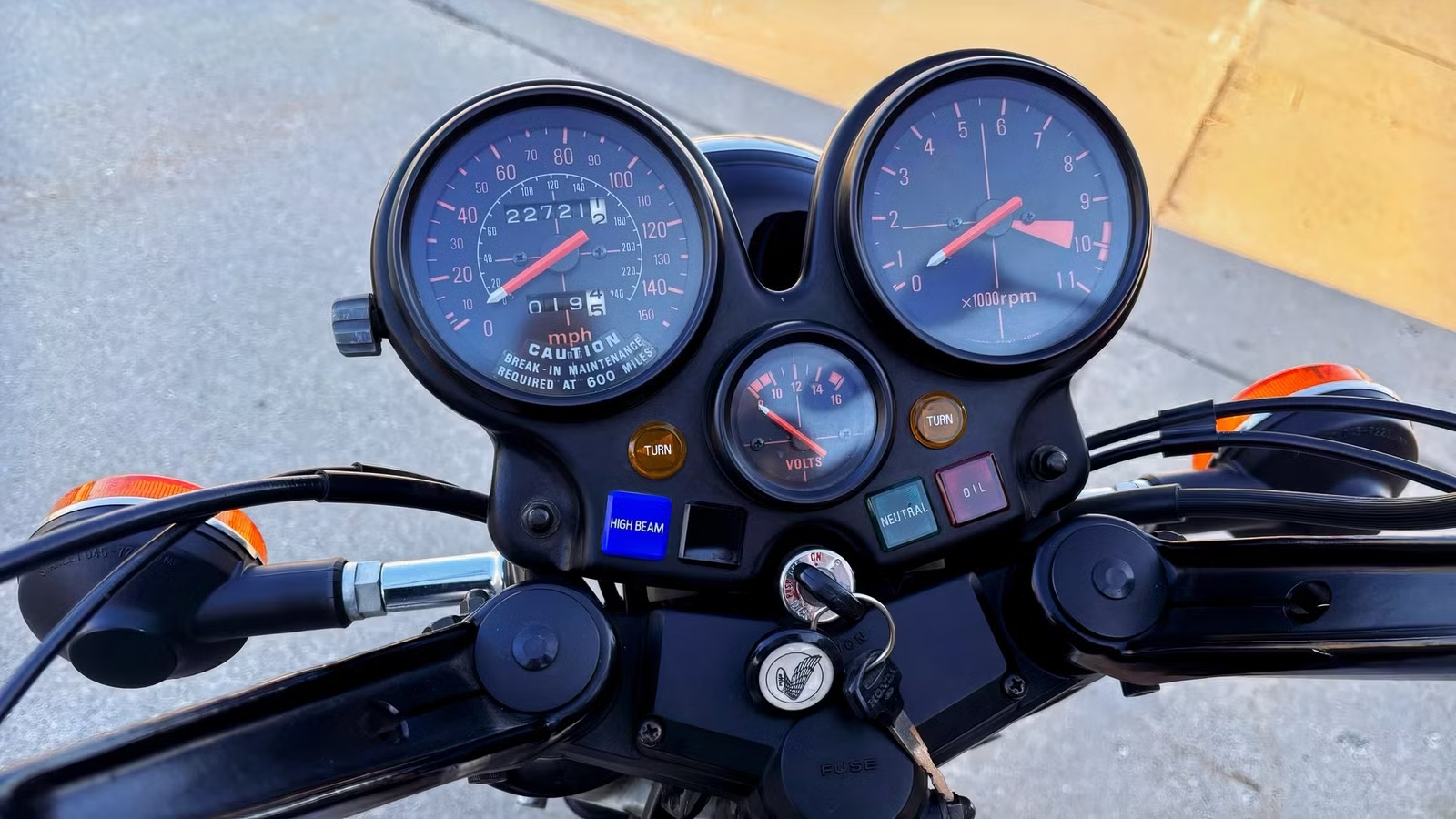
Honda’s engineers once spent time at a Japanese Air Force base recording F-4 Phantom jet fighters. They wanted that sound in a motorcycle exhaust. Management heard the result and said it was too much. So they toned it down. What made it to production was still unlike anything anyone had heard from two wheels, and it ruined the V-twin for a whole generation of riders. Honda’s CB series has never been shy about bold experiments, and this one is the reason that brand legacy resonates the way it does.
A Time When Japanese Superbikes Rewrote The Rules For Cylinder Count

The 1970s were when two-wheeled motorsport became a full-blown arms race. Bikes got faster and more extreme, and manufacturers with deep pockets started bolting racing engines straight onto road bikes. Most of what came out of that era was over a thousand cc, running more than two cylinders, and gloriously over-engineered. That groundwork made everything that came after possible.
Late 1970s Japan was the most brutal playground in motorcycling. Every major brand had a flagship worth talking about. Yamaha had the XS1100, Kawasaki had the Z1-R 1000, and Suzuki had the GS1000. All big, all multi-cylinder, all serious machines. Honda, meanwhile, was still sitting on a CB750 platform that hadn’t changed since 1969. The press had started saying Honda wasn’t exciting anymore. That landed on R&D director Tadashi Kume, who decided it was time to change.
The Fire That Ignited Six Cylinders And Made It The Next Frontier

Before Honda committed to six cylinders, Benelli had already been there with the 750 Sei. It wasn’t a clean-sheet design though. It added two extra cylinders to a Honda CB500 base. Honda had a different plan. It built the six from the ground up: high-revving, DOHC, four valves per cylinder, with Grand Prix DNA baked in. Two candidate engines ran in parallel during development. A four-cylinder, four-valve unit at 98 horsepower, and the inline-six at 103 hp. Honda chose the six, and the deciding factor wasn’t the power difference. It was the sound and the engineering complexity.


Suzuki Built The Fastest Motorcycle Nobody Could Handle
This 194-mph machine ended the speed wars by forcing a global truce that capped all future production motorcycles.
The Inline-Six Sound That No V-Twin Can Match

There’s a reason the inline-six doesn’t just sound different from a V-twin. It sounds categorically different. The firing order, the way exhaust pulses stack against each other, the register they hit at high rpm. None of it works the same way. Once you’ve heard a six at full song, a twin starts to feel like it’s missing something.

Let’s get nerdy about it for a second. With a six-into-two exhaust layout, three cylinders exhaust into each muffler with firing intervals every 120 degrees, and the pulses come every 240 degrees of rotation. In a four-cylinder two-into-one setup, those pulses arrive at 180-degree intervals with a 540-degree gap in between. The six distributes those pulses far more evenly, and the result is a smoother, higher-pitched note with far less of the loping gap that defines a twin. V-twin firing intervals are even more irregular. The difference isn’t just preference. It’s physics.
Headache Of Packing A Six Cylinder Engine Inside A Motorcycle Frame

Six cylinders in a line make for a wide engine, and a wide engine has no business inside a motorcycle frame. Hanging the alternator and ignition off the crank ends is standard practice on a four, but on a six it makes the engine unacceptably broad. Kawasaki took a shot at this problem in 1979 with the Z1300: water cooling, shaft drive, 1,286cc. The engineering worked. But the weight penalty was brutal, and that weight pushed the Z1300 firmly into tourer territory, whether that was the plan or not.
The Honda CBX1000 And Its Famous Exhaust Note

Honda’s answer was the CBX1000, and it solved the packaging problem on entirely different terms. A jackshaft, driven by a chain from the crank center, handled the alternator, ignition timing, and clutch drive simultaneously, keeping the engine to 23.4 inches wide. The whole unit tilted 33 degrees forward in the frame, and the result weighed in at 599.95 lbs wet. Where the Kawasaki went big and heavy, Honda went narrow and purposeful. The numbers told part of the story. The exhaust told the rest.
Shoichiro Irimajiri had already designed Honda’s six-cylinder GP race engines before he led this project, and he built the CBX’s powertrain in 18 months. The US spec made 103 hp at the crankshaft at 9,000 rpm; European spec ran 105 bhp gross, which is the figure that shows up most in period literature. Period press testing put rear-wheel output at 85.56 horsepower and 52.27 lb-ft of torque at 6,500 rpm. In dry-track testing, it ran the quarter mile in 11.55 seconds at 117.49 mph.
The Exhaust Configuration And The Signature Harmony It Created

Honda’s engineers visited Japan’s Hyakuri Air Base in Chiba Prefecture and spent time recording F-4 Phantom jet fighters, with one goal: capture that turbine scream in the CBX’s exhaust. The first version hit the Suzuka test circuit with Honda test rider Sato.
|
Spec |
Details |
|
Engine |
1,047cc DOHC air-cooled inline-six, 63.9 Cu in |
|
Power (US) |
103 hp @ 9,000 rpm (net claimed) |
|
Power (European) |
105 bhp @ 9,000 rpm (gross) |
|
Torque |
52.27 lb-ft @ 6,500 rpm (rear wheel, period testing) |
|
Quarter Mile |
11.55 sec @ 117.49 mph |
|
Top speed |
134-140 mph |
|
Transmission |
5-speed manual |
|
Production |
1979-1982 |
|
Original price |
$3,998 (1979 US) |
The engineers worked their magic, and the symphony was top-notch. Management heard it and said no. Too much. The production exhaust was reworked to be more street-sensible, but the six-into-two layout and its harmonic signature stayed.

Honda’s Turbocharged Motorcycle Was Decades Ahead Of Its Time
Honda built a turbocharged motorcycle loaded with future tech in the 1980s, but it lasted only one model year.
How Honda Turned A Street Weapon Into A Sport Tourer

The CBX was built to be the ultimate street machine. The inline-six, the exhaust, the spec sheet: all of it pointed one direction. Nobody expected what came next. In 1981, Honda converted the street weapon into a sport tourer, complete with full fairing, saddlebags, and revised ergonomics. It was a different machine entirely, and the riders who loved the original felt it.
The 1981 Fairing Decision And What It Cost The CBX

The updates ran deep. Twin shocks out, single air-shock Pro-Link monoshock in. Front forks upsized from 35mm to 39mm. Wheelbase extended 40mm. New cam profiles, horizontal carburetor mounting, and an exhaust crossover pipe that improved mid-range pull but softened the original’s top-end character. Then there were the cosmetics. One color only: Magnum Silver with black accents. No red. The 1980 model had already been detuned from 103 horsepower to 98 to meet German and US EPA requirements, so by the time the fairing arrived, the CBX was already a different machine.
Why Honda Nailed The Job, Who Got Left Behind

The commercial reasoning made sense. The CBX was a tough sell, and the CB900F sibling had been outselling it since late 1979. But the sport-tourer conversion created a dead end. The riders who wanted the raw CBX experience couldn’t get it from the tourer anymore. The ones who wanted a tourer already had the Gold Wing. Honda tried to broaden the CBX’s appeal at the exact moment the market had already made its decision.

12 Japanese Motorcycles That Practically Last Forever
These ten Japanese motorcycles have one thing in common: with basic maintenance, they just keep going. Some owners have even seen six-figure mileage.
Why The CBX1000 Was The Last Of Its Kind

The CBX1000 is Honda’s only inline-six street motorcycle, and no major manufacturer has built a dedicated inline-six superbike since. That exclusivity is the real legacy here. The engineering it demanded included four camshafts, 24 valves, six individual carburetors, and a bespoke jackshaft solution. The sales numbers never justified it. Honda moved on.
The CBX ran from 1979 to 1982 across four model years. Frame number records put the 1979 model alone at approximately 23,000 units, with production declining from there. At $3,998 in 1979, it was a premium ask, and sport buyers were already moving toward purpose-built machines with better chassis. The CB900F was easier to live with and handled better. The Gold Wing owned the touring segment. There was no lane left for the CBX.
The Legacy CBX1000 Left Behind And Why Honda Never Got Back To It

That rarity is now the collector market’s fuel. Today, the average sale price sits at $16,829, with 2026 auction results hitting $19,800 at Mecum and a peak of $23,000 tracked through Classic.com. The 1979 CBX1000Z in red, unmodified, commands the highest prices. In 1990, Irimajiri wrote to the US CBX Owners’ Club to explain the original engineering call: the four-cylinder rival Honda built for comparison was lighter and actually faster. Honda chose the six anyway, because the four-cylinder lacked something that couldn’t be measured in speed or weight. The market rejected it. Collectors haven’t stopped paying for it since.
Sources: Mecum, Classic.com, Bring A Trailer

Related posts

Latest Post


No Comments