
Harley-Davidson Revived The Bike That Invented The Factory Custom, But Only 2,500 Get One
By the late 1960s, Harley-Davidson had become something of a blank canvas for some. Riders were taking perfectly good motorcycles apart, swapping components between models, and building customs that looked nothing like the machines leaving Milwaukee. California’s chopper scene was particularly influential, and Harley designer Willie G. Davidson started paying attention.

Rather than leave that business entirely to independent builders, Harley decided to get involved. Davidson believed the company could offer something with the appearance of a custom motorcycle without requiring buyers to build one themselves. The idea would eventually influence Harley’s lineup for decades, although its first attempt wasn’t an immediate success.
The 1971 Super Glide Helped Define The Factory Custom
The 1971 FX Super Glide was Harley-Davidson’s first factory custom, combining components from existing motorcycles into something previously unavailable from the manufacturer. Customers could buy a motorcycle influenced by the growing custom scene without replacing half its parts. It wasn’t quite a chopper, nor was it a traditional heavyweight Harley. The FX occupied unfamiliar territory between the two.

Unfortunately, the Super Glide didn’t exactly fly out of dealerships. Harley sold fewer than 5,000 examples during its first year, and the styling attracted criticism. The company made changes for 1972, and the revised motorcycle proved more successful. The Super Glide subsequently helped establish the FX family, which produced models such as the Low Rider and Wide Glide.
Willie G. Davidson Combined Big Twin Muscle With A Sportster Front End

Davidson’s original design used the chassis and Shovelhead engine from Harley’s FL Big Twin, paired with the narrower front fork and wheel from a Sportster. It was a relatively straightforward combination of existing components, but the proportions were considerably different. The smaller front end made the large V-twin look leaner, an approach already popular among custom builders.
Then there was the boattail. This large fiberglass section surrounded the seat and extended over the rear wheel, giving the FX one of the strangest rear ends Harley had ever fitted to a production motorcycle. Buyers weren’t particularly enthusiastic, and Harley dropped the bodywork after 1971. Ironically, that short-lived design is now one of the features collectors associate most strongly with the original Super Glide.
The 2026 Harley-Davidson Super Glide Returns With Just 2,500 Examples

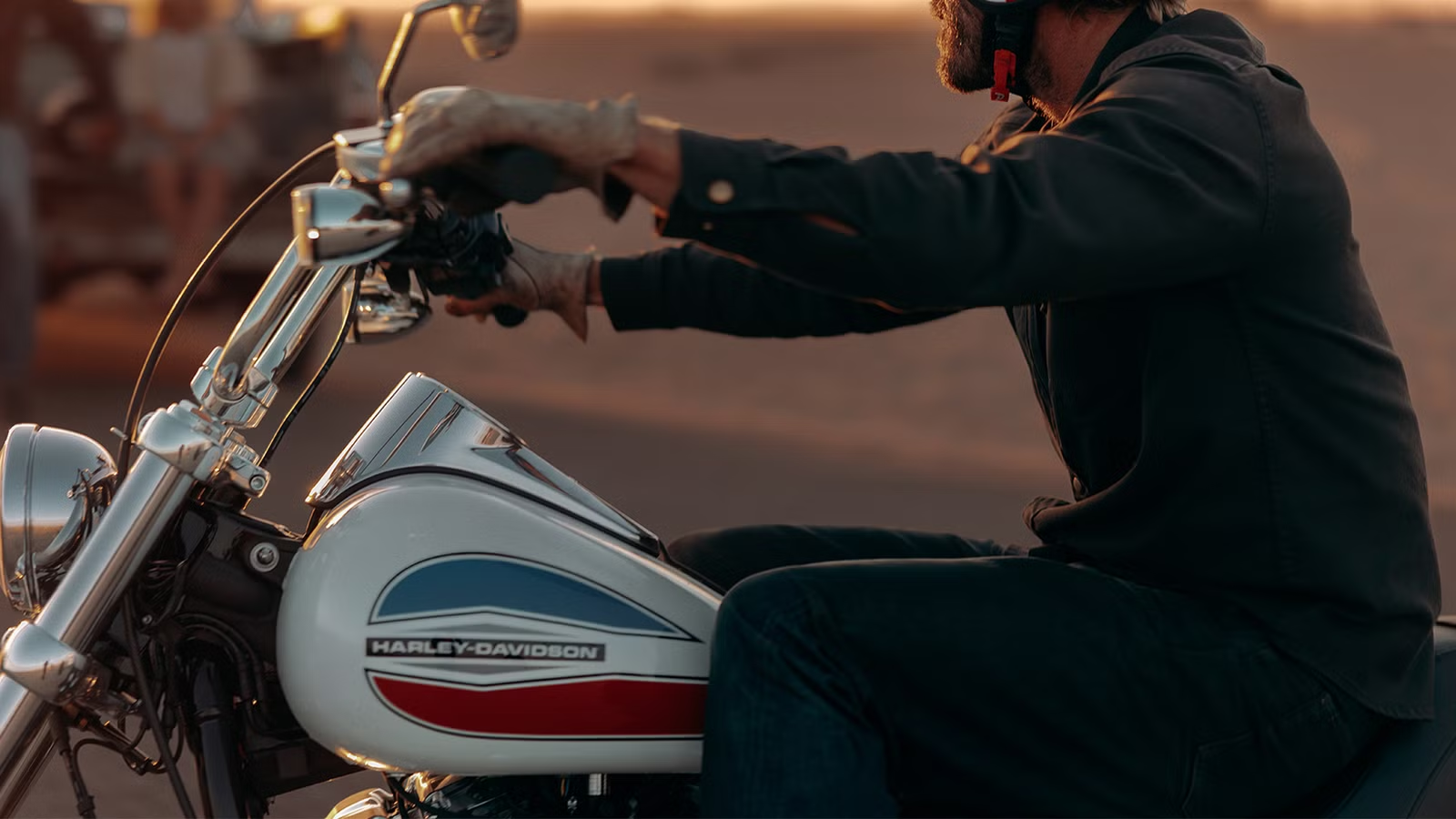
Fifty-five years later, Harley-Davidson has revived the Super Glide as a limited-production Special Edition for 2026. The motorcycle celebrates the 250th anniversary of the United States, with production restricted to 2,500 individually numbered examples. Each carries its number on the fuel-tank console, and Harley is offering the model exclusively in the United States and Canada.
The new Super Glide starts at $15,999, which makes it considerably less expensive than Harley’s exclusive CVO motorcycles as far as special editions are concerned. Buyers are primarily paying for the anniversary styling, limited production, and historical connection. Whether those qualities eventually translate into collector value is another matter.
The Paint Recalls 1971, But The Boattail Doesn’t Return

Harley has done a convincing job of recreating the original paint scheme. White Onyx Pearl covers the tank and fenders, with red-and-blue striping and stretched graphics inspired by the 1971 FX. Chrome appears throughout the motorcycle, including the exhaust, engine covers, headlamp, and rear fender supports. Laced wheels and mini-ape handlebars add to the period appearance.
The controversial boattail hasn’t made a comeback, however. Instead, Harley uses a clipped rear fender, low two-up seat, and exposed rear tire. The five-gallon teardrop tank also gives the motorcycle proportions more familiar to modern Harley buyers. The result is an obvious tribute to the original without recreating the part that customers disliked the most on the original.
The Milwaukee-Eight 117 Classic Produces 98 Horsepower

The new Super Glide gets Harley’s Milwaukee-Eight 117 Classic, a 1,923cc V-twin producing 98 horsepower at 4,600 rpm and 120 lb-ft of torque at 2,500 rpm. Its 10.3:1 compression ratio and relatively broad torque delivery suit a conventional cruiser rather than a high-revving performance model. The same engine is also found in the 2026 Street Bob.
Power reaches the rear wheel through a six-speed transmission, while a two-into-one exhaust exits through a single muffler. Harley lists the Super Glide at 656 pounds in running order, with a 26.2-inch unladen seat height. Its five-gallon tank also provides more fuel capacity than the Street Bob’s 3.5-gallon unit. Mechanically, there is little here that Harley hasn’t already proven elsewhere in its cruiser range.
Modern Softail Hardware Sits Beneath The Retro Styling

Since the Dyna platform no longer exists, the new version doesn’t come with dual shocks in the rear, but instead gets a monoshock beneath its seat. Rear-wheel travel measures 3.4 inches, and a 49mm dual-bending-valve fork handles the front suspension. Harley also fits tubeless laced wheels, preserving the traditional spoke pattern without requiring conventional inner tubes.
The electronics are far more advanced than the motorcycle’s appearance suggests. Road, Sport, and Rain modes adjust its response, while cornering ABS, traction control, and drag-torque slip control come standard. Cruise control and tire-pressure monitoring are also included. A five-inch analog speedometer incorporates a digital display, which keeps the cockpit relatively traditional despite the added technology.
Harley Revived The Factory Custom Without Building A Replica

via Harley Davidson
At $15,999, the Super Glide costs $1,000 more than a 2026 Street Bob, despite sharing its basic engine and Softail architecture. The extra money buys considerably more chrome, the larger fuel tank, distinctive bodywork, and the numbered anniversary treatment. It isn’t a faster motorcycle, and Harley hasn’t attempted to reproduce the original FX’s unusual construction.
That actually makes the revival fairly consistent with Willie G. Davidson’s original approach. The 1971 Super Glide was assembled from familiar Harley components, with its appearance providing the main distinction. The 2026 version follows much the same formula, borrowing from the company’s existing cruiser range rather than introducing something completely new. The difference is that Harley has made this particular factory custom available to just 2,500 buyers.
Source: Harley Davidson

Related posts




Latest Post


No Comments