
The Used Luxury ADV That Delivers Ducati Quality At Honda Money
The adventure motorcycle segment has evolved from rugged dual-sport machines into the undisputed kings of long-distance touring. Today, riders demand that a single motorcycle tackle high-speed interstate hauls, weekend mountain twisties, and rutted trails without breaking a sweat. As a result, modern adventure bikes have steadily grown more technologically sophisticated, heavier, and substantially more expensive. Showroom pricing for luxury adventure motorcycles frequently breaches the $20,000 mark, turning what used to be a versatile tool for open-road exploration into an intimidating financial barrier for many riders.
Dakar Pedigree And An Automatic Gearbox Keeps The Africa Twin At A Premium Price

Honda has long served as the pragmatic cornerstone of this genre, building durable, unfussy machinery engineered to run indefinitely. The Africa Twin can do it all without compromise. Especially in the modern Adventure Sports ES DCT guise, it has led the way for riders who prioritize globe-trotting dependability, genuine Dakar-bred off-road capability, and effortless automatic-shifting convenience.
In the broader context of the luxury adventure market, its $18,599 asking price is actually remarkably reasonable. Yet for the everyday consumer, eighteen and a half grand before dealer fees remains a massive sum of money for a twin making just over 100 horsepower.
A $10,199 Transalp E-Clutch Feels Like A Compromise Even Through Its Value

On the accessible end of the showroom floor, Honda offers the XL750 Transalp, newly fitted with an automated E-Clutch system starting at an appealing $10,199 that now makes it possibly the most complete all-rounder in its class. It functions brilliantly as an everyday commuter appliance, but the cost-cutting measures are evident the moment you push the chassis. You get an agreeable four-figure price tag, but you also end up with built-to-a-cost suspension damping and utilitarian brakes that struggle to provide genuine mechanical excitement or high-speed touring luxury.

Scouring Classifieds Can Turn A $10,000 Compromise Into High-End Italian Luxury

If you are willing to scour the pre-owned classifieds, that exact same $10,000 budget stops being a middleweight compromise. Instead of settling for a sensible, mass-market showroom parallel twin with entry-level cycle parts, that money can put a fully loaded, high-end Italian flagship in your garage. A machine that originally sat at the absolute peak of the luxury adventure segment with semi-active suspension, superbike-derived brakes, and genuine continent-crossing pedigree.
Depreciation Drops Bologna’s 160-Horsepower Flagship Directly Into Transalp Territory

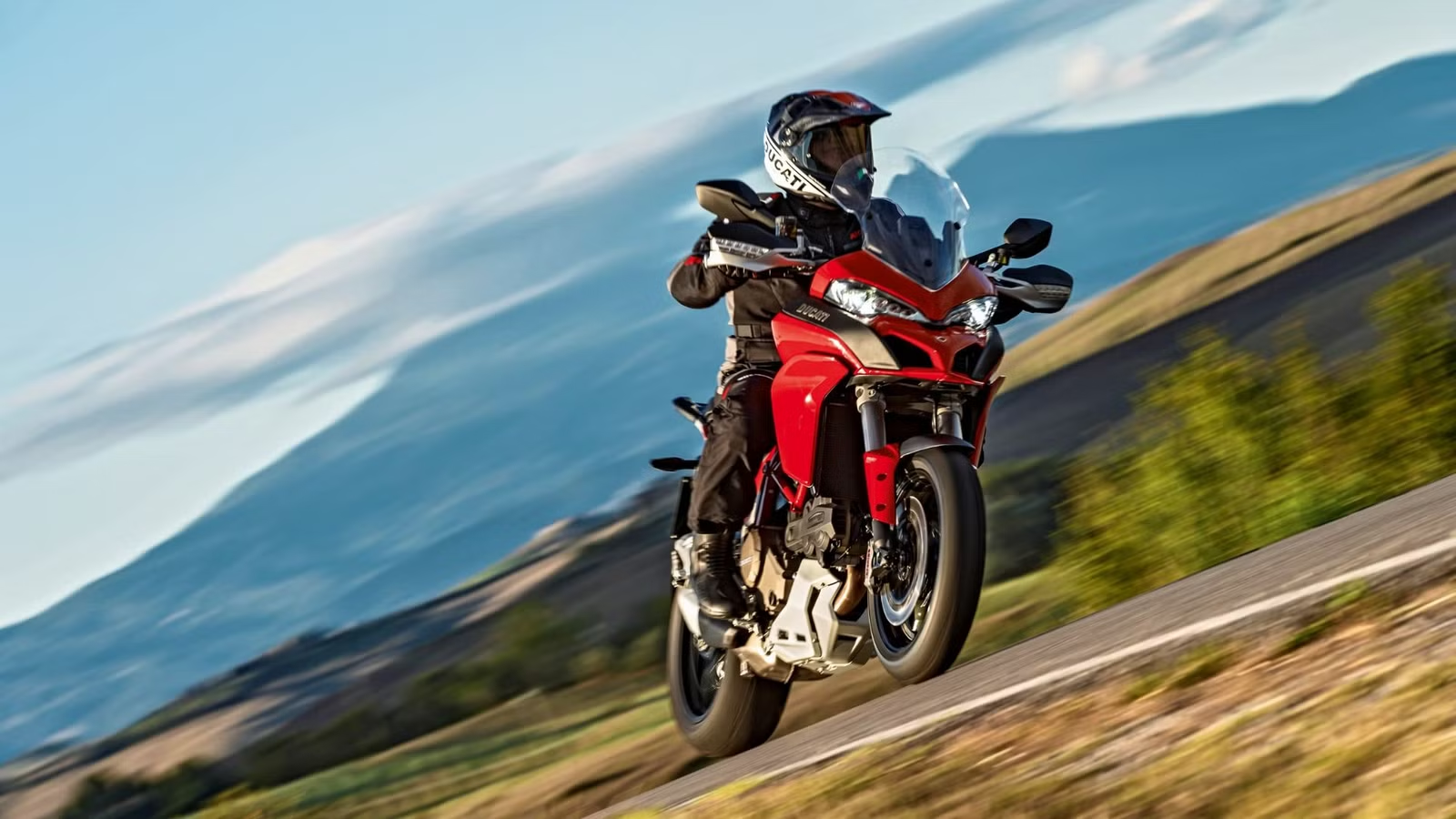
When Ducati introduced the second-generation DVT (Desmodromic Variable Timing) Multistrada 1200 S, it commanded a price of, what else, nearly $20,000. It sat at the pinnacle of the sport-touring adventure hierarchy, engineered to rival the BMW GS while delivering superbike chassis dynamics.
Depreciation has done prospective buyers a huge favor. According to Kelley Blue Book, a standard 2017 Ducati Multistrada 1200 lists around $10,455. Because valuation guides often lump variants together, a clean Multistrada 1200 S trades in the exact same $10,000 to $11,000 bracket. For the price of a brand-new Transalp E-Clutch, or a little over half the cost of a new Africa Twin Adventure Sports ES DCT, you get semi-active suspension, Brembo monobloc brakes, and nearly double the horsepower of any new Japanese bike at this price.
Testastretta DVT Tech Delivers 80 Percent Of Peak Torque Right At 3,500 RPM

The centerpiece of the Multistrada 1200 S is its Testastretta DVT 90-degree V-twin. Early Multistradas were notoriously snatchy at low revs, unlike the smooth, stable V-twin of the current Multistrada V2. Variable valve timing solved that by independently adjusting intake and exhaust camshafts continuously across the rev band.
Displacing 1,198 cc with a 12.5:1 compression ratio, it generates 160 horsepower at 9,500 RPM and 73.8 pound-feet of torque at 7,500 RPM. With 80 percent of its torque available by 3,500 RPM, highway roll-on punch effortlessly puts distance between it and an Africa Twin or Transalp. A six-speed gearbox, light assist and slipper clutch, ride-by-wire throttle, and chain final drive complete the powertrain.
Semi-Active Sachs Skyhook Dampers And 330mm Brembo M50 Calipers Are Coupled With A Single-Sided Swingarm

The Multistrada 1200 S earns its keep through chassis hardware. The tubular steel trellis frame is bolted onto the cylinder heads, the aluminum subframe is bolted onto the frame, while the aluminum single-sided swingarm is bolted directly onto the engine crankcase. The suspension is the Ducati Skyhook Suspension Evo. This semi-active Sachs system pairs a 48 mm inverted fork with a rear monoshock, both offering 6.7 inches of travel while adjusting damping automatically in milliseconds.
Braking is superbike-grade: twin 330 mm front discs are paired with Brembo monobloc Evo M50 four-piston radial calipers, and a 265 mm rear disc with a two-piston floating caliper. These are mounted on 17-inch alloy wheels with Pirelli Scorpion Trail II tubeless radial tires that prioritize tarmac agility. The chassis feature set alone makes it unbelievable that this is a Ducati that undercuts a midweight Japanese adventure bike.
Centralized Mass And An Accessible Saddle Make This Tourer Confidence-Inspiring
The 60.2-inch wheelbase ensures high-speed stability, while wide handlebars keep wrist pressure minimal. The seat height can be changed between 32.5 and 33.3 inches, making it easier to flat-foot than an Africa Twin, as the electronic suspension doesn’t auto-lower when at a stop. Wet weight is 518 pounds with a full 5.3-gallon tank. The mass is centralized and low enough to feel unintimidating. Pillion comfort is good as well.
Electronics Deliver Modern Safety But Demand Qualified Shop Maintenance

The cockpit features a five-inch color TFT display and cornering LED headlights. A six-axis IMU enables cornering ABS, traction control, and wheelie control, with four riding modes (Sport, Touring, Urban, Enduro). Cruise control is a standard feature. You will probably find one with quite a few accessories included, and that is a good thing because it only reinforces the fact that this has depreciated into a good buy.
The catch with any used Ducati is maintenance. The DVT engine stretched valve clearance checks to 18,000 miles, but that major Desmo service is expensive and requires a qualified shop. The internal timing belts must also be replaced every five years regardless of mileage. Additionally, the 160-horsepower twin radiates noticeable heat in stop-and-go traffic, and the 17-inch front wheel limits off-pavement ambition.
Choosing a 10-year-old Ducati over a proven Honda is a choice that comes down to what you expect from an adventure tourer. For riders who spend ninety percent of their time devouring asphalt and refuse to compromise on premium suspension, superbike brakes, and visceral engine character, the 2017 Ducati Multistrada 1200 S delivers authentic flagship Ducati luxury and quality for Honda middleweight money.
Source: Ducati USA, KBB

Related posts


Latest Post


No Comments