
The Hand-Built Japanese Sports Car Nearly As Rare As A Lamborghini Miura
If you’re looking to collect a ‘60s sports car, there’s one that will stand above them all, the Lamborghini Miura. This is the car that arguably started the supercar as we know it, with dramatic styling, a mid-engine layout and a glorious V12 powertrain. Put that into any collection, and it’s going to be a crown jewel.

But what if we told you that you could have something arguably more eye-catching in that collection, with its own significant place in history and almost as rare?
The ’60s Was An Incredible Decade For Sports Cars
Before we get there, though, let’s look at the context of the segment in the 1960s. No doubt the Lamborghini Miura deserves its spot as the most illustrious sports car of the decade.

As the first mid-engine car to go into production, it would set the template for the supercar in the decades to come, put Lamborghini firmly on the radar of both enthusiasts and rival manufacturers, while cementing itself as a classic from day one.
Today, their significance and rarity are huge factors in why these cars are so sought after. Although nobody seems to agree on an exact figure for the number produced, it’s widely believed that comfortably fewer than 800 examples of the Lamborghini Miura were produced in total.
Lamborghini Built The World’s First Real Supercar
Lamborghini’s mid-engined masterpiece proved more extreme than any Ferrari at the time and redefined the sports car segment.
It wasn’t just the Lamborghini Miura taking headlines throughout the ‘60s, though. This was the decade of the Porsche 911, the Aston Martin DB5 and the Ferrari 250 series. Meanwhile, the US had its own icon in the C2 Chevrolet Corvette.
At the time, Japanese car manufacturers were also beginning to show what they could do. While renowned for making low-cost cars, many had begun making serious sports cars like the Datsun 240Z, Toyota 2000GT and Honda S800. Oh, and one real rarity from Mazda that would define its sports car of the future.
Mazda Showed The World What It Could Make

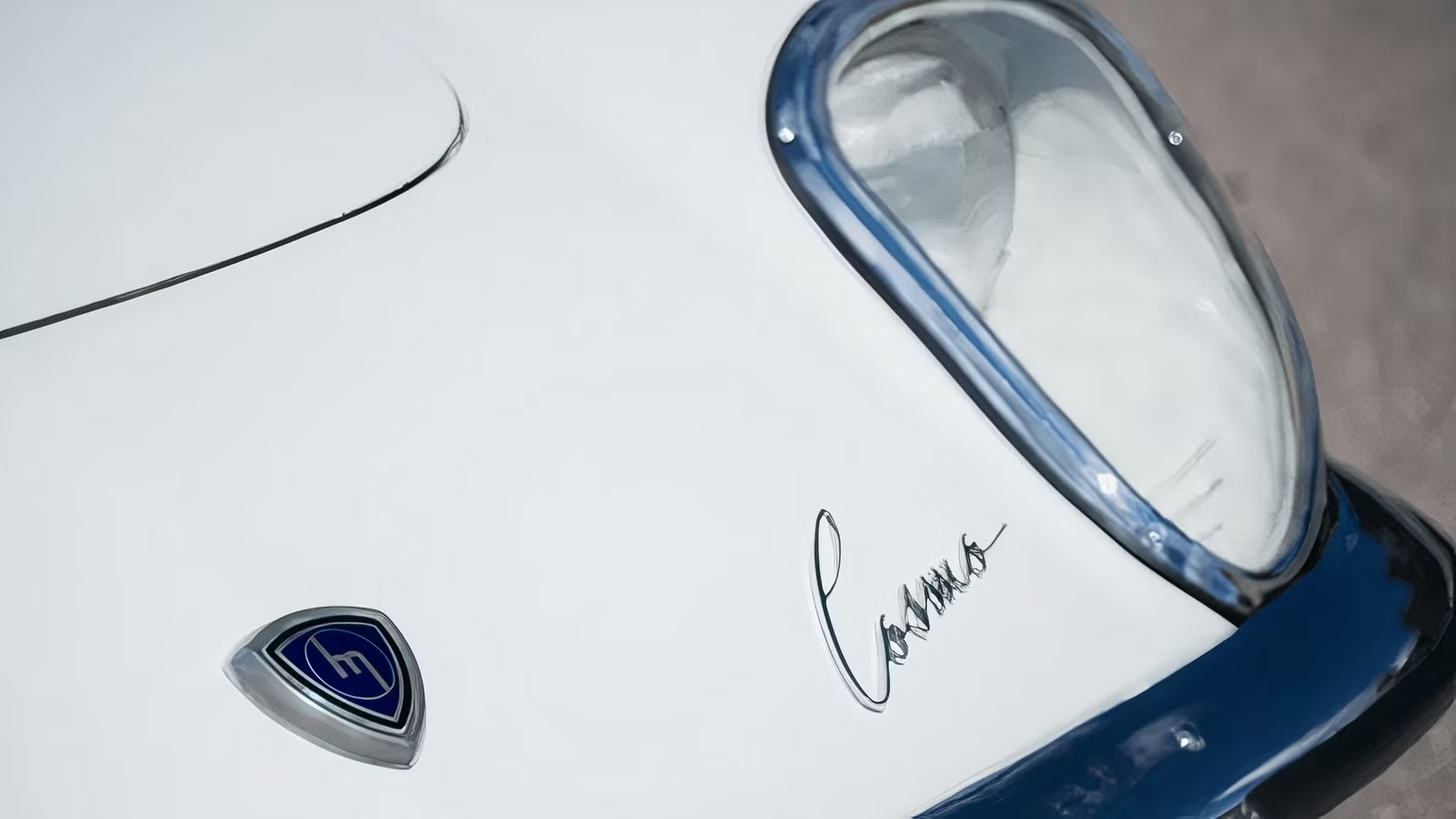
When visitors arrived at the 1964 Tokyo Motor Show, they would be met by the most striking car that Mazda had produced to date. This was the Mazda Cosmo Sport, a two-door coupe with Wankel rotary power.
Of all things, Mazda drew inspiration for the global phenomenon of the space ace in the ‘60s as naming inspiration, riffing on cosmos.
It was set to be the first car from Mazda to use that engine configuration, though not the first rotary-powered car to enter production, having been beaten to the punch by the reveal of the NSU Spider at the Frankfurt Motor Show earlier that year.
The Japanese Sports Car The Collector Market Forgot To Inflate
Thought you’d missed the boat when it comes to JDM classics? Think again.
The plan was to provide a sports car that, with a small capacity yet powerful, high-revving engine, could offer serious performance without being affected by a tax in Japan that hit cars with more than 1,000cc in displacement.
It Would Take Years To Enter Production

It would take quite some time before any customers could get their hands on a Mazda Cosmo Sport. A protracted development period saw 80 prototype cars built for internal and dealership testing in 1965, with the car finally entering production in 1967.
When it hit the roads at last, it used a 982cc two-rotor engine, in the front using a four-barrel carburetor with a four-speed manual gearbox and sending its 110 horsepower to the rear wheels.
It remained in that spec for its first full year of production, eventually dubbed the Series I, with 343 of these cars produced. July 1968 saw a revised model with the same engine capacity but now with around 130hp, a five-speed manual gearbox, assisted brakes and an increased wheelbase to improve ride quality.
You’re much more likely to see a Series II car, with its additional fender vents, with 833 produced from 1968 through to 1972.
Both series were predominantly sold in Japan, though a handful did find their way to other markets through unofficial channels.
What’s It Like To Drive Today?

|
Engine |
982cc twin-rotor |
|---|---|
|
Horsepower |
130 hp |
|
Torque |
103 lb-ft |
|
0-60mph |
~8.6 seconds |
|
Top speed |
~120mph |
Although most were sold in Japan new, one of those Series II cars has found its way into the heritage press fleet of Mazda UK. It doesn’t just exist to look pretty as well, offering me the chance to get behind the wheel of the rare coupe in August 2025.
Climbing into it, you realize just how small a car it is. Standing at 5’10, I wouldn’t consider myself particularly tall, but it’s a cramped place to be with the steering wheel deep into your lap, the headliner touching the top of my unkept mullet and the white paint reflecting right back at you as if you’re about to drive a Tic Tac. The handbrake isn’t exactly ergonomic, sitting just next to the center console and effectively resting against your calf. Honestly, it makes a NA Mazda Miata feel like a CX-90 by comparison.
It’s full of charm before you even turn it on, though. Red shag carpets wouldn’t look out of place on the set of an Austin Powers movie, and its houndstooth seats look incredibly classy. Then you turn the thing on.
Its two-rotor fires into life with its signature idle brapping, only without decades of emissions-strangling technology to cull it. Small though it is, it feels raw and puts on a serious occasion.

When you get it moving, you really do feel the ancestry of the following decades of Mazda rotary sports cars. It’s light on its feet, the two-rotor sings up towards its 7000rpm redline and with a gearbox that feels surprisingly slick by modern standards.
It’s not without its problems. Stalling it is not a hard feat if you’re used to modern manual cars, and ‘60s Japanese build quality does mean trim parts don’t always stay put. Finding replacements is effectively impossible, too.
Even Mazda UK can’t find them. For example, the original Cosmo badge had cracked, and a replacement had to be reproduced using the original part as a template by the nearby RML Group. If that name rings a bell, it has supported several sports car teams in global motorsport.
Yet, it’s such an endearing car that will instantly put a smile on your face and on those passing by. Put this into a collector’s garage, and its place feels more than deserved.
The Affordable Exotic With Ferrari Looks And Honda Running Costs
This mid-engine sports car delivers Ferrari-style looks and exotic performance without the supercar price tag or maintenance drama.
How Much Are They Worth Today?

Given how few were built, and with it being unclear remain today, it’s not often that a Mazda Cosmo Sport publicly comes up for sale. Especially not in North America, with the last documented example a 1968 Series II example which sold in Canada for $115,000 (USD) early in 2026. When you consider that you’ll need to compete with global collectors for these cars, don’t expect to see future examples go for much less than that, either.
That’s not exactly a small amount of money, but bring that back into a collector contest with a Lamborghini Miura, with those cars valued by Hagerty as being worth $1.75m, and it suddenly seems reasonable.
Sure, the wider significance of the Cosmo Sport isn’t as much as the Miura, but we can almost guarantee it’ll turn more heads at a Cars and Coffee than the Italian.
Sources: Inside Mazda, Hagerty

Related posts





Latest Post


No Comments