
Why A Sport-Touring Motorcycle Can Make More Sense Than An American Touring Bike
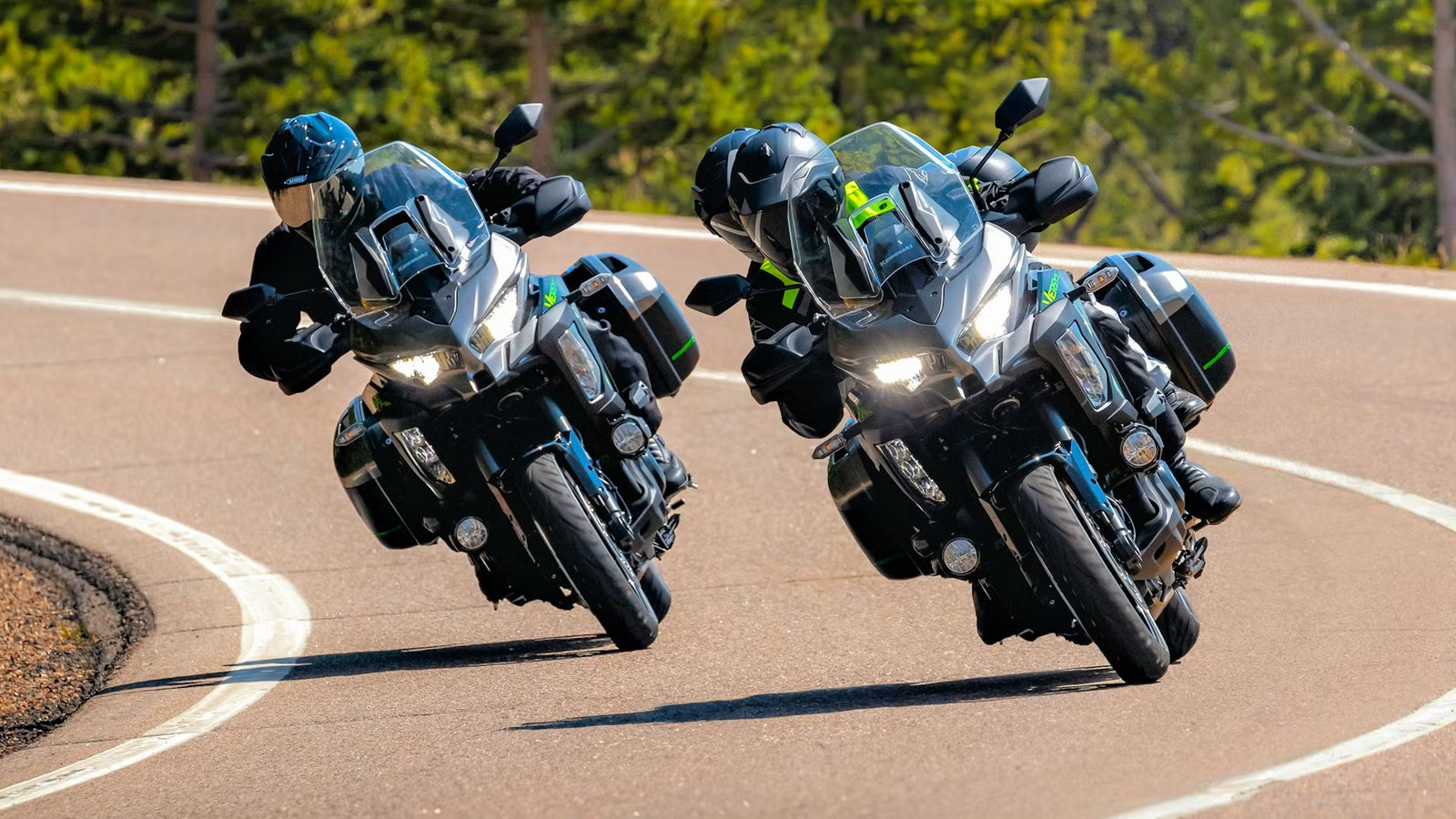
Versatility has never been more important in the motorcycle market. Nearly every two-wheeler segment is focusing on this, and that includes touring motorcycles. Accordingly, attention has shifted from baggers and full-dressers to more approachable sport-touring bikes. So much so that even American bikemakers are trying to join the bandwagon with experimental products like the Harley-Davidson Pan America ST and Buell SuperTouring. Why is that shift happening, you ask? Well, because of the advantages these sport-tourers bring, some of which are listed below.
Contemporary Aesthetics

American touring bikes mostly follow a fixed recipe. The proportions are massive, there’s a wide fairing up top, and you get integrated saddlebags. This is topped with ample chrome. As good as that looks, the aesthetic attracts a niche audience that loves old-school charm. For everyone else, a new-age sport-tourer would feel pleasing to the eyes.

There’s more variety, too. Proper sport touring bikes look like sports bikes with edgy fairings and nose-heavy designs, while crossover-type sport-tourers have an ADV-like design with sharper elements. This is a subjective take, though, so feel free to disagree in the comments.
Weight


We all know weight is the enemy of two-wheelers. This not only hurts the power-to-weight ratio, but it also makes life difficult in tight spaces. Every small movement feels like a leg day workout. That’s half the reason why electric motorcycles haven’t become mainstream (large batteries come with huge weight penalties).

This gives sport tourers a big advantage over dedicated touring bikes. Thanks to their sport bike origins, most sport tourers weigh considerably less than their traditional alternatives. As a reference, the Versys 1100 SE LT is one of the heaviest sport-tourers at 571 pounds, yet it is a whopping 241 pounds lighter Harley’s smallest tourer (the Street Glide).
Sharp Handling

The sport bike derivation helps with handling, too. Most sport-tourers use sporty twin-spar frames, topped with sturdy subframes. That brings the best of both worlds: the ability for luggage and pillion, plus occasional knee-down capabilities. The sharp rake, 17-inch wheels, and adjustable suspension add to the fun.

In comparison, an American touring bike often has a double-cradle chassis. This provides brilliant stability for freeways, but compromises sporty riding abilities. More often than not, the cornering clearance is quite low, and the suspension has barely any adjustment.
Powerful Engines

If you want advanced engines and more power, the sport-touring segment is again your best bet. Most bikes in the $12,000 to $18,000 ballpark use powerful inline-four or inline-triple engines, with an average of over 120 horsepower and 65 pound-feet. That can help you attain some high speeds without breaking a sweat. Some bikes like the S 1000 XR even have close to 170 horsepower via a superbike-derived engine.

The American tourer segment lacks dearly here. Air-cooled V-twins are the norm, most of which have well over 1,800cc. But the output is commonly in the 100 horsepower ballpark. Add to that the low redlines, and you’re looking at something that will happily do 80-100 MPH all day, but will struggle to reach serious speeds.
Versatility

A positive side effect of all the above advantages is excellent versatility of sport-touring bikes. The overall lower weight lets you ride it around the city easily, crossover examples have ample ground clearance for broken patches, and the sporty underpinnings can even let you have decent fun on the racetrack. You will have to chuck away the saddlebags for the latter, though.

A traditional American touring bike is nowhere near as versatile. They are built prioritizing freeway riding, and everything else is secondary. Most of these bikes don’t even have quick-release saddlebags. Even if you take them off, they look simply ugly without them.
Cost Of Admission
This might just be the biggest reason for the popularity of sport-touring bikes. Part-sharing and global-scale production help bikemakers keep sport-touring bikes easier on the pocket than American examples. For example, you can find several highly capable sport-touring bikes under $15,000, such as the Yamaha Tracer 9, Kawasaki Versys 900 SE LT, or Triumph Tiger Sport 800. Liter-class examples with top-tier tech are just a few thousand dollars above, near the $18,000 mark.

American tourers, however, cost a bomb in comparison. Both Harley-Davidson and Indian have priced their dedicated touring bikes around the $25,000 mark, which rises sharply if you pick something more premium. The latest CVO Street Glide Limited is a prime example, costing over $50,000 in its base trim. That means you can buy two high-end sport-tourers, while still having enough cash for a third midweight machine!
Source: Various Manufacturers

Related posts


Latest Post


No Comments