
Ford Planned 500 Mid-Engine Rally Cars, Then Built Only A Handful
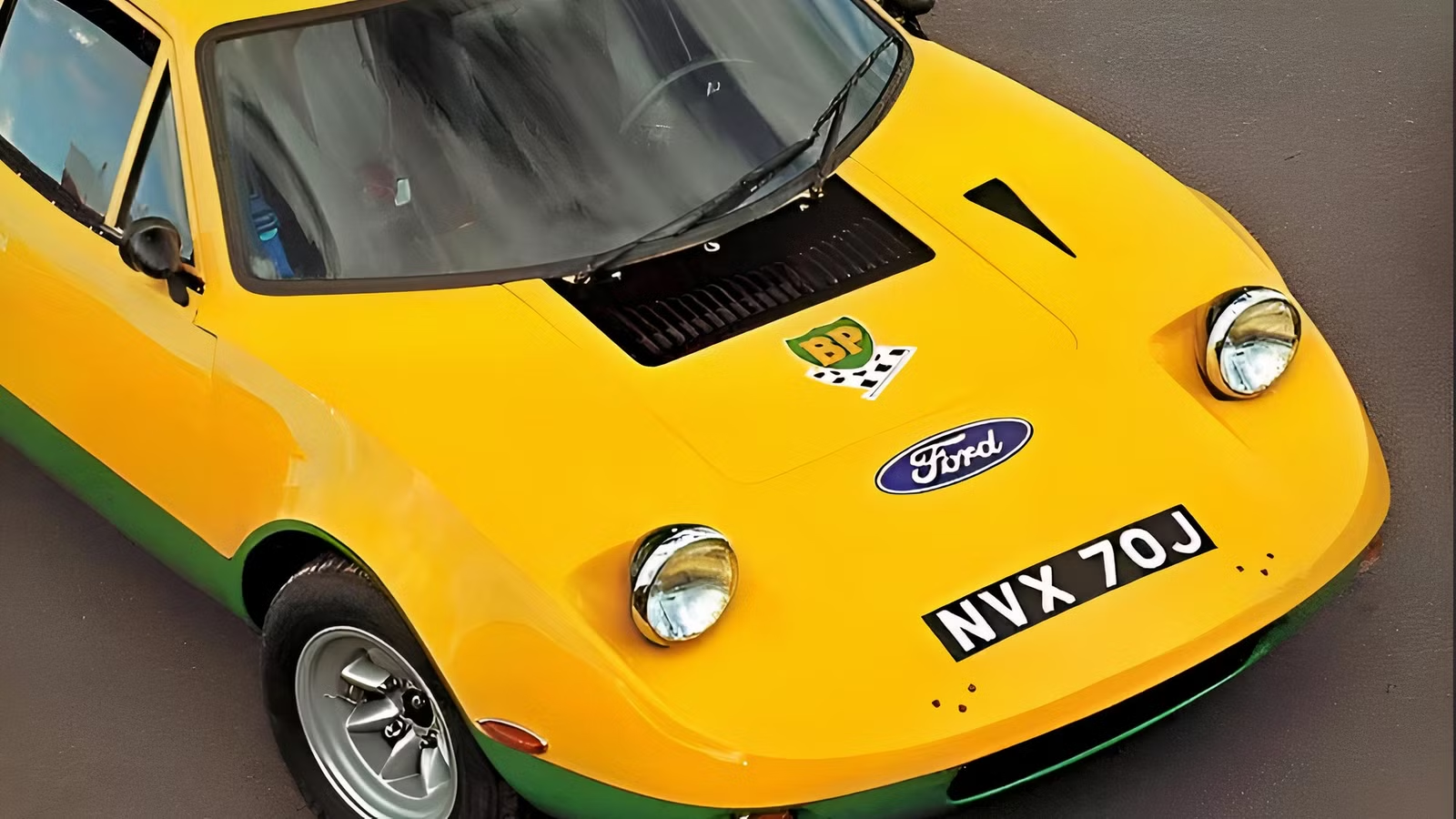
Ford and rallying go hand in hand. Yet, there’s a hierarchy of cars that folks cherish from the golden age of Ford’s endeavors in rally racing. You know the highlights: the Mk 1 and II Escort of the ’70s, the alien spaceship RS2000, the Cosworth-engined Escorts of the ’90s, Colin McRae’s personal plaything Focus RS, and even the Fiesta WRCs and Pula Rally1s of the present day. They all cemented their places in history because they made an impact, but what if the most interesting Ford rally car of them all is one you’ve never even heard of before? Possibly even one connected to Ford’s most iconic racing car ever?
Rally Racing in the ’60s and ‘70s: A Whole Different Kind of Racing

The earliest days of sanctioned rally racing can only be described as chaotic. Before the World Rally Championship was formed, the discipline was sanctioned by a patchwork of several international rally races with different rules and regulations. The closest entity to a global sanctioning body in those days was the International Championship for Manufacturers, the direct predecessor of the WRC, which functioned separately from individual rally races that operated independently of one another.
One race could be a high-speed forest gravel-slinger with specific rules for engine displacement, curb weight, or strict homologation standards, while another could be a no-holds-barred arms race with a bare minimum of rules at all. On the Ford side of things, its attack strategy for rally racing was surprisingly simple. Step one: take a normal, everyday production car like an Escort or a Cortina, tune its engine to the gills, mount a roll cage and some lights, and send the thing out to compete.
The strategy was surprisingly effective, with famous drivers like Roger Clark and Timo Mäkinen taking home a number of prestigious victories, cementing Ford as a force within the rally racing space. Yet the sport was changing by the turn of the ’60s into the ’70s. The sport was getting faster, with rear-engined Porsche 911s and Alpine A110s primed to take the sport by storm. It was a realization Ford came to at the 1970 Monte Carlo rally, watching nimble European sports cars run circles around heavier, less precise front-engine machines on that icy mountain pass. On the flight back home, Ford’s Competition Director Stuart Turner shared a plane with its top driver, Roger Clark, and the idea for an altogether different kind of rally machine took shape.

Taking Inspiration From Greatness

That one conversation at 30,000 feet was a turning point for rally racing development at Ford. Before the plane had even touched back down in the UK, a general plan was in place to design Ford’s own mid-rear-mounted, low-slung rally car to fight the 911. The plan was simple, do what the competition was doing, but better, lighter, and with some of the best rally drivers in the world behind the wheel.
While modern race cars take years, if not a decade, to design and roll out, Ford’s plan involved a sprint to the next rally season. To make it happen, Ford employed the services of none other than Len Bailey, and if that name rings a bell, it’s because he’s the man behind the legendary Ford GT40 Le Mans racer that took Ferrari to the cleaners every year from 1966 to 1969. No stranger to mid-mounted engine layouts, Bailey penned a steel box-frame chassis capable of accepting a wide array of engines, not just a single engine type. The suspension was double-wishbone up front with rear components borrowed from the Cortina. Meanwhile, the brakes were vented steel discs at all four corners, a welcome sign when the curb weight was set to be no more than 1,700 lbs.

Underneath that rear hatch, a 2.6-liter V6 out of a Capri RS2600 was used in most cases, but the car was capable of supporting a 1.6-liter Cosworth four-pot; both were paired to a five-speed manual gearbox. As for the body, it was designed by Italian designer Ercole Spada, an employee of the Zagato design firm then owned directly by Ford. With such aggressively talented automotive minds behind the project, the result was sure to impress. At least, visually it sure did, if not performance-wise.
Ford GT70: Visually Stunning, But Not Very Successful

Compared to previous Ford rally cars, the GT70 looked like a UFO that had descended upon a woodland gravel pit. At just 44 inches tall, only four inches taller than a GT40, it was even sleeker than the 911s and Alpines it was designed to compete with. The body, formed from fiberglass instead of metal to cut down on weight, was just over 153 inches long, and its 91.7-inch wheelbase, at least in theory, should have made the platform extremely agile. With 240 horsepower on tap in its V6 layout, everything was certainly in place for a top-notch rally car.
The reality of the situation was far more complicated. For starters, Len Bailey’s unquestionable talent may have translated brilliantly onto the Circuit de la Sarthe, but the GT70’s tube steel box-frame just wasn’t rigid enough to handle the bumps, jumps, and ruts of the average rally stage. The chassis flexed worryingly under load and was surprisingly unstable in corners where grip and poise were paramount. The noodle-like chassis was a stark contrast to the almost comically overbuilt steel monocoque Porsche 911.

While the GT70 was certainly lighter and had a better power-to-weight ratio, the 911’s more robust chassis, plus the benefit of its engine pushing directly on top of the drive wheels, made it a far more effective rally racer. Ford had every intention of producing as many as 500 GT70s in a mix of V6 and four-pot configurations for the general public in order to comply with homologation rules dictating that OEMs needed a certain number of road cars on file to compete in sanctioned racing. In the end, the company only managed to produce a meager six units total. The reason why had absolutely nothing to do with a perceived lack of rallying effectiveness, and everything to do with cold-hard cash.
A Neat Idea, Ended By Its Absurd Price

As we all know, designing race cars isn’t exactly cheap. Even by those standards, the investment capital needed to get the GT70 off the ground was exceptionally costly. The bespoke box-frame chassis, the fiberglass body, and the suspension hardware necessitated a sale price of £5,000 just to meet homologation standards. For context, a Jaguar E-Type was over £1,500 less expensive.
Simply put, the economics didn’t add up in any capacity, and the prospects of it selling in anywhere near profitable numbers seemed remote. Meanwhile, the Escort RS1600 was already winning rallies. By 1973, the GT70 project was thrown under the bus. Interestingly, the four-spoke cast-aluminum wheels designed for the program were carried over to the Escort, where they became extremely popular. Most of the six survivors faded into obscurity, though Ford Heritage did pull one surviving chassis out of the dark in 2002, restoring it with a 2.0-liter Cosworth engine to run at vintage motorsport exhibitions, saving at least one from the crusher. Unlike the GT40, the GT70 is nothing but a footnote. But it could be worse — it could have been the GT90. Yeah, we went there.
Source: Ford, Hagerty

Related posts


Latest Post


No Comments