
Hyundai And Kia Just Made Ford And Chevy’s Biggest Bets Look Shaky
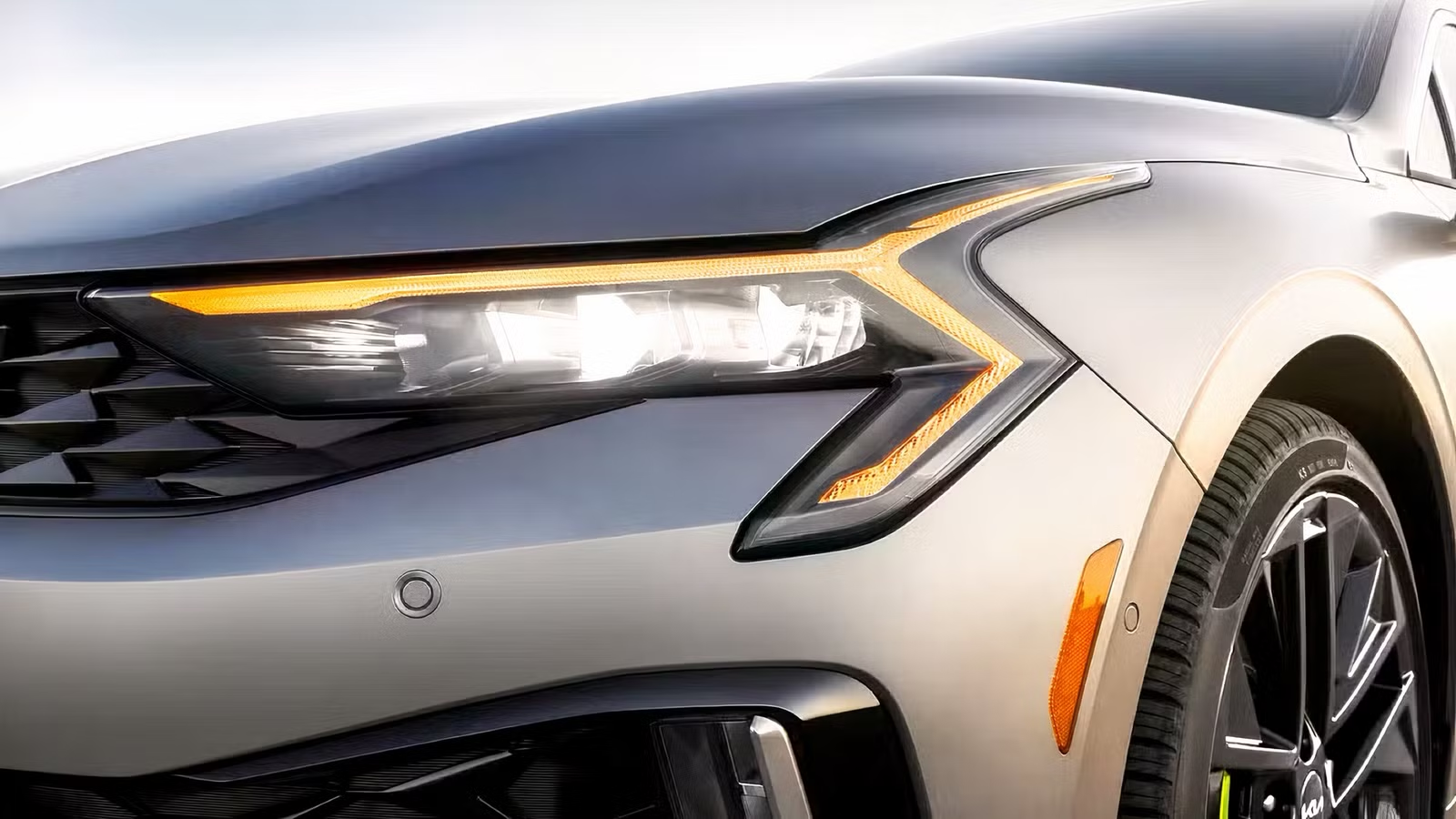
SUVs and crossovers have grown to be the new mainstream option for most American consumers. This trend resulted in the discontinuation of many popular American sedans, such as the Chevrolet Malibu and Ford Taurus. The main reason was a lack of sales.

Recently, there has been a resurgence in sedans, according to sales reports from import brands that still offer sedans. This is a direct result of consumers showing more appreciation for affordability and value over a higher riding position and the prestige of a utility vehicle.
The Fall Of The American Sedan
The decline of the American sedan stems primarily from a fundamental shift in consumer preferences toward crossovers and SUVs. These gained momentum in the late 2000s and early 2010s. Unibody crossover platforms allow modern light trucks to offer car-like ride comfort, competitive fuel economy, and better interior visibility, effectively neutralizing the traditional efficiency and driving-dynamics advantages of the three-box sedan layout.

Since then, buyers have increasingly prioritized higher seating positions, all-wheel-drive capability, and flexible rear cargo space for family use. At the same time, foreign rivals like Toyota and Honda maintained a strong grip on the remaining sedan volume. Consequently, domestic nameplates like the Ford Taurus, Chevrolet Impala, and Chrysler 300 experienced steep sales drops as buyers migrated toward high-riding alternatives.
The Numbers For American Sedans Stopped Making Sense

Economic factors and corporate strategy sealed the fate of the domestic three-box layout. SUVs and pickup trucks command higher average transaction prices and profit margins, making them far more lucrative for Detroit automakers than low-margin midsize or full-size sedans. Regulatory structures, such as Corporate Average Fuel Economy standards, also penalized traditional passenger cars with stricter targets based on smaller vehicle footprints, while lighter regulatory hurdles favored larger truck-based footprints.
Seeking higher profit margins to finance electrification programs and advanced driver-assistance research, Ford, General Motors, and Stellantis systematically reallocated development capital away from passenger cars. Factory assembly lines were repurposed for high-margin trucks and crossover production, culminating in the discontinuation of key models like the Ford Fusion and Chevrolet Malibu, effectively ending the traditional American family sedan era.
Hyundai And Kia’s Competitive American Presence

Hyundai entered the U.S. market in 1986 with the budget-friendly Excel, followed by Kia in 1994 with the Sephia. Initially competing strictly on affordability, both brands aggressively expanded their market footprint by pairing long-term warranty coverage with steady improvements in build quality. Over the decades, the Korean automakers transitioned from entry-level alternatives to dominant industry players, establishing local manufacturing facilities in Alabama and Georgia.
The group broadened its portfolio beyond compact sedans to include high-margin crossover SUVs like the Hyundai Palisade and Kia Telluride, alongside the standalone Genesis luxury brand. Today, advanced hybrid architectures, dedicated electric vehicle platforms, and flexible domestic production drive the company’s presence, securing over 11 percent of total U.S. market share and positioning the collective group among the top four automakers nationwide.
Hyundai And Kia Prove That The Family Sedan Isn’t Dead

Both Hyundai and Kia have reported record-breaking sales for July 2026, with sedans being the star of the show. The South Korean group’s crossovers and SUVs remain the more popular option, but the performance shows sedans coming back to the mainstream market in a big way. Hyundai reports that it was able to sell 11,115 units of the compact Elantra, reflecting a 39 percent year-on-year increase. Its year-to-date figure climbed to 87,122 units, reflecting an 11 percent increase. The brand reports its midsize Sonata sales at a lower 5,218 units for July 2026, but this still reflects an 18 percent sales increase. For the year so far, it has sold 42,275 units of the sedan, resulting in a 13 percent increase.
Kia confirmed it sold 12,094 units of the K4 and Forte, combined, bringing the tally for the year up to 85,673. July’s performance reflects a two percent improvement compared to last year, but its year-on-year result reflects a fractional decline. The K5 also performed well, selling 6,694 units in July 2026, compared to last year’s 5,879-unit sales performance. For the year so far, Kia confirms 45,088 unit sales, reflecting a noteworthy improvement over last year’s 40,444 unit result.
Kia’s Dynamic Compact Hatch And Sedan Duo

The 2026 Kia K4 competes in the compact sedan and hatchback segment. The base 2026 Kia K4 LX starts at $22,190. Standard configurations for both bodystyles feature a 2.0-liter naturally aspirated four-cylinder engine producing 147 horsepower and 132 pound-feet of torque paired with an Intelligent Variable Transmission. Performance-oriented trims utilize a turbocharged 1.6-liter four-cylinder engine.
While the previous Forte GT develops 201 hp using either a six-speed manual or a seven-speed dual-clutch automatic transmission, the new K4 GT-Line Turbo generates 190 hp through an eight-speed automatic transmission. According to the EPA, the 2026 Kia K4 sedan with the base engine achieves a 29/39/33 MPG consumption average on the city/highway/combined cycle. A 12.4-gallon tank affords it a 409-mile range estimate.
The 2026 Kia K4 currently holds an 84/100 consumer-verified overall score from J.D. Power, consisting of an 86/100 rating for quality and reliability, 88/100 for the driving experience, 87/100 for resale, and 73/100 for the dealership experience. The compact sedan currently holds a 4.4/5-star overall score on the Edmunds consumer review section, with key strengths being its value, driving experience, and visual appeal.
Bringing Balanced And Aspirational Performance To The Midsize Segment

The 2026 Kia K5 competes in the midsize sedan segment. Pricing starts at a base MSRP of $27,490 for the entry-level LXS trim. Standard models feature a 2.5-liter naturally aspirated four-cylinder engine. This engine delivers 191 hp and 181 lb-ft of torque through an eight-speed automatic transmission. The performance-oriented K5 GT trim utilizes a turbocharged 2.5-liter four-cylinder engine. This engine produces 290 hp and 311 lb-ft of torque. An eight-speed dual-clutch automatic transmission handles gear shifting on the GT trim. The EPA estimates that the most efficient K5 model will consume 26/37/30 MPG and cover 474 miles of range from a single 15.8-gallon tank.
The 2026 Kia K5 currently holds an 83/100 consumer-verified overall score from J.D. Power. This includes an 85/100 rating for quality and reliability, 92/100 for the driving experience, 82/100 for resale, and 73/100 for the dealership experience. The midsize sedan currently holds a 4.2/5-star overall score on the Edmunds consumer review section, with key strengths being its striking design, overall value, and comprehensive technological features.
Hyundai’s Corolla-Fighting Compact Sedan Offering

The 2026 Hyundai Elantra competes in the compact sedan segment. Pricing starts at a base MSRP of $21,875 for the entry-level SE trim. Standard models feature a 2.0-liter naturally aspirated four-cylinder engine. This engine generates 147 hp and 132 lb-ft of torque through an Intelligent Variable Transmission. The sport-focused N Line trim upgrades to a turbocharged 1.6-liter four-cylinder engine producing 201 hp and 195 lb-ft of torque. A seven-speed dual-clutch automatic transmission handles gear changes on the N Line. The high-performance Elantra N utilizes a turbocharged 2.0-liter four-cylinder engine making 276 hp, paired with either a six-speed manual or an eight-speed dual-clutch automatic transmission.
The Elantra Hybrid Blue is one of the most efficient cars you can buy in the U.S., achieving a 51/58/54 MPG consumption estimate and a 594-mile range from an 11-gallon tank. J.D. Power awards the 2026 Hyundai Elantra an 83/100 consumer-verified overall score, consisting of an 86/100 quality and reliability score, 84/100 for the driving experience, 86/100 for resale, and 71/100 for the driving experience. Interestingly, the Elantra doesn’t score as well in the Edmunds consumer review section, with a 3.5/5 overall score, based on 37 submissions. Key strengths include its driving experience, fuel efficiency, and value.
The Hyundai Sonata Blends Refinement With Dependability

The 2026 Hyundai Sonata competes in the midsize sedan segment. Pricing starts at a base MSRP of $26,900 for the entry-level SE trim. Standard models feature a 2.5-liter naturally aspirated four-cylinder engine. This engine produces 191 hp and 181 lb-ft of torque through an eight-speed automatic transmission. The performance-oriented Sonata N Line upgrades to a turbocharged 2.5-liter four-cylinder engine generating 290 hp and 311 lb-ft of torque. An eight-speed wet dual-clutch automatic transmission handles gear changes on the N Line. Hyundai also offers a Sonata Hybrid utilizing a 2.0-liter four-cylinder hybrid powertrain that outputs 192 combined hp through a six-speed automatic transmission.
The Sonata Hybrid Blue earns a 47/56/51 MPG result from the EPA, together with a 673-mile range estimate from its 13.2-gallon gas tank. The 2026 Hyundai Sonata holds an 83/100 consumer review score from J.D. Power. This includes 86/100 for quality and reliability, 86/100 for the driving experience, 85/100 for resale, and 71/100 for the dealership experience. It also holds a 4/5 average score, based on 47 reviews. Common pros include its technological features, attractive exterior design, and ride quality.
Sources: Kia, J.D. Power, Edmunds, and the EPA.

Related posts




Latest Post


No Comments