
The Rarest Plymouth Muscle Car Ever Sold To The Public
Plymouth is often overlooked among the great Detroit car brands of the muscle car golden age muscle cars. Yet the brand produced some of the finest — and rarest — performance cars of that era. One example stands above the rest: a muscle car so uncommon that it technically was never supposed to leave the factory at all.
The Plymouth GTX Is A Gentleman’s Muscle Car From The End Of The Golden Era

From 1967 to 1974, the GTX nameplate was a cornerstone of Mopar’s muscle car lineup. Originally introduced as a trim level of the Plymouth Belvedere, the GTX eventually became a standalone model. It shared many components with the Dodge Charger, Dodge Coronet, and Plymouth Satellite of the same era — including the engine options: the 7.2-liter Magnum V8 and the 7.0-liter Hemi V8. Those big-block engines were exclusive to the GTX for good reason. The car was intended to be a gentleman’s muscle car — more refined than the Charger, but packing the same brutal power and glorious V8 soundtrack.
After 1971, the GTX reverted to trim-level status rather than standing as a model in its own right. This time it was a trim level of the Road Runner rather than the Belvedere. That first year of the new arrangement is when Plymouth accidentally — we’ll explain why it was an accident shortly — produced one of the rarest and most desirable muscle cars of all time.
The 1972 Plymouth Road Runner GTX 440+6 Is The Rarest Of Its Kind
 46 autotech Engine |
Transmission |
Drivetrain |
Power |
Torque |
|
7.2-liter V8 |
3-speed automatic |
Rear-wheel drive |
390 hp |
490 lb-ft |
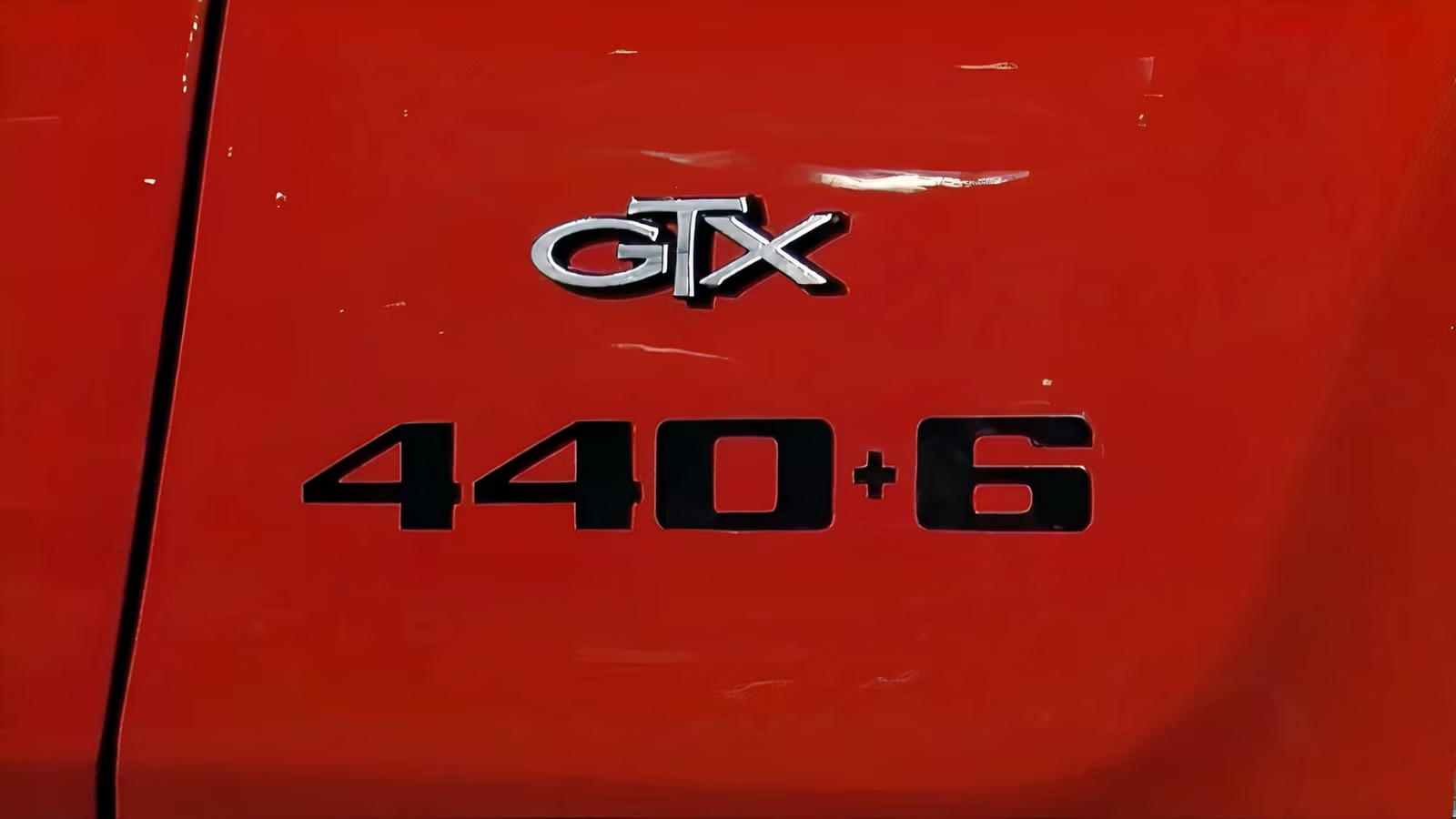
At first glance, the 1972 Plymouth Road Runner GTX 440+6 looks like any other early-’70s Road Runner or GTX — and in many ways, it is the same car. But one crucial difference elevates it from a regular Road Runner GTX into something truly extraordinary. This variant carries the 440+6 engine, known as the 440 Six Pack in Dodges and the 440 6-BBL in Plymouths — names derived from its trio of two-barrel Holley carburetors.
That engine alone is what makes this car a genuine unicorn. Only three 1972 Road Runner GTXs with this engine option are thought to have been built, and the example you see here is the only one confirmed to still exist. This specific Road Runner GTX is equipped with the 3-speed automatic transmission — the 1972 Road Runner allowed any engine to be paired with any transmission — and it was ordered with a generous list of factory options.
It Wasn’t Supposed To Exist

How did this specification of the 1972 Plymouth Road Runner GTX become so rare? Because it was never supposed to exist in the first place. Plymouth had decided to discontinue the 440+6 engine after 1971, as the Clean Air Act came into force. Like several other big-block engines from the muscle car era, it simply couldn’t meet the new emissions regulations. However, because the decision to drop the engine was made relatively late in the production cycle, a handful of 1972 cars had already been fitted with it.
How Much Is A 1972 GTX 440+6 Worth?

If you wanted to buy this car — or either of the other examples supposedly built, should they ever surface — what would you expect to pay? Pinning down an accurate figure is difficult, since the single confirmed surviving example does not appear to have ever come up for sale. What we do know is what more conventional Road Runner and Road Runner GTX models fetch on the collector market. The average value for a good-condition 1972 Plymouth Road Runner GTX is around $37,200, while the 1972 Road Runner as a whole averages around $41,767.
The 440 Six-Pack Was The Ultimate Muscle Car Engine

The rarity of this engine is remarkable on its own, but it’s worth appreciating just how capable a performer the 440 Six-Pack actually was. The triple two-barrel setup could be tuned to optimize throttle response, highway cruising, fuel economy, and outright power. A single center carburetor feeds the engine under light throttle, giving the car the relaxed, undemanding character of any everyday driver of the period. Stomp the accelerator, however, and the two outboard carburetors open up for maximum airflow, transforming the engine into something genuinely fearsome.
The 440 Six-Pack made its debut partway through the 1969 model year in the infamous A12 cars. Ronnie Sox of Sox and Martin piloted a 1969½ Road Runner through the quarter-mile in 12.9 seconds — the quickest recorded time slip for any factory-equipped muscle car of the era. While there are minor differences between the original 440 Six-Packs and the versions that followed in 1970, they share the same dual-personality character that leads many Mopar enthusiasts to prefer the Six-Pack over the Hemi for street use.
Was The Six-Pack Better Than The Hemi?

It’s one of the great Mopar debates: the 440 Six-Pack or the 426 Hemi — which engine was better? The honest answer is that it depends on the context.
For street use, the 440 Six-Pack is generally regarded as the stronger choice. It delivers better low-end throttle response, whereas the 426 Hemi is known to be temperamental at everyday speeds, and a properly tuned Six-Pack can edge a stock street Hemi in the quarter-mile. That said, this should not be taken to mean the 440 Six-Pack is the universally superior engine — particularly in all-out competition.
440 Six-Pack VS 426 Hemi

|
Engine |
440 Six-Pack |
426 Street Hemi |
|
Horsepower |
390 HP |
425 HP |
|
Torque |
490 LB-FT |
490 LB-FT |
The 426 Street Hemi was rated to produce 425 horsepower and 490 lb-ft of torque. This is a conservative rating, and, considering these are de-tuned versions of the race engines they were designed to be, you start to understand there’s a lot of potential left on the table. Naturally aspirated NASCAR-spec engines used in the Charger Daytona and Plymouth Superbird could turn out north of 600 horsepower on a good day. Adding forced induction and more serious hardware can push that figure far higher still. Today’s Top Fuel dragsters continue to rely on the basic architecture of the 426 Hemi, producing around 10,000 horsepower.
These modern engines aren’t identical to the original 426 Hemi, but the lineage makes it clear that the Hemi is not merely a superior race engine to the 440 — it is arguably the greatest competition V8 of all time. Even so, the fact that the 440 Six-Pack could hold its own against the most fearsome racer of the era only adds to the street credibility of rare machines like this 1972 GTX.
Other Incredibly Rare Plymouth Muscle Cars

The 1972 Plymouth Road Runner GTX 440+6 is easily the rarest muscle car Plymouth ever produced. But it’s far from the only model that left the factory in tiny numbers. Plymouth has a broader history of building muscle cars with unicorn specifications — and those cars have consistently become some of the most sought-after collector pieces in the hobby, even if they don’t always receive the same recognition as ultra-rare machines from Chrysler’s Detroit rivals.
1967 Plymouth Hemi GTX Convertible

|
Engine |
Transmission |
Drivetrain |
Power |
Torque |
|
7-liter V8 |
4-speed manual, 3-speed automatic |
Rear-wheel drive |
425 bhp |
490 lb-ft |
Finding a 1967 Plymouth GTX ordered with the factory Hemi V8 is already a tall order. Finding one that is also a convertible is rarer still. Only 17 1967 Plymouth Hemi GTX convertibles are thought to have been built — 10 automatics and 7 manuals — placing them among the rarest muscle cars anywhere. Their value reflects that scarcity: one sold for $160,000 at auction.
1970 Plymouth Hemi ‘Cuda Convertible

|
Engine |
Transmission |
Drivetrain |
Power |
Torque |
|
7-liter V8 |
4-speed manual, 3-speed automatic |
Rear-wheel drive |
425 bhp |
490 lb-ft |
The Hemi ‘Cuda is already one of the most coveted cars in the Mopar world. The 1970 Hemi ‘Cuda convertible is a unicorn within that. Only 14 were produced in 1970, making them among the most desirable variants of an already highly sought-after car. When these reach the auction block, they routinely sell for over $2 million.
1971 Plymouth Hemi ‘Cuda Convertible

|
Engine |
Transmission |
Drivetrain |
Power |
Torque |
|
7-liter V8 |
4-speed manual, 3-speed automatic |
Rear-wheel drive |
425 bhp |
490 lb-ft |
If you thought the 1970 Hemi ‘Cuda convertible was the rarest version of this classic muscle car, the 1971 model year convertible is even scarcer. Only 11 are known to have been built, and estimates suggest just 7 were ever retailed to the public. Predictably, these cars command extraordinary prices at auction. One example sold for $3 million.
1969 Plymouth Hemi Road Runner Convertible
|
Engine |
Transmission |
Drivetrain |
Power |
Torque |
|
7-liter V8 |
4-speed manual, 3-speed automatic |
Rear-wheel drive |
425 bhp |
490 lb-ft |
If any other Plymouth muscle car comes close to matching the rarity of the 1972 Road Runner GTX 440+6, it’s this one. Late-’60s Hemi Road Runners are scarce enough on their own; the convertible variants are in a class by themselves. It’s estimated that between 10 and 12 were built for the 1969 model year, and as few as 3 may have survived to the present day.
Sources: Classic.com, Hagerty, Plymouth, YouTube (@MoparCenter, @mecum)

Related posts





Latest Post


No Comments